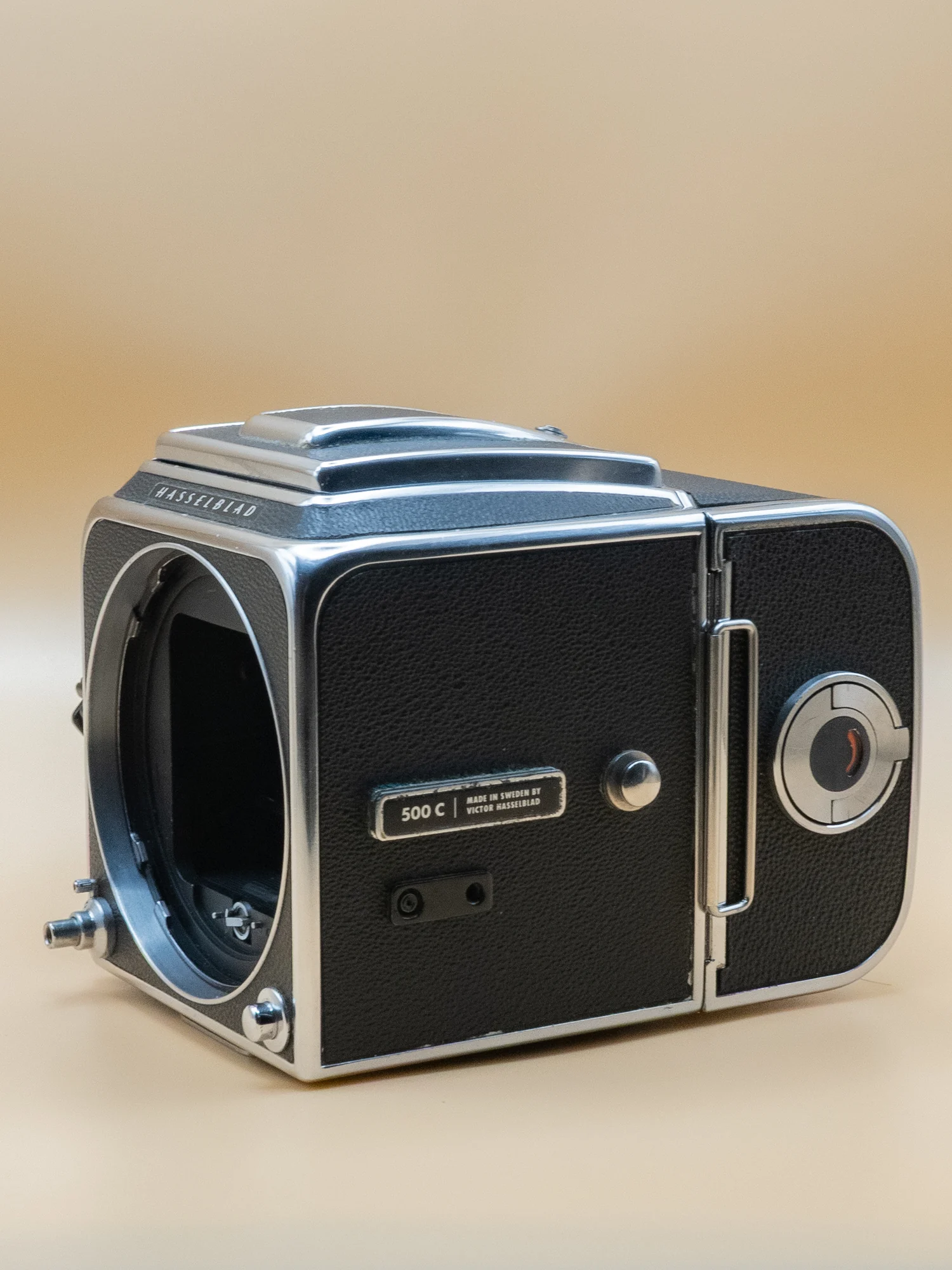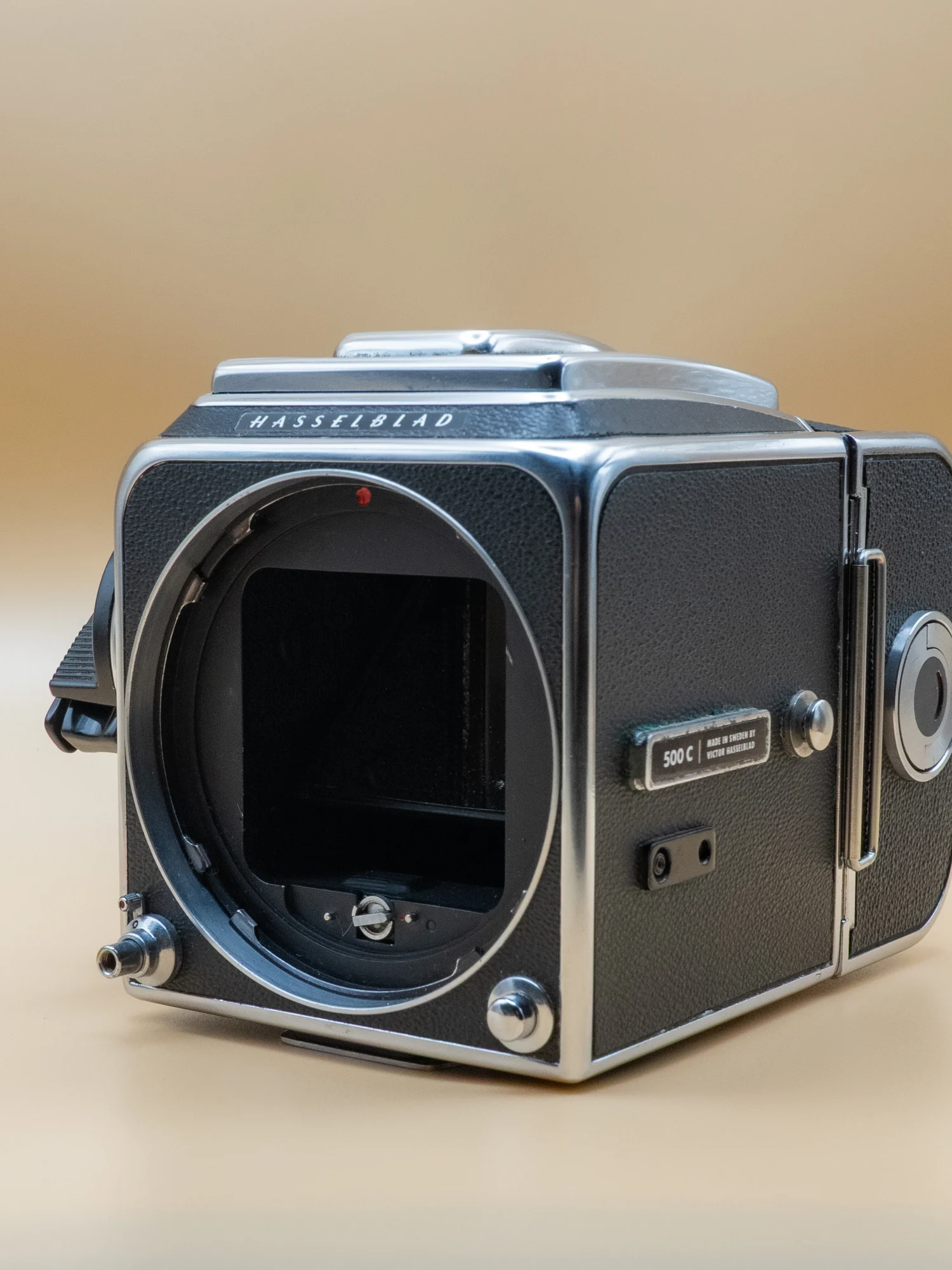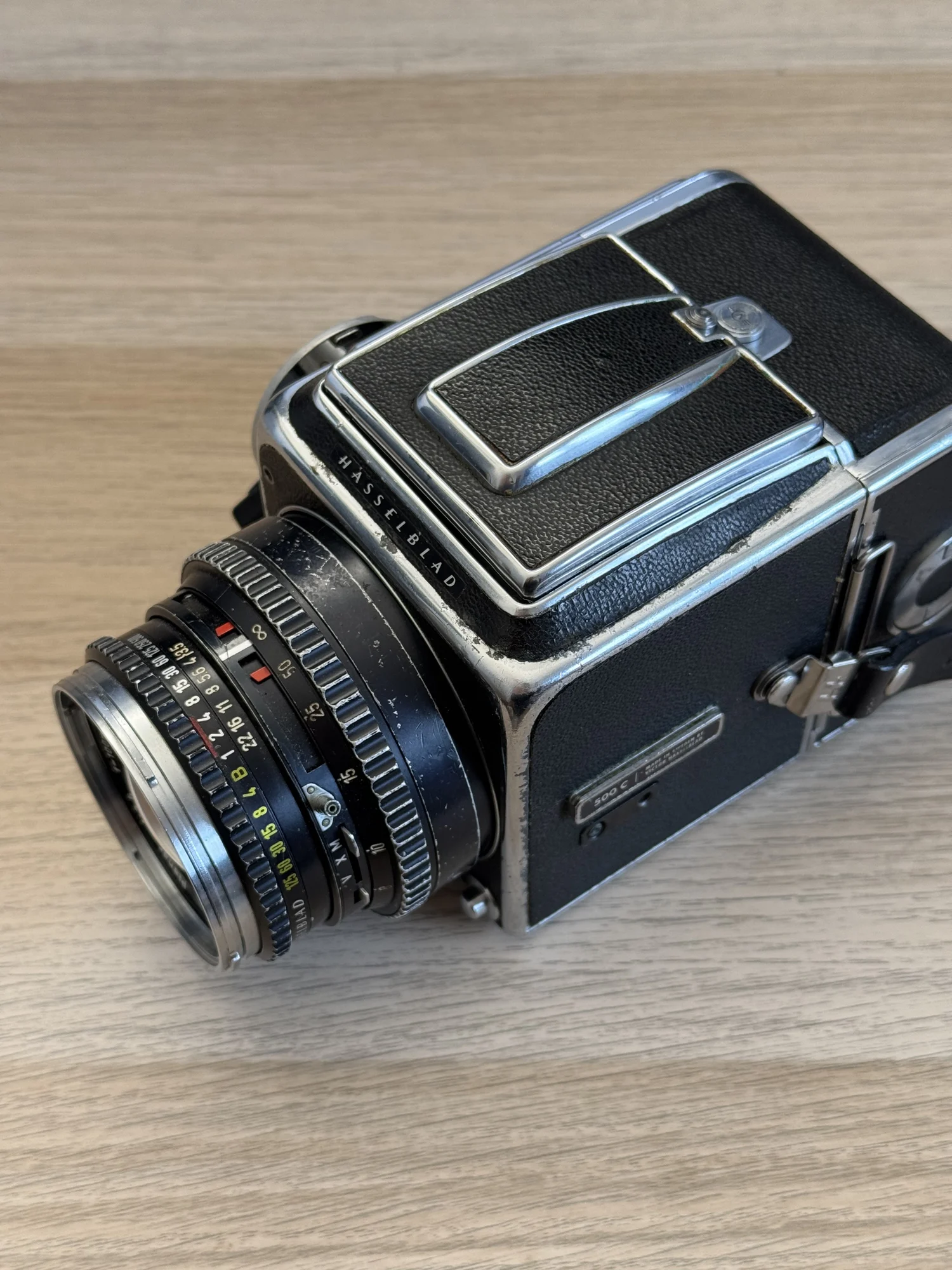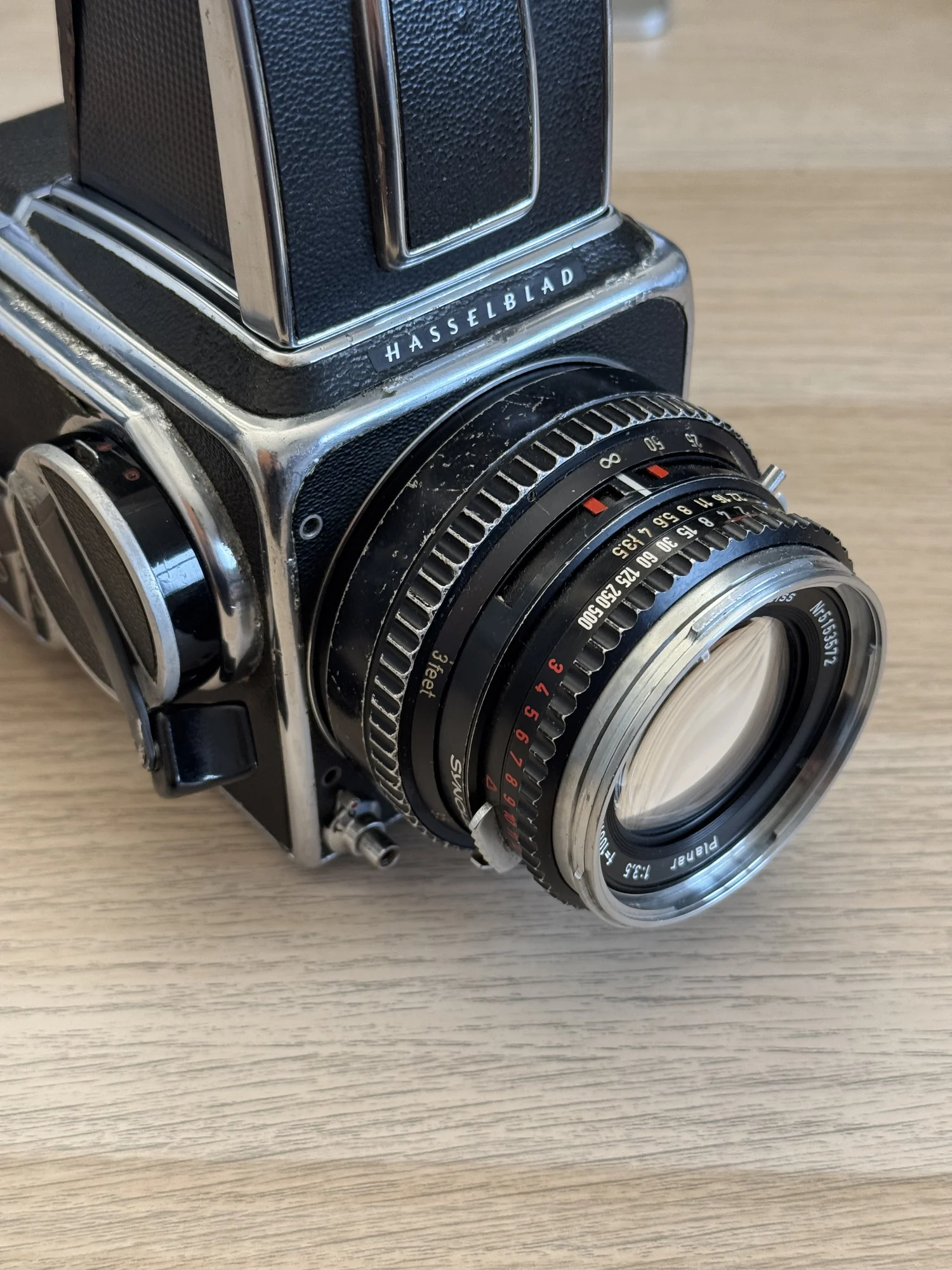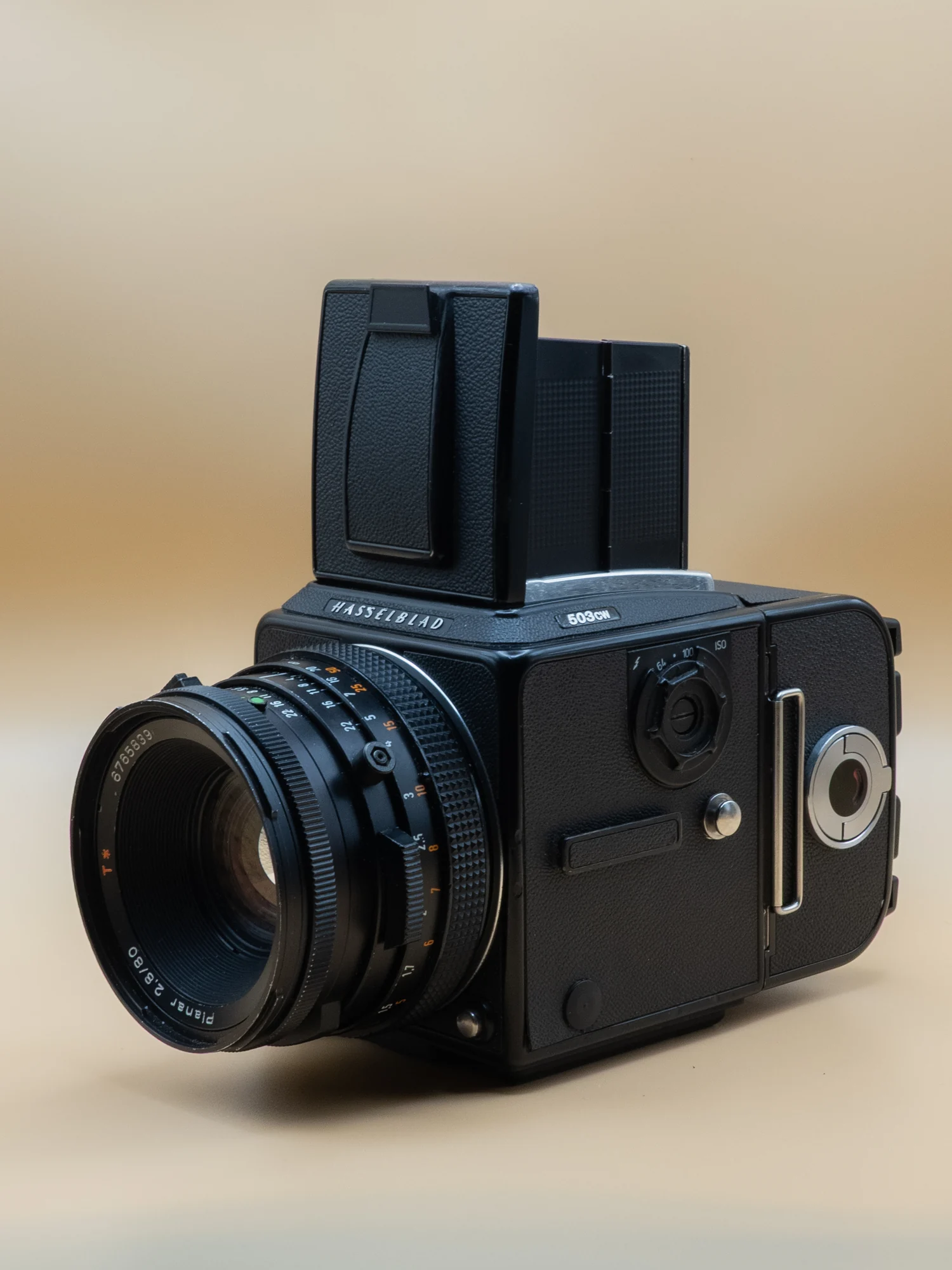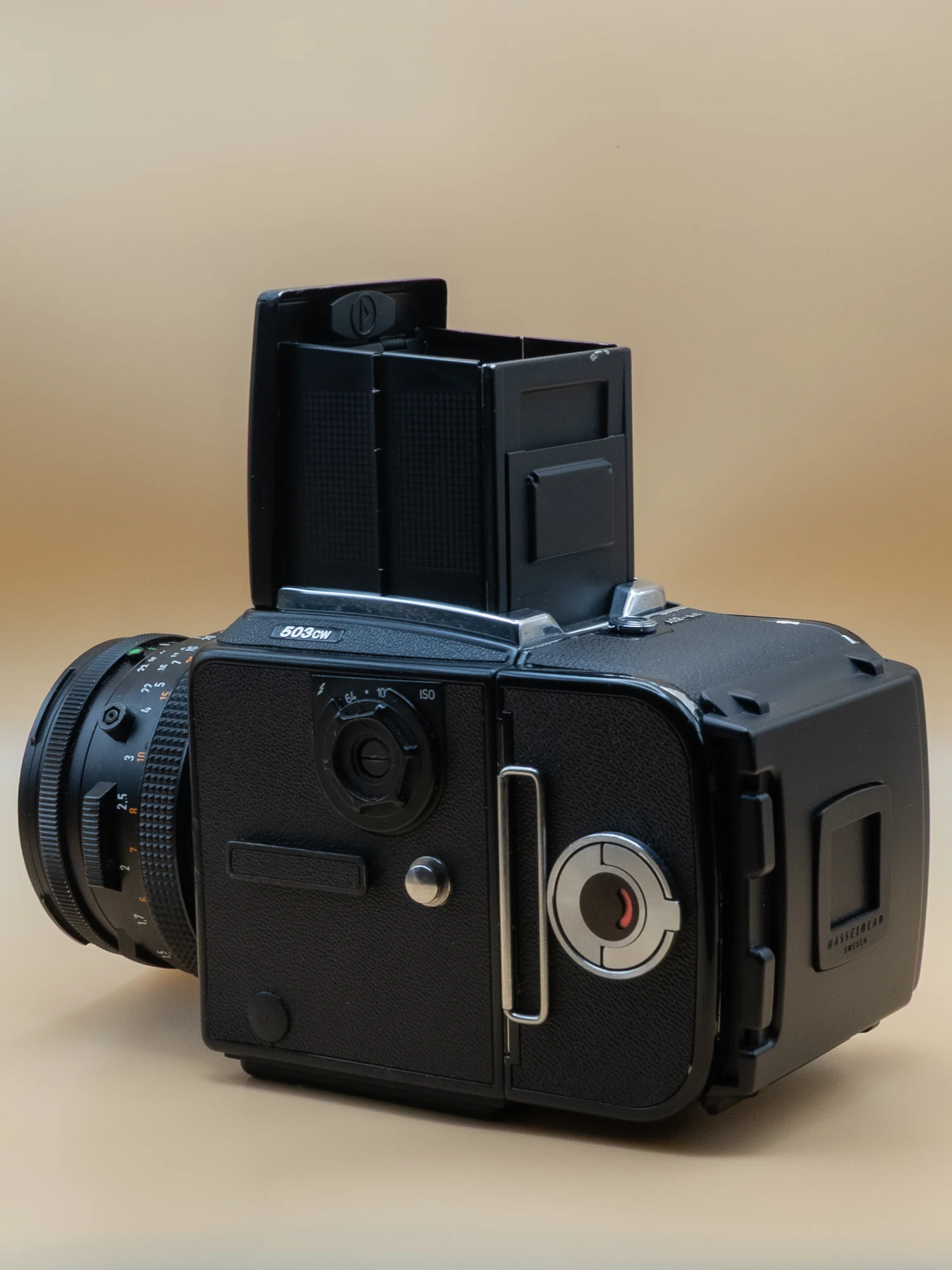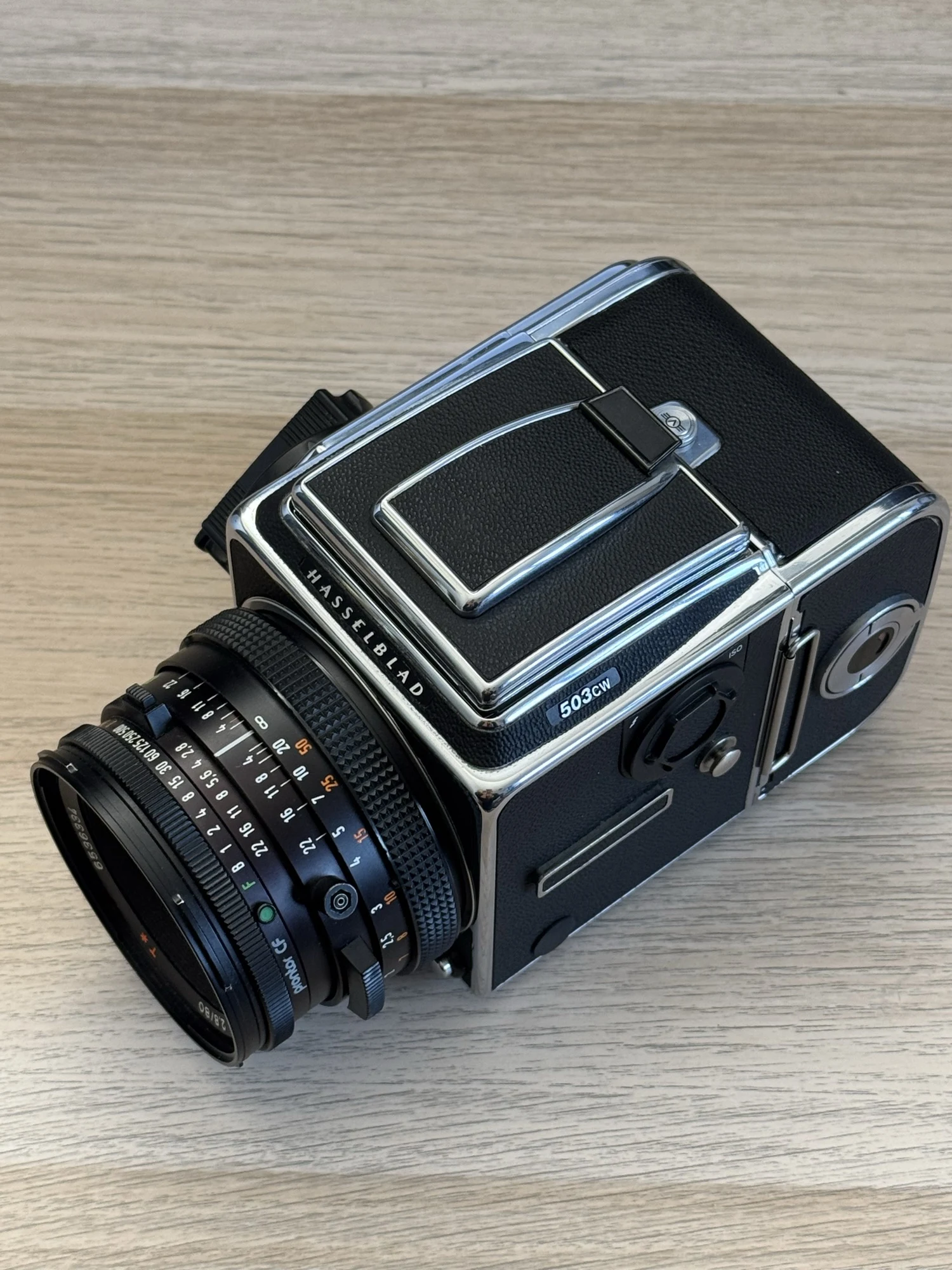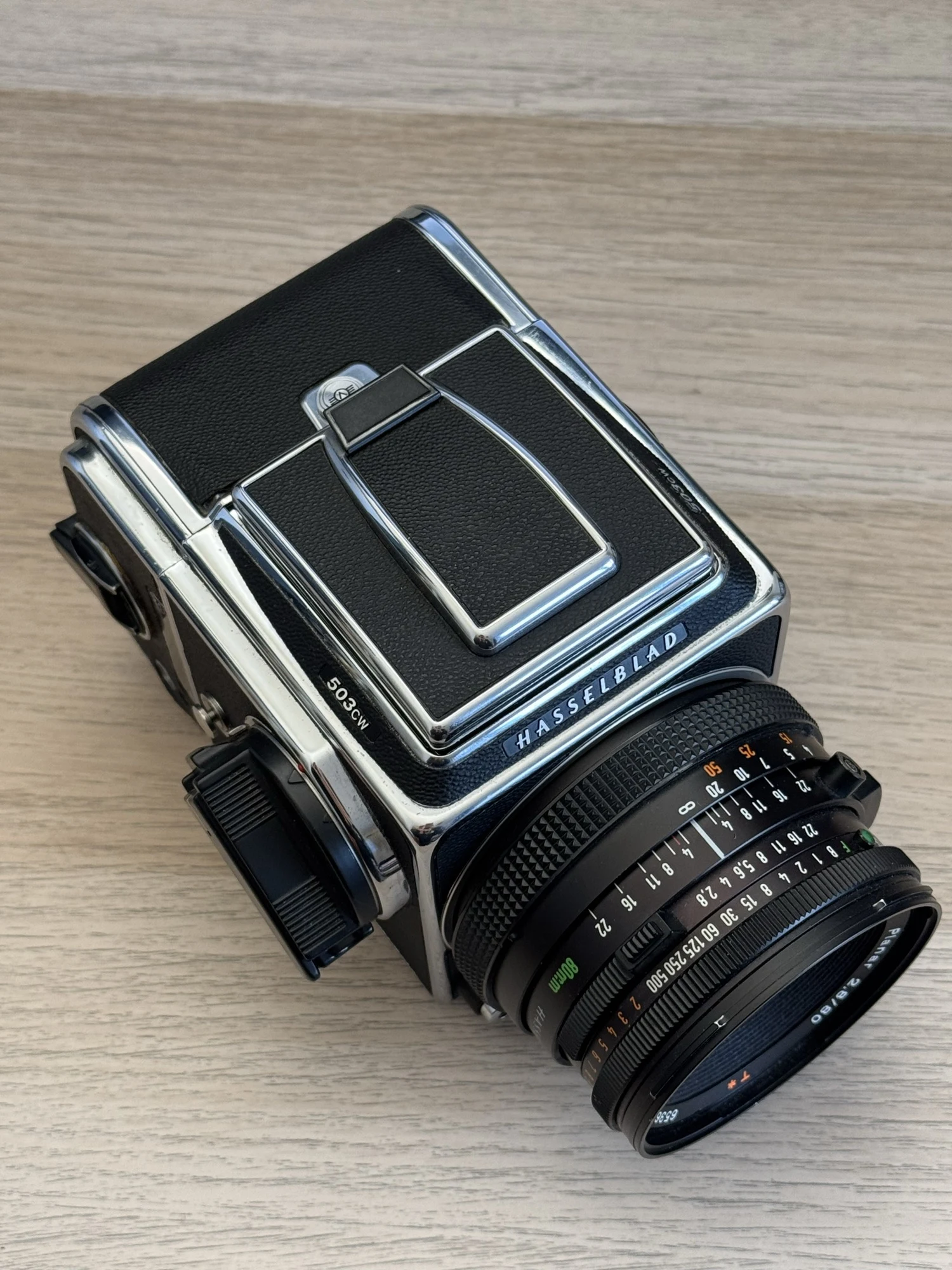
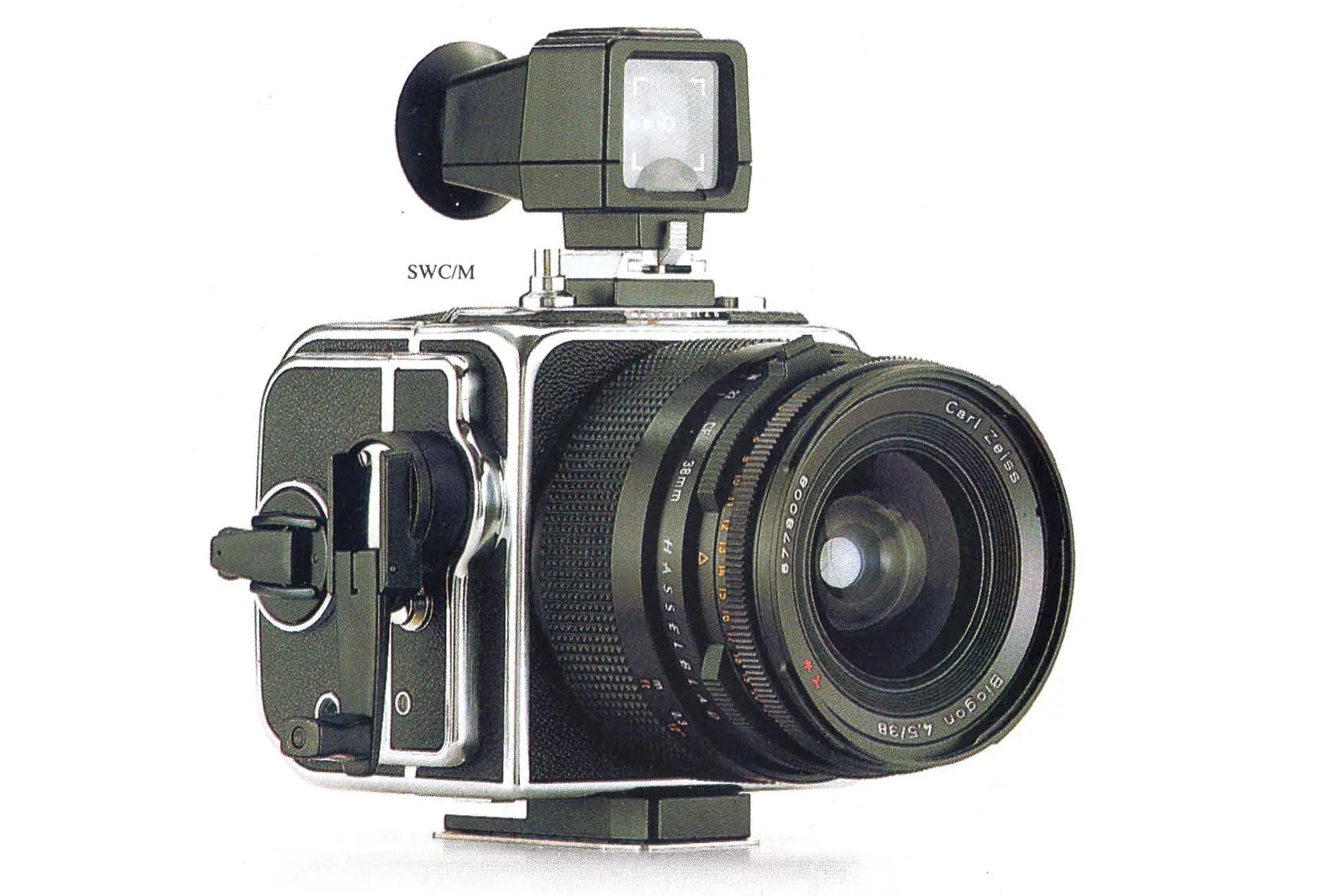
The Hasselblad Super Wide is the odd one out in the V system. It has no mirror, no focusing screen and no interchangeable lens: a Zeiss Biogon 38mm f/4.5 is fixed to a short metal box, a film back goes on the rear and an optical finder sits on top. From the 1954 SWA to the 905SWC that ended the line in 2006, the cameras look almost identical, which is exactly why people struggle to tell them apart.
This guide explains why the camera is built this way, what changed from one generation to the next, who it suits, and what we look at before buying one. Dates and specifications come from Hasselblad's own model chronology, the original instruction manuals and catalogues, and Zeiss's data sheets for the Biogon 38.
Why does the Hasselblad SWC have no mirror?
It is tempting to think Hasselblad removed the mirror to make room for a wide lens. The cause runs the other way: the lens leaves no room for a mirror.
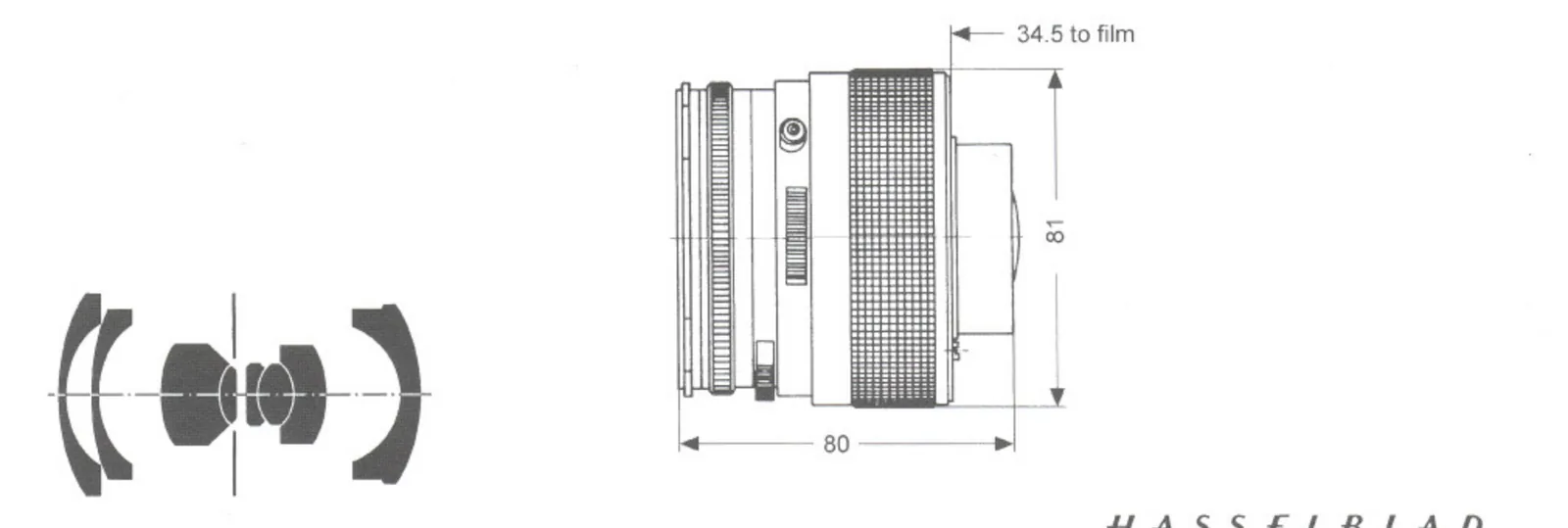
The Biogon is an almost symmetrical design, with the aperture in the middle and similar groups in front and behind. That makes it compact and keeps distortion very low, but the rear element ends up extremely close to the film. On the CF version, Zeiss gives the distance from the last lens vertex to the film as 18.8 mm; on the CFi, 19.0 mm. A 500-series mirror needs far more space than that to swing.
Hasselblad's own 903SWC manual says the same thing in plain words: the lens's symmetrical design and very short focal length leave no room for a viewfinder mirror between the rear of the lens and the film, so instead of going on a reflex body it is permanently attached to a short, robust die-cast housing. Zeiss's older data sheet for the C lens notes that the Biogon cannot be used on the 500C/M or 500EL/M and is therefore built into its own body, the Superwide C.
The SLR alternative is a retrofocus wide-angle, which deliberately pushes the rear element forward to clear the mirror and grows larger as a result. Zeiss's view of that trade-off was blunt: for compactness and performance, the Biogon "cannot be beaten by any retrofocus system."
What every Biogon 38 has in common
Across all versions, Zeiss lists 8 elements in 5 groups, an actual focal length of 38.6 mm, apertures from f/4.5 to f/22, and a 90° diagonal angle of view (72° along the side) on 6×6. Closest focus is 0.3 m from the SWC onwards; the first SWA and SW only focus to 0.5 m.
Which Hasselblad Super Wide models are there?
There are five generations. Hasselblad's chronology treats the SWA and SW as a single entry.
| SWA / SW | SWC | SWC/M | 903SWC | 905SWC | |
|---|---|---|---|---|---|
| Years | 1954–1958 | 1959–1979 | 1980–1988 | 1988–2001 | 2001–2006 |
| Lens | Biogon 38 | C: silver, black, then T* | C T*, then CF from 1982 | CF T* | CFi T* |
| Closest focus | 0.5 m | 0.3 m | 0.3 m | 0.3 m | 0.3 m |
| Wind and cock | Knob plus shutter trigger, two steps | Crank, one turn | Crank, can be pumped | Ratchet crank | Ratchet crank |
| Shutter release | Front of body | Top | Top | Top | Top |
| T lock on release | No | Yes | Yes | Yes | Yes |
| Body status window | Yes | Yes | Yes | Yes | No |
| Spirit level | Read via finder prism | On top of body | Body until 1985, then in finder | In finder | In finder |
| Polaroid back | No | No | Yes | Yes | Yes |
| Filters | Series VIII | Series 63 | 63 (C), Ø60 (CF) | Ø60 | Ø60 |
| Weight | 866 g | 834 g | 960 g* | 940 g | 940 g |
Weights are body with lens. *The SWC/M figure includes the finder but not a film back.
What changed with each generation?
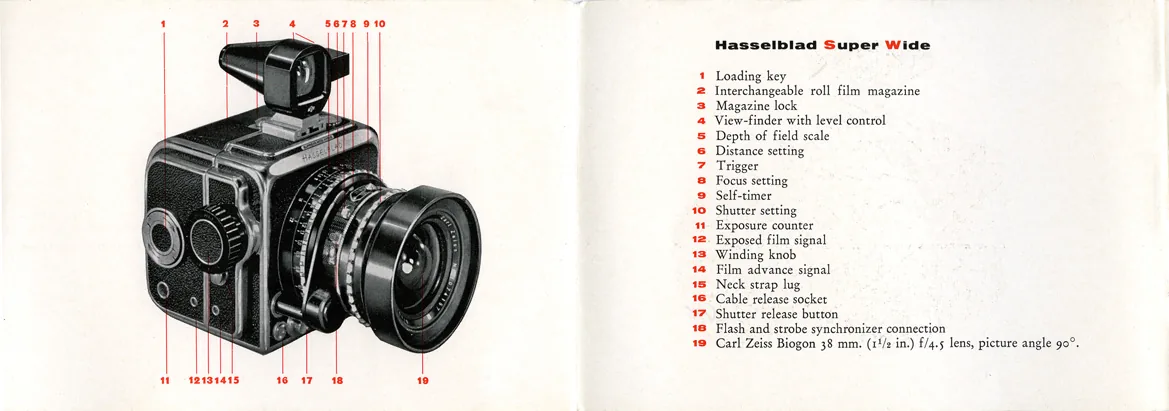
SWA and SW (1954–1958)
The SWA, for Supreme Wide Angle, appeared at Photokina in 1954. From 1956 the camera became the SW, with a slightly changed lens barrel and a new nameplate. Fewer than 2,000 were made of the two together, and some 1957 cameras were not delivered until 1959, which is why you sometimes see the SW dated later than it really was.
Operation is the main difference from everything that followed. You cock the Synchro-Compur shutter with a trigger on the lens, then advance the film with a separate knob. The release button sits low on the front of the body. The shutter uses the old speed sequence (1, 1/2, 1/5, 1/10, 1/25, 1/50, 1/100, 1/250, 1/500 plus B). The finder has what Hasselblad called "level control": a spirit level you view through a small prism while looking at the subject. The film backs are shared with the 1600F and 1000F.
SWC (1959–1979)
The SWC is where the camera's lasting layout arrived. One turn of the crank now cocks the shutter and advances the film together. The release moves to the top of the body, with a cable-release thread, and gains a T lock: set it to T and the release stays down for long exposures on B; until it goes back to O, the film will not advance. The spirit level sits on top of the body, and a prism on the side of the finder reflects it so you can see it while framing. Closest focus drops to 0.3 m.
The changes during its twenty-year run were to the lens, not the body: silver C lens from 1959, black C from 1969 and multicoated C T* from 1973. The SWC cannot take a Polaroid back.
SWC/M (1980–1988)
The SWC/M accepts every Hasselblad film magazine except the Polaroid 80 back. With a Polaroid back fitted, the crank cannot complete a full turn, so you pump it up and down until it stops.
One SWC/M can be three slightly different cameras:
- 1980–1982: still the C T* lens.
- From 1982: the CF lens, with rubber grip rings, a focusing scale in feet and metres, shutter and aperture rings that can be coupled with a button, and the same Ø60 accessory mount as other CF lenses.
- From 1985: the spirit level moves into a new finder, the 52036, and disappears from the body top. Hasselblad's 1987 catalogue lists it as standard, and the product numbers change from 10050 (chrome) and 10198 (black) to 10051 and 10199.
The 52036 also fits the earlier SWC and SW, though with a C lens you cannot see the focusing scale through it.
903SWC (1988–2001)
From the outside the 903 continues the late SWC/M. The change Hasselblad records is inside: a Palpas coating on the inner walls of the body to reduce flare. The finder's spirit level sits beneath the image area, and each millimetre of bubble travel is roughly 1°. A crescent-shaped bifocal section shows the lens scales at the same time, and there are marks for 6×4.5. The ratchet crank works with a full turn or a pumping action. Product numbers are 10052 (chrome) and 10201 (black).
905SWC (2001–2006)
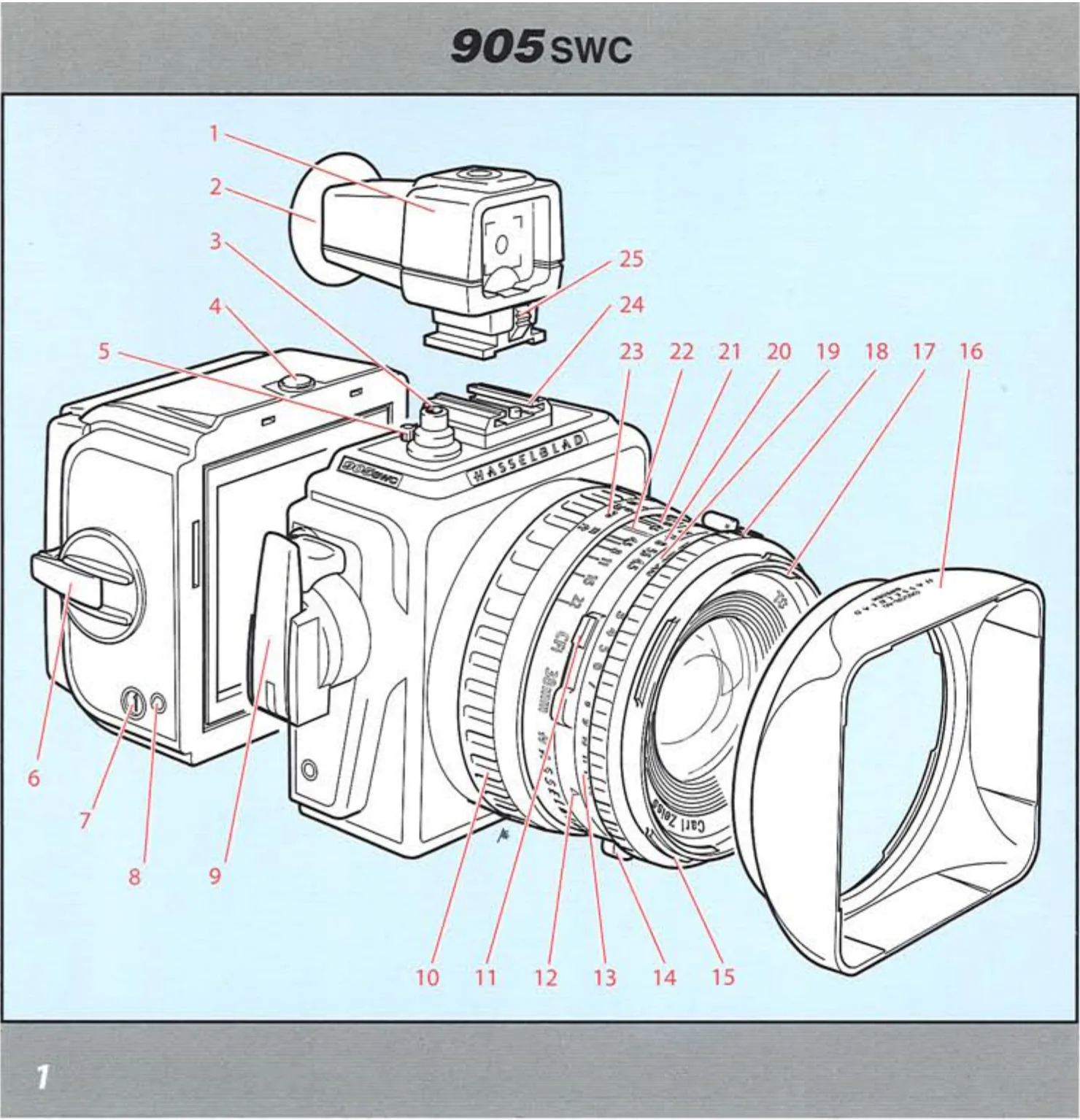
The last Super Wide. Hasselblad had to recalculate the Biogon for new, environmentally friendly glass types, and it now came as a CFi lens. The camera shipped with the 52036 finder (0.23× magnification), a 40668 lens shade, strap and caps. It weighs 940 g, or 1365 g with an A12 back. The manual lists it in chrome (10304). Unlike the 903, the 905 has no body status window under the crank: to see whether it is wound, try the crank. If it will not turn clockwise, the camera is wound.
How do you frame and level a Hasselblad SWC?
Without a mirror you never see through the lens, so the finder and the level matter more than on any other Hasselblad. A wide-angle lens exaggerates any tilt, and Hasselblad's original argument for the level was that it let you shoot straight verticals by hand, without a tripod.
The optical finder sits above the lens, so it sees a little more than the film. Hasselblad's SWC/M manual puts it at about 6 in (15 cm) extra at the top of the frame and 3 in (7.5 cm) extra on each side, with the bottom edge matching, regardless of distance.
For exact framing, remove the film back and fit a focusing screen adapter, then put any Hasselblad finder on top. Set the shutter to B, open the aperture fully, lock the release at T and compose on the ground glass. Afterwards, return the lock to O, wind on and refit the back. The SWC/M uses adapter 41025; the 903 and 905 manuals list 41050. With the adapter, Zeiss says you can focus precisely down to 20 cm from the front of the lens.
Did the Hasselblad SWC go to space?
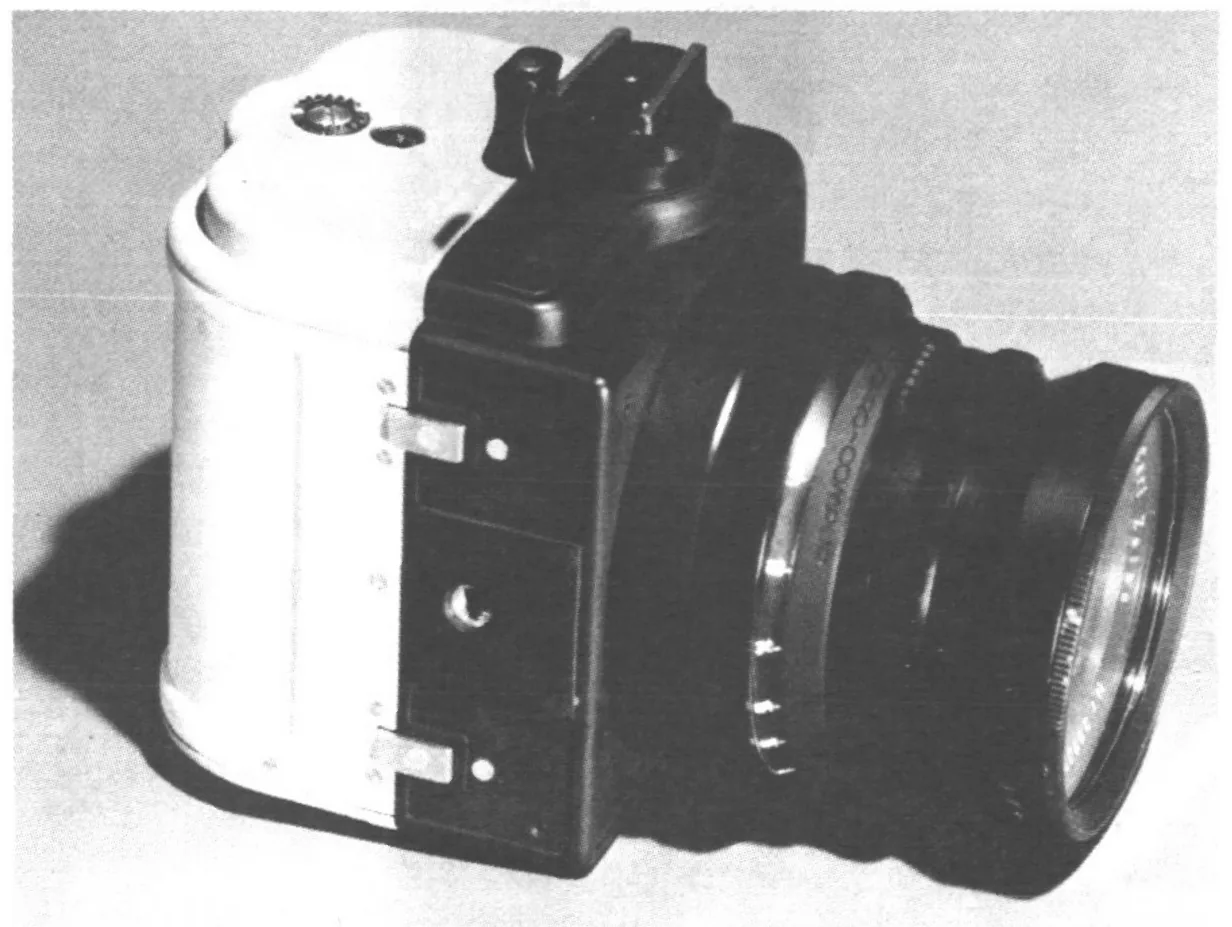
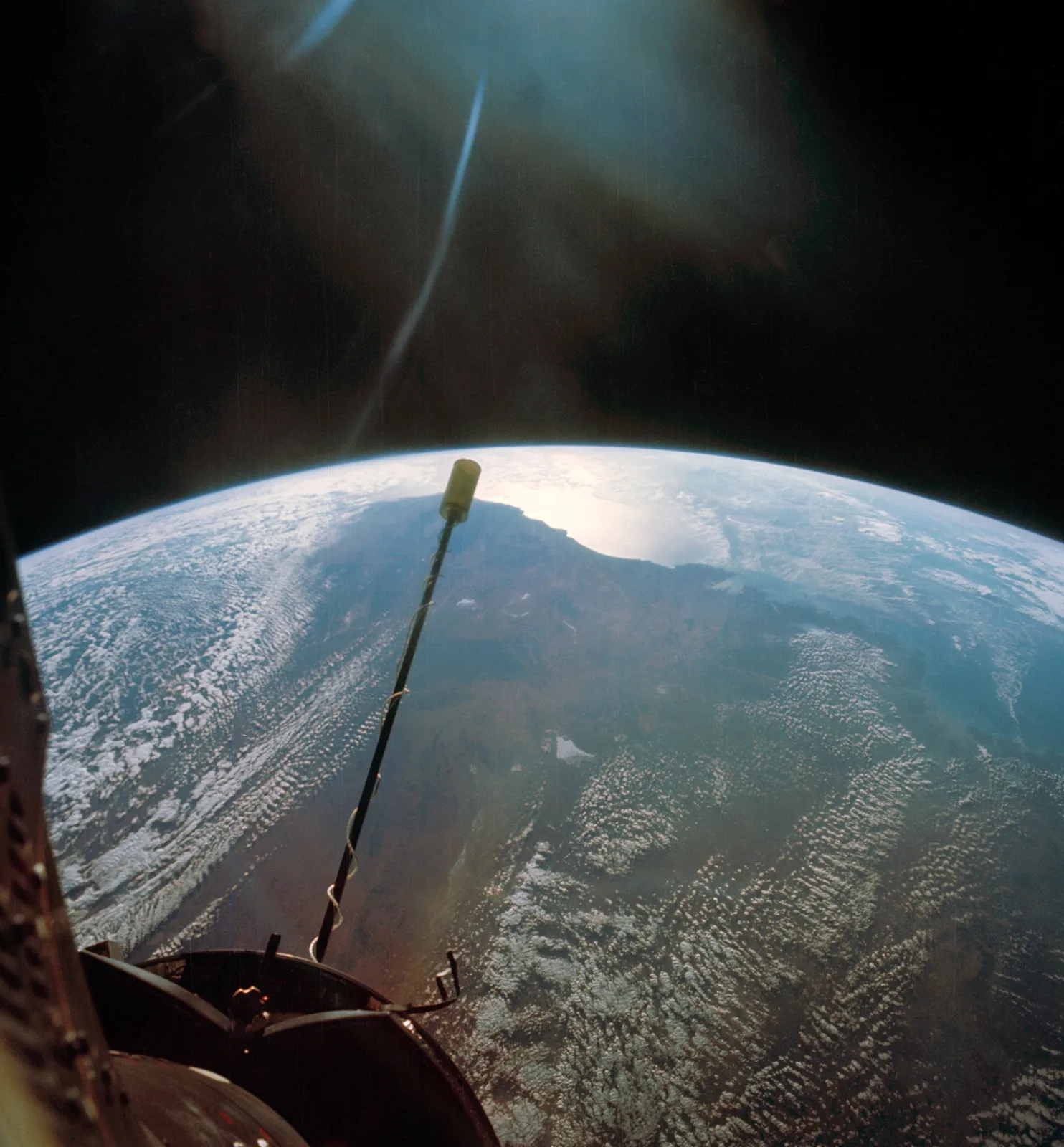
Yes, though not to the Moon. NASA flew a modified Hasselblad Super Wide with the Biogon 38 on Gemini IX-A, X, XI and XII in 1966, mainly for spacewalks, rendezvous with the Agena target vehicle and high-altitude views of Earth. NASA's own report calls some of that camera's photographs among the most valuable and widely published of the Gemini programme. NASA's equipment table also lists it for Apollo 9 in Earth orbit. The cameras used on the lunar surface were 500EL Data Cameras with a 60mm Biogon, a different lens and a different body.
Who is the Hasselblad SWC for?
Zeiss listed the Biogon's preferred uses as architecture, demanding interiors, industrial work, documentation, aerials, travel and high-quality snapshots. In practice it suits people who want very wide, very straight pictures on medium format from something small enough to carry all day. It suits you less if you need to focus close by eye, or if you dislike guessing distances: everything is set by scale unless you fit the ground-glass adapter.
Which Hasselblad SWC should I buy?
- You want Polaroid or current film backs: an SWC/M from 1982 onwards, or a 903SWC.
- You want the latest coatings and the lens shade in the box: the 905SWC.
- You want 6×4.5 or instant film: anything from the SWC/M onwards.
- You want the oldest and most collectable: an SWA, SW or silver-lens SWC. These have the oldest shutters, so plan on a service.
What should I check before buying a Hasselblad SWC?
- Identify the generation. A lens marked Synchro-Compur is a C lens; CF or CFi means a later camera. On an SWC/M, check whether it is a pre- or post-1982 lens.
- Fire every speed, then try B with the T lock. Old Compur shutters slow down after long storage, and the slow speeds show it first.
- Try the crank with a full turn and with a pumping action. Pumping only works from the SWC/M onwards, so do not force an older crank.
- Look at the spirit level. Is the bubble there, and is the liquid leaking or yellowed? Whether it sits on the body or in the finder also helps date the camera.
- Check the finder. Is it the right one for the generation (52035 or 52036), and is there haze on the glass or the scale window?
- Match the signals before fitting a back. Body and magazine indicators should show the same colour, or you can lose or double-expose a frame.
- Confirm the back you need will fit. Polaroid and 6×4.5 backs need an SWC/M or later.
- Ask about the focusing screen adapter if you want ground-glass framing, and check which number it is.
We sell, buy and service Hasselblad V-system cameras, the Super Wide family included. You can see what is in stock on our Hasselblad cameras page, read how the reflex bodies developed in our Hasselblad 500 series guide, or find out about shutter and crank work on our Hasselblad repair page.