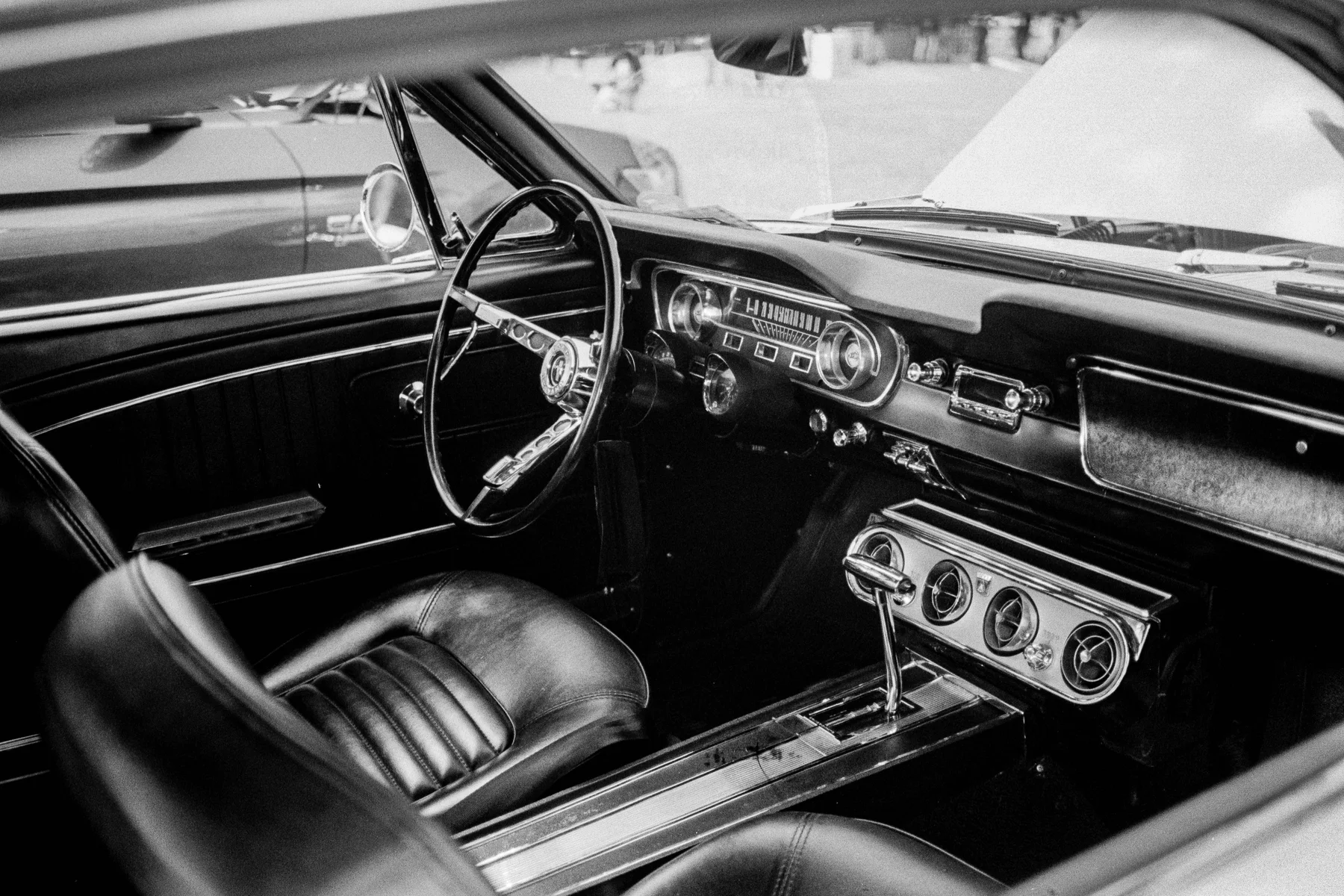
Black and white is the best place to learn film. It is cheaper to develop than colour, and what you get back depends on your exposure rather than on a lab's scanner presets. Fifteen black and white films are still made in 35mm. They differ in three ways, and once you know which one matters to you, the choice is short.
Grain, contrast and latitude
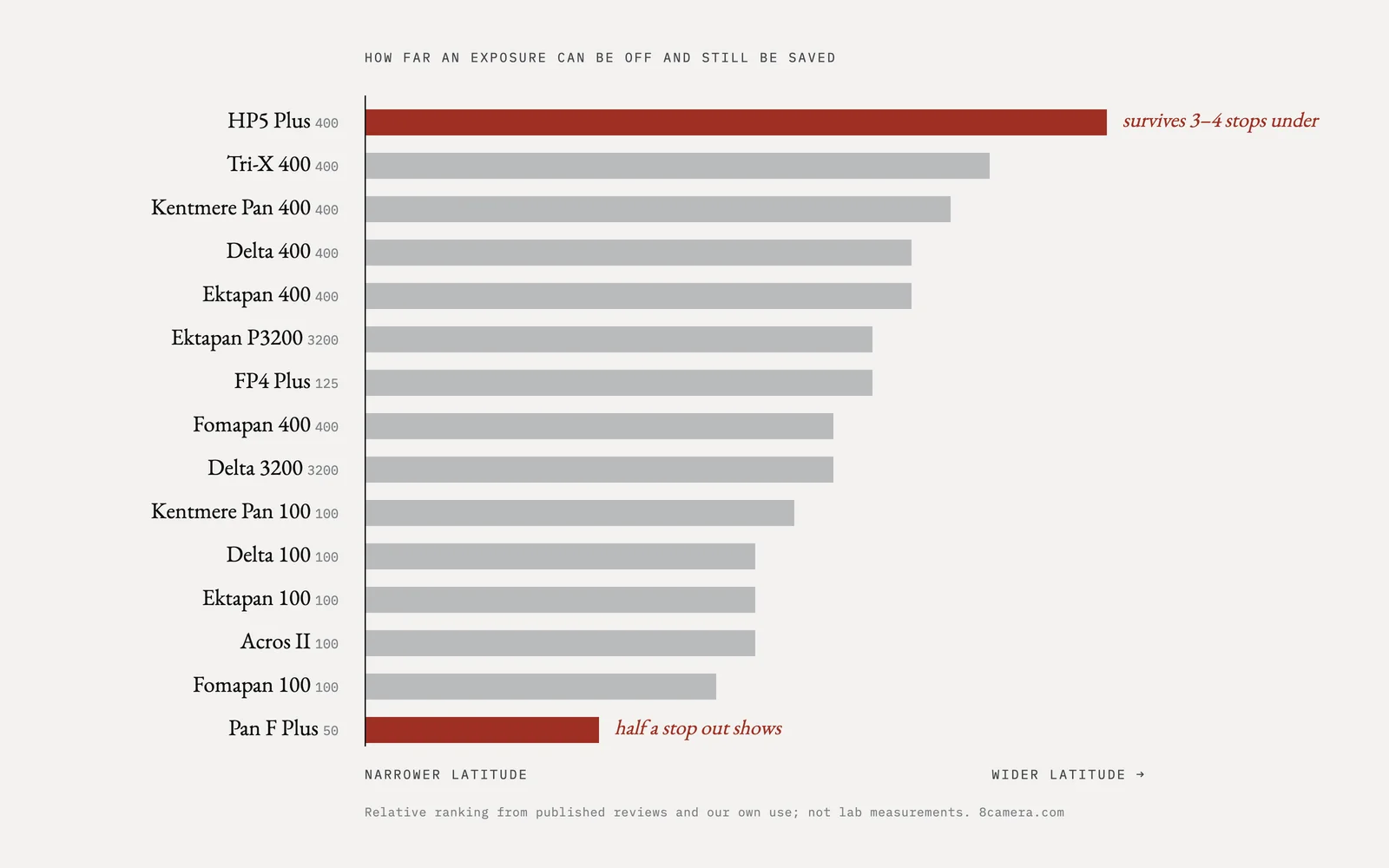
Grain rises with speed within a family. Across families, T-grain emulsions (Ilford Delta, Kodak Ektapan) are finer than traditional-grain films such as HP5 Plus and Tri-X. Contrast is a tendency under standard development; change the developer and it changes. Latitude is discussed least, but it decides whether a bad exposure can be saved, and for a beginner it matters more than the other two.
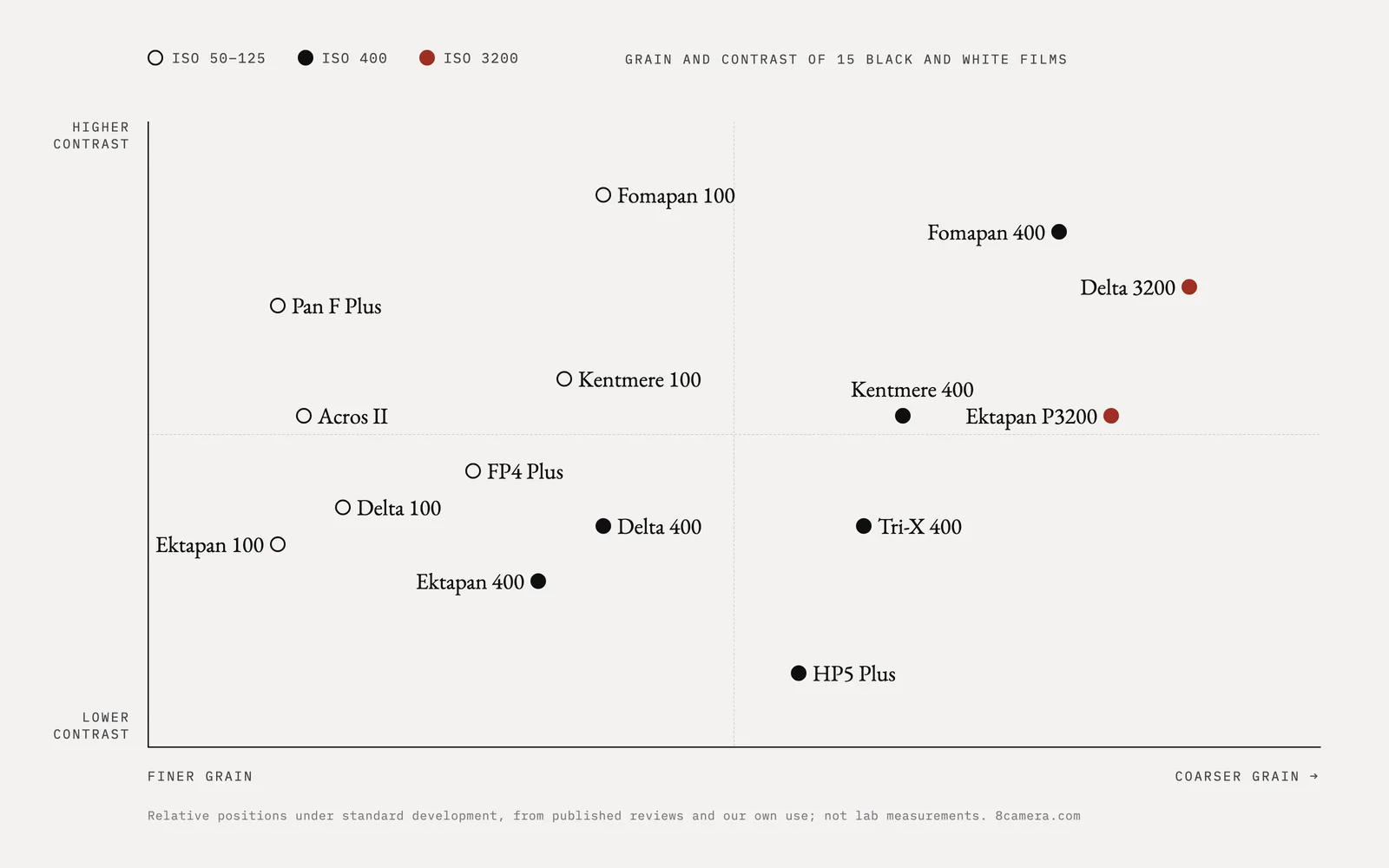
No corner of the chart is better than another; it depends on the picture you want. Fine and soft sits bottom left, coarse and hard top right. Latitude is a separate question:
All fifteen films
| Film | ISO | Character |
|---|---|---|
| Ilford Pan F Plus | 50 | The finest grain, but the narrowest latitude: half a stop out shows |
| Kodak Ektapan 100 (formerly T-MAX 100) | 100 | Among the finest mainstream films, very linear tones |
| Ilford Delta 100 | 100 | T-grain, fine and smooth, enlarges well |
| Fujifilm Acros II | 100 | Extremely fine, and barely needs reciprocity correction on long exposures |
| Kentmere Pan 100 | 100 | Ilford's budget line; grain more visible than other 100s |
| Fomapan 100 Classic | 100 | The most affordable 100, with higher contrast |
| Ilford FP4 Plus | 125 | The fine-grain sibling of HP5, very steady in daylight |
| Ilford HP5 Plus | 400 | The widest latitude of any mainstream film, and the best for pushing |
| Kodak Tri-X 400 | 400 | Visible, characterful grain that gets stronger when pushed |
| Ilford Delta 400 | 400 | The finest grain of the 400s |
| Kodak Ektapan 400 (formerly T-MAX 400) | 400 | A fine-grain 400 with linear tones |
| Kentmere Pan 400 | 400 | Made in the same factory as HP5; closer to it than its price suggests |
| Fomapan 400 Action | 400 | The coarsest grain here, and in practice closer to ISO 200–250 |
| Ilford Delta 3200 | 3200 | Gets a picture in the dark, at the cost of heavy grain |
| Kodak Ektapan P3200 (formerly T-MAX P3200) | 3200 | Softer tonality than Delta 3200; highlights hold better |
From March 2026 Kodak sells T-MAX as Ektapan. The emulsions are unchanged, and both boxes are on sale until old stock runs out.
Which ISO 400 film is best for beginners?
HP5 Plus is the one we hand people for a first roll. Underexpose it by three or four stops, push it to 1600 or even 3200, and it still gives a printable negative. Tri-X is the choice if you want grain you can see: Kodak publishes an RMS granularity of 17, and the grain is the point. For clean, smooth 400, look at Delta 400 or Ektapan 400.
Kentmere Pan 400 deserves a look. Kentmere is the budget brand of Harman, Ilford's parent company, and has been made at Harman's Mobberley factory since Harman bought it in 2007. Grain is a little more visible than HP5 and latitude a little narrower, and it has no anti-halation layer, so bright highlights bloom. But the gap in results is smaller than the gap in what you pay.
Is ISO 100 worth it?
The 100s are finer, but the practical difference from 400 is latitude, not grain. Miss by a stop and a 100-speed roll is much harder to rescue. Acros II has one unique advantage: exposures of tens of seconds need almost no reciprocity compensation, which matters more than grain for night scenes and moving water. Fuji discontinued the original Acros in October 2018 and brought it back as Acros II in November 2019. Pan F Plus is the finest of all, and the least forgiving.
Are ISO 3200 films really 3200?
No. Delta 3200 and Ektapan P3200 both have a true speed around ISO 1000; the box speed already assumes a push. We meter and develop both at 1600, which is more reliable than 3200. Don't expect shadow detail. Of the two, P3200 has softer tones and holds highlights better.
Pushing, pulling and the developer
Every black and white film can be pushed or pulled:
- Push (rate it faster, develop longer): contrast rises, grain coarsens, shadows go first.
- Pull (rate it slower, develop less): contrast flattens and highlights hold, but grain barely changes. Pulling for finer grain is a myth.
A roll gets one development time, so decide before you load and tell the lab what you shot it at: a roll shot at 1600 and developed as 400 is lost. Developer choice can shift contrast, grain and shadow detail by more than the difference between two films, and a lab will use whatever is in its tank.
Black and white negative can also be reversal processed into a positive. The slow, thin emulsions (Pan F Plus, Ektapan 100, Delta 100, Acros II) come out clean; HP5 and Tri-X turn flat and muddy. And if there is no black and white lab near you, Ilford XP2 Super is developed in ordinary C-41 colour chemistry.
The cheapest black and white film
Kentmere Pan 400 and Fomapan 400 are the cheapest 400s, at about £7 a roll in the UK in October 2026, against roughly £9.50 to £14 for Tri-X, HP5 Plus and Delta 400. Fomapan 400 has coarser grain and a real speed nearer ISO 200–250. While you are learning, cheap film is the right choice: the money saved buys more rolls, and more rolls teach you more than changing film.
Which black and white film should I buy?
- First roll, unsure of the light: HP5 Plus.
- Grain and a street feel: Tri-X 400.
- Fine detail and big prints: Delta 100 or Ektapan 100.
- Tight budget, lots of practice: Kentmere Pan 400.
- Night scenes and long exposures: Acros II.
- Handheld at night: Delta 3200, metered at 1600.
Choosing between colour, black and white and slide in the first place? Start with How to choose 35mm film. Loading your first roll? Read Your first roll of film.