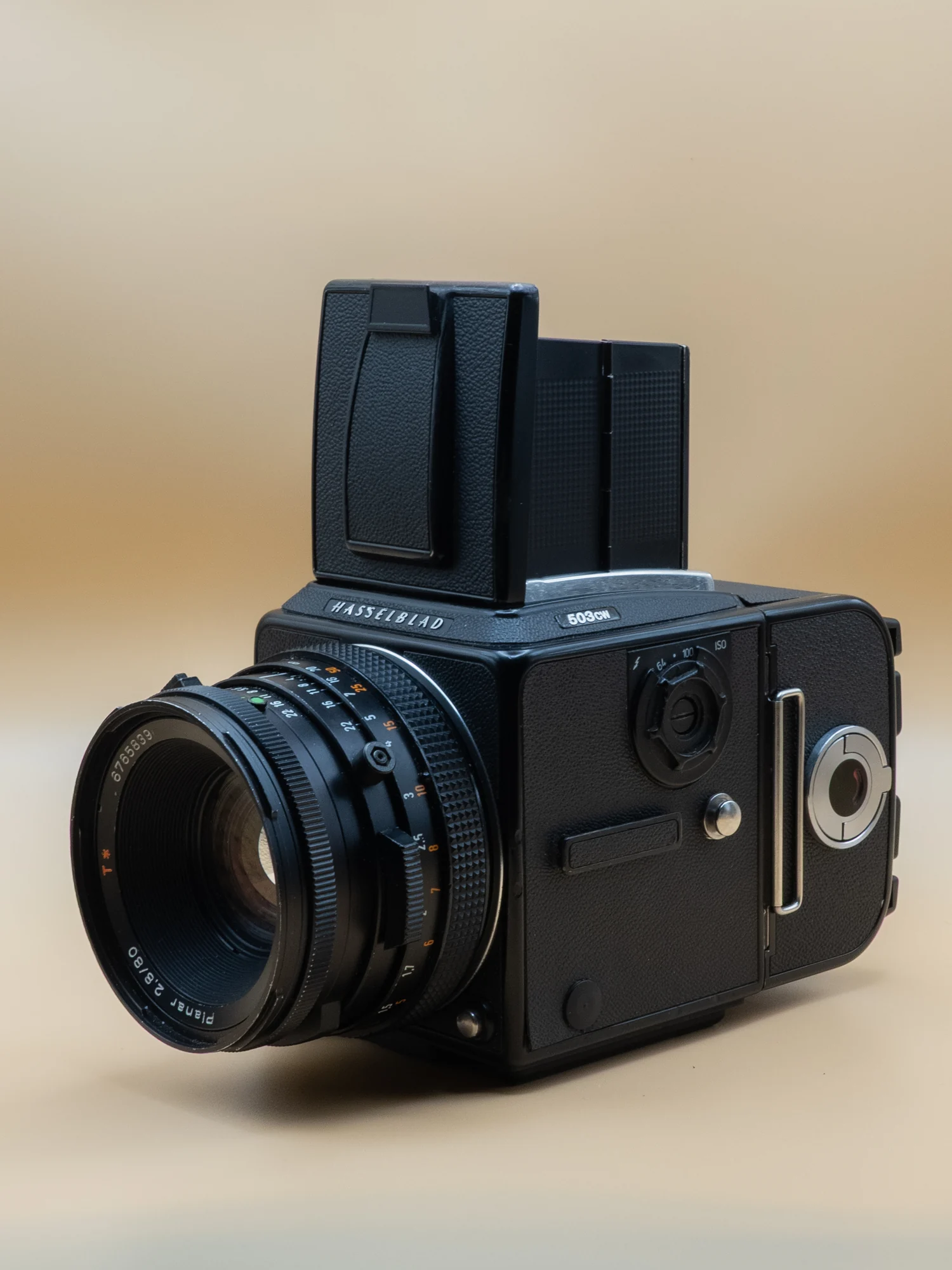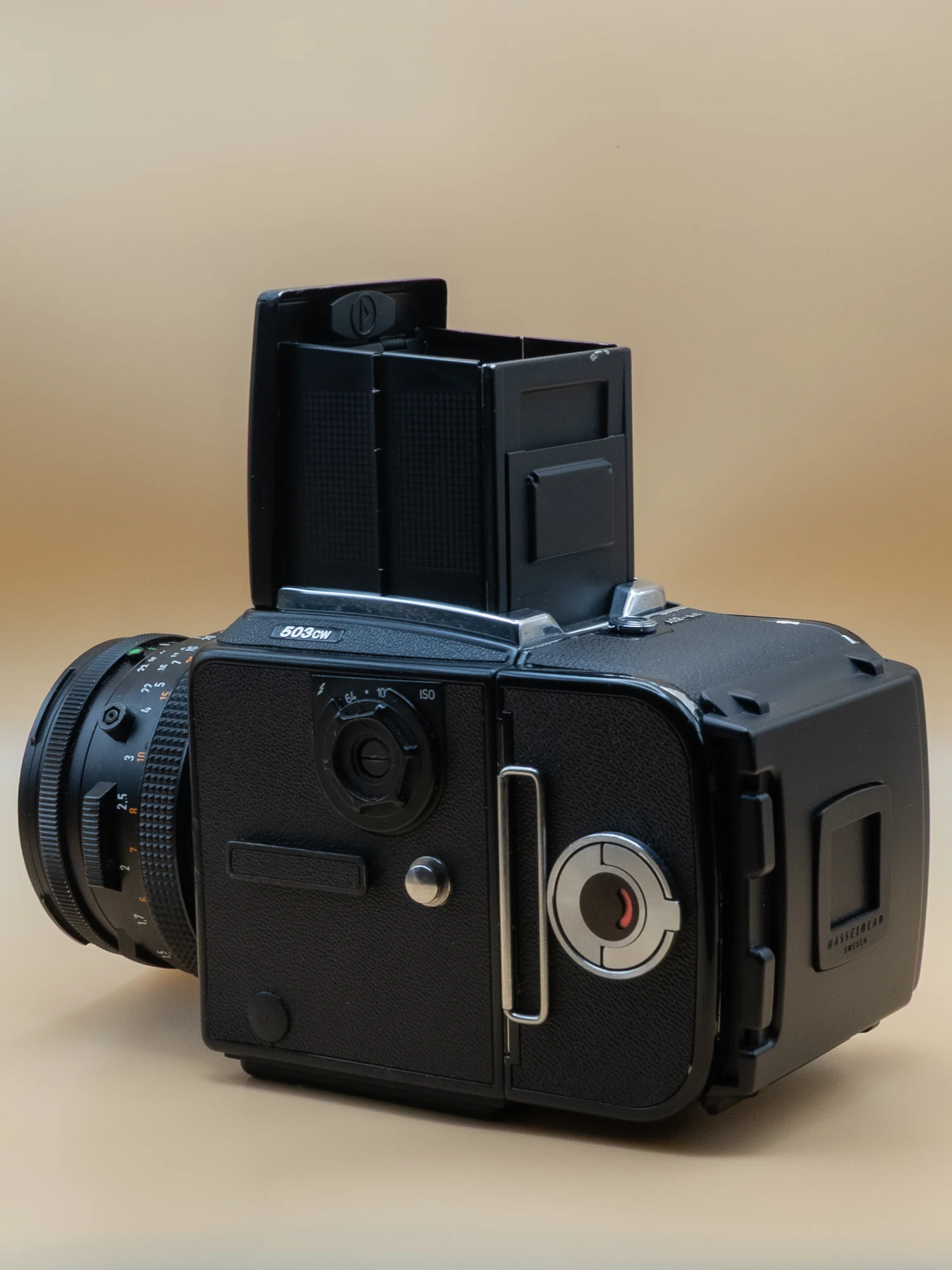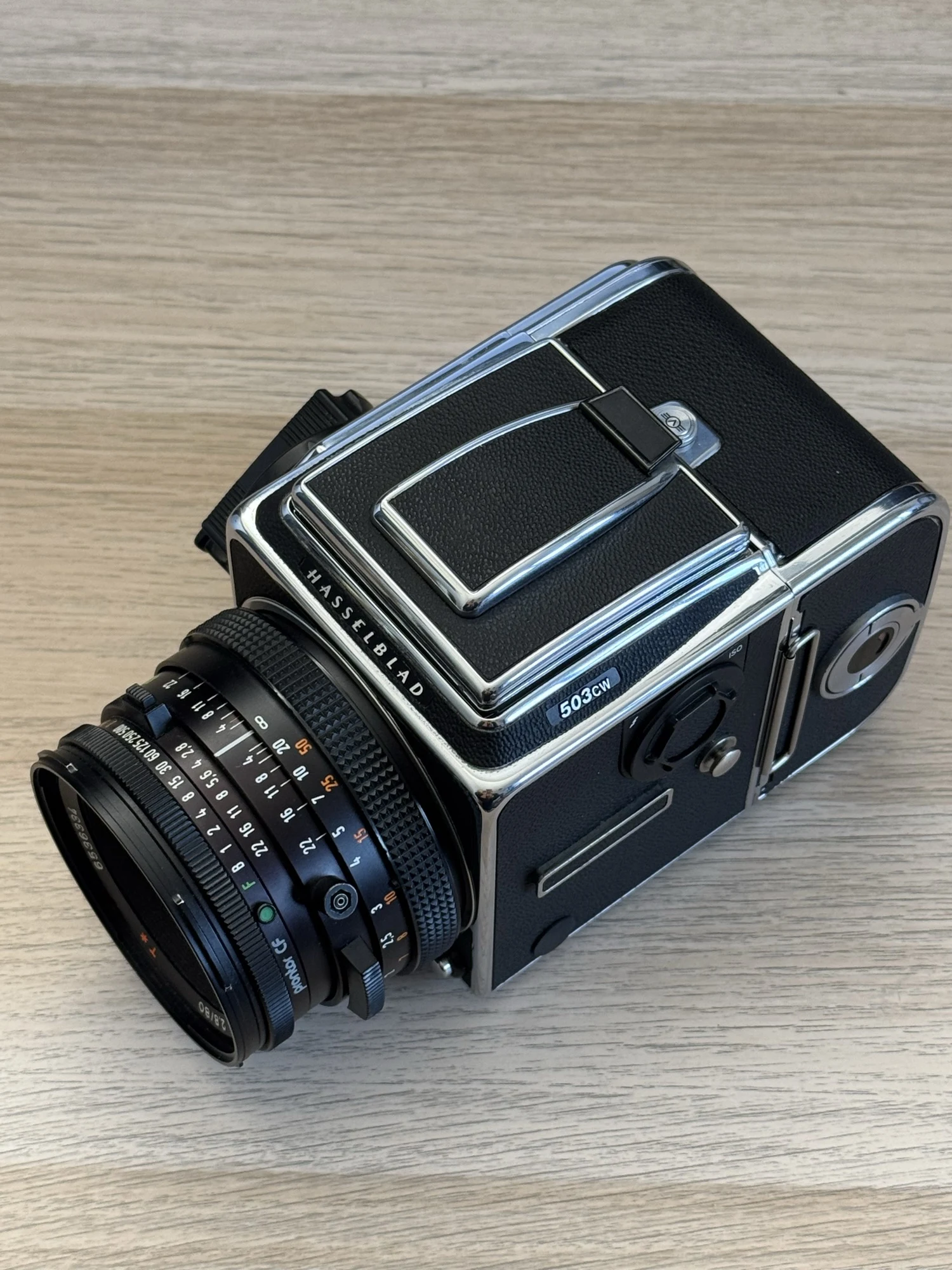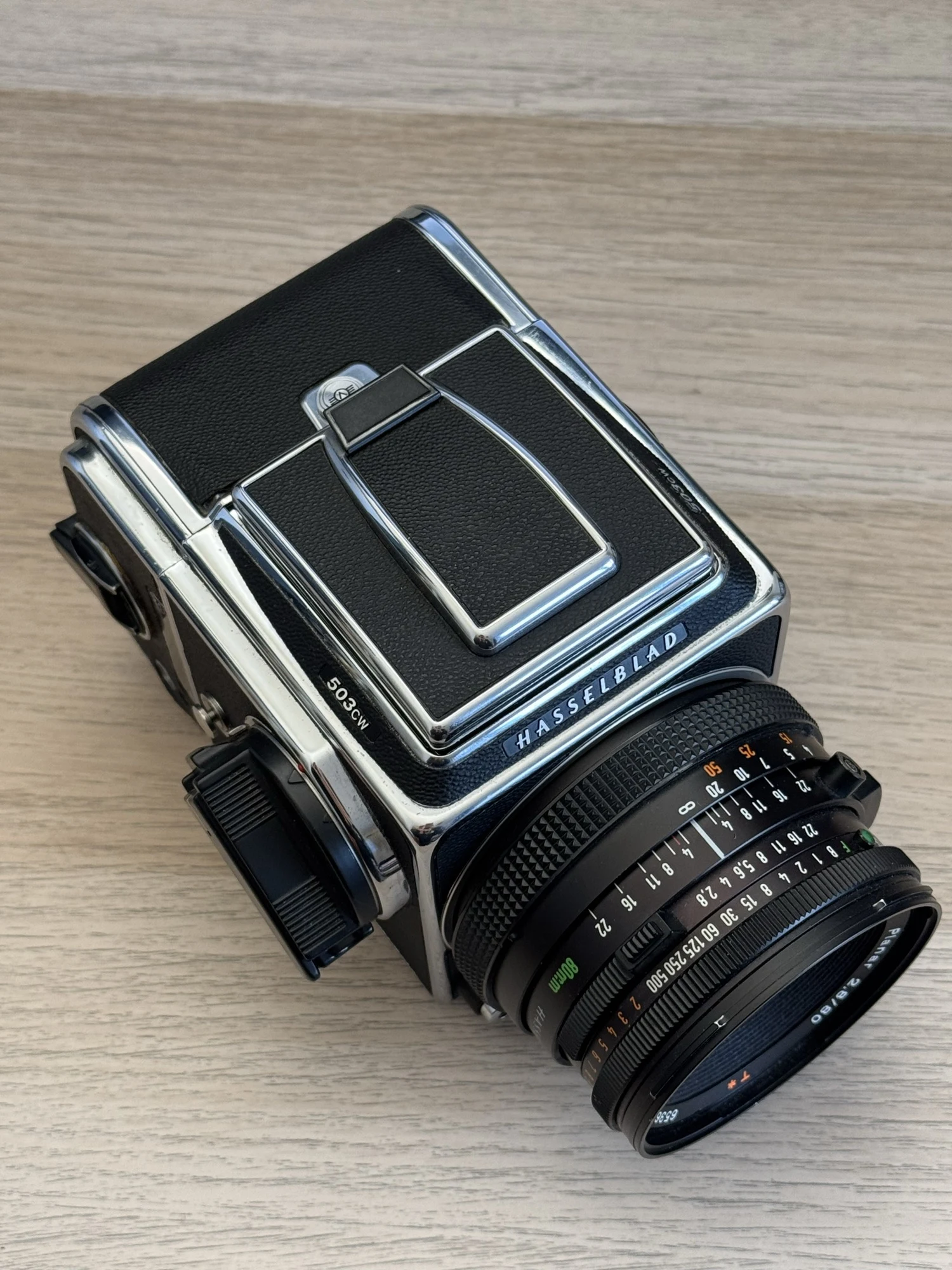
On a Hasselblad 500, the lens matters more than on most cameras, because the shutter lives inside it. Every lens carries its own leaf shutter, so when you buy a Hasselblad lens you are buying a piece of Zeiss glass and a mechanical shutter that may be fifty years old. That is why the generation letters engraved on the barrel (C, CF, CB, CFi, CFE) are worth understanding: they tell you which shutter is inside, how the lens handles and how easy it will be to keep running.
This guide covers the lenses themselves: what each generation changed, which focal lengths were made in which versions, how to tell them apart on a dealer's shelf, where to start, and what we check on the bench. For the bodies, backs and finders, see our Hasselblad 500 series guide. The facts here come from Carl Zeiss's own lens data sheets, Hasselblad's instruction manuals and the Hasselblad Historical archive.
Which Hasselblad lenses fit a 500-series camera?
Any V-system lens with a built-in leaf shutter. Hasselblad's 501CM/503CW manual says the 500 cameras "are compatible with lenses that have an integral leaf shutter, namely all C-series lenses". In practice C, C T\*, CF, CB, CFi, CFE and the late ZV Classic lenses all work on every 500 body, from the 1957 500C to the 503CW.
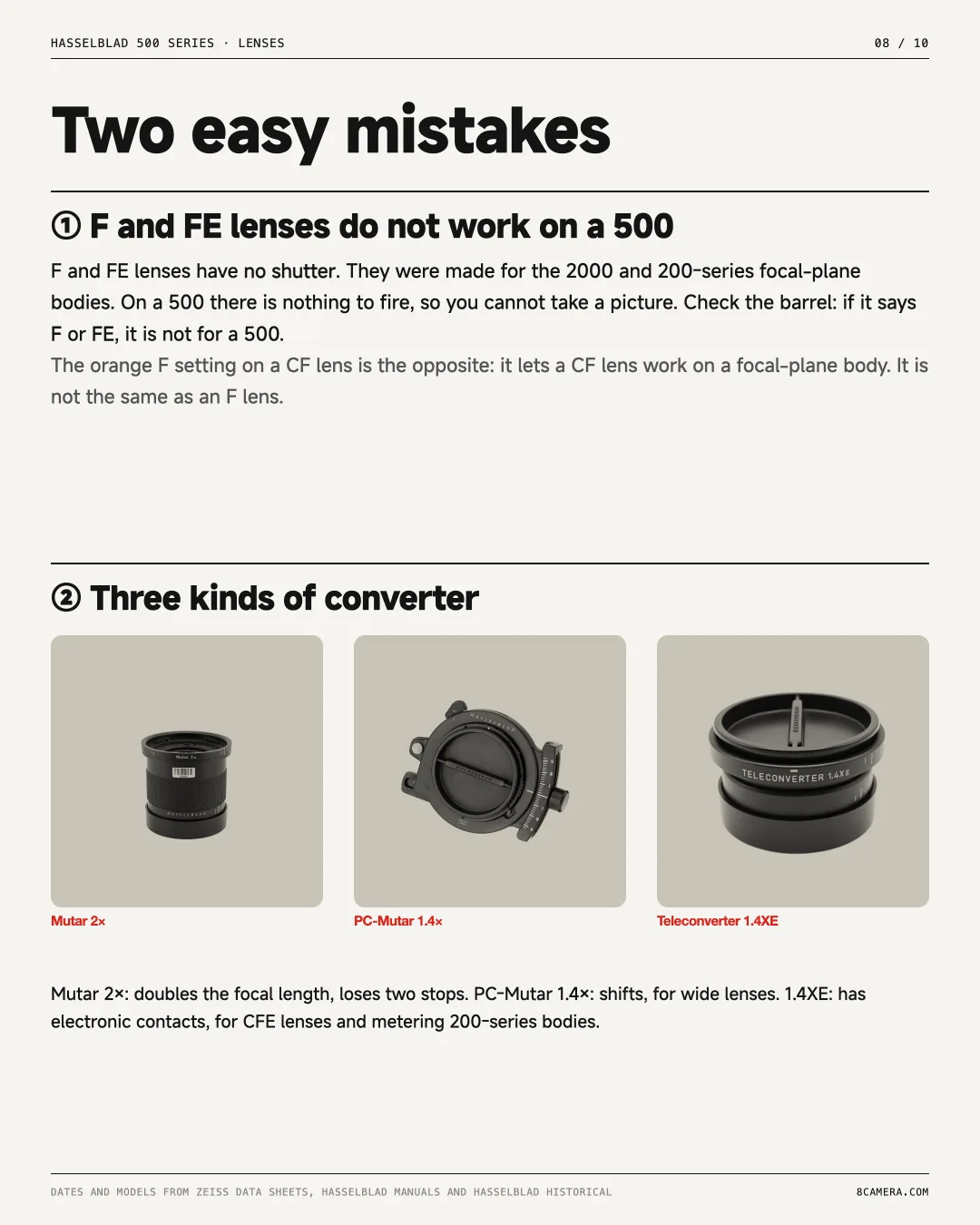
What does not fit is F and FE lenses. They have no shutter: Hasselblad's manuals say F lenses work only with the 2000 and 200 series, and FE lenses only with focal-plane shutter cameras. On a 500 there is nothing to open, so you cannot take a picture. Do not confuse an F lens with the orange F setting on a CF lens, which does the opposite job: it lets a CF lens be used on a focal-plane body with its own shutter held open. The Biogon 38mm is not a 500 lens either; it is built into the SWC cameras.
How do I tell Hasselblad lens generations apart?
| Generation | From | Shutter | How to recognise it |
|---|---|---|---|
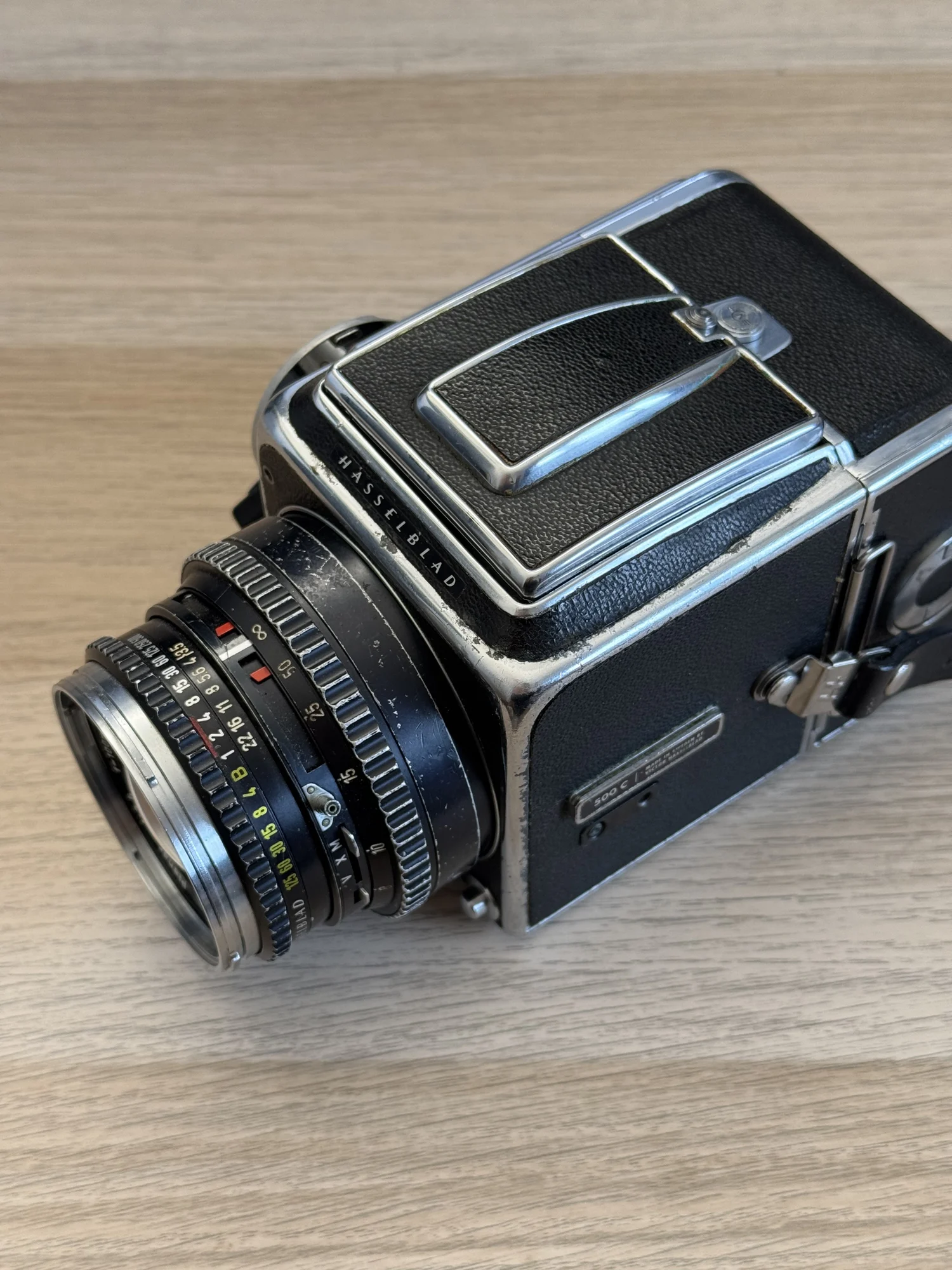
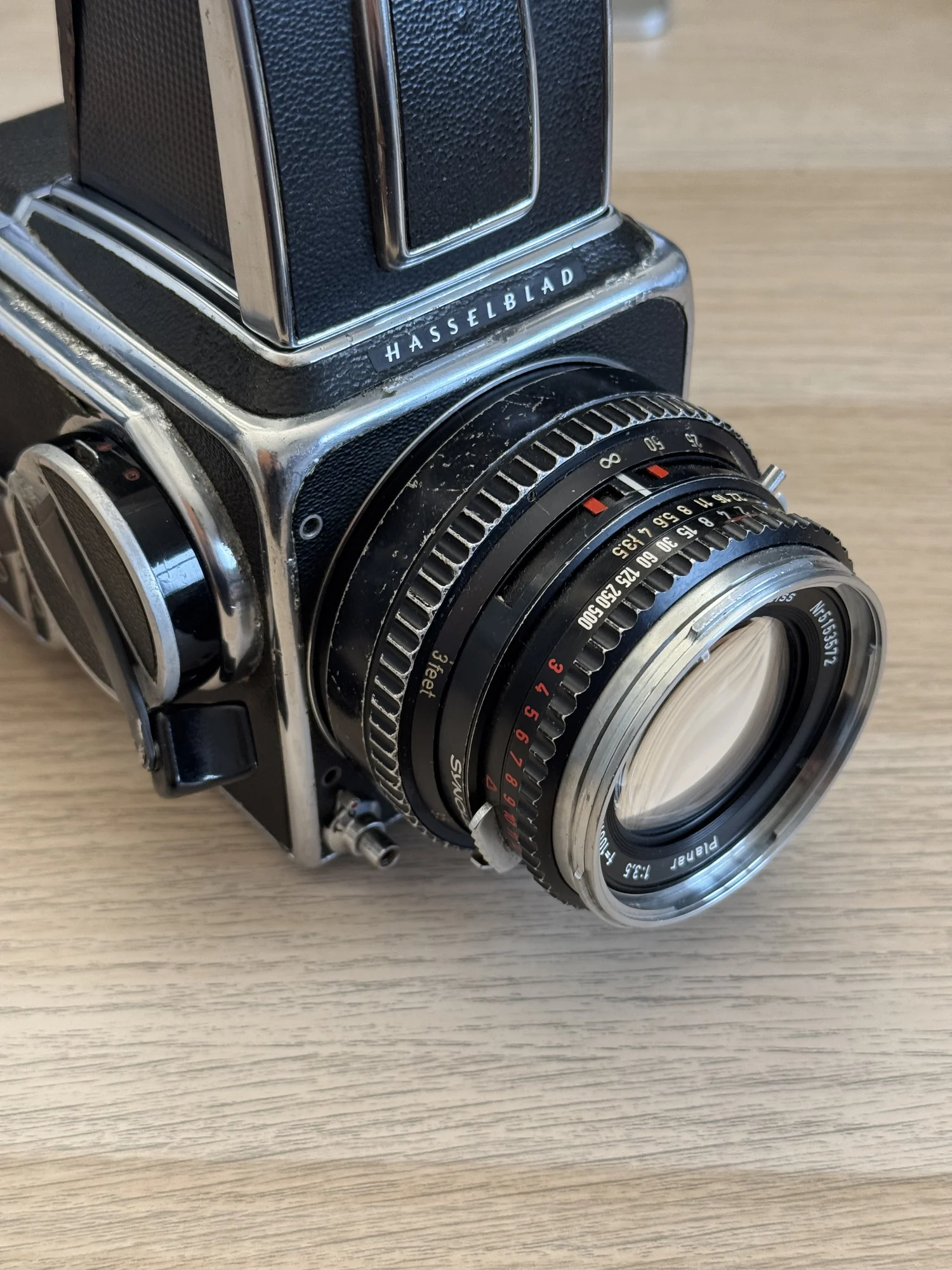
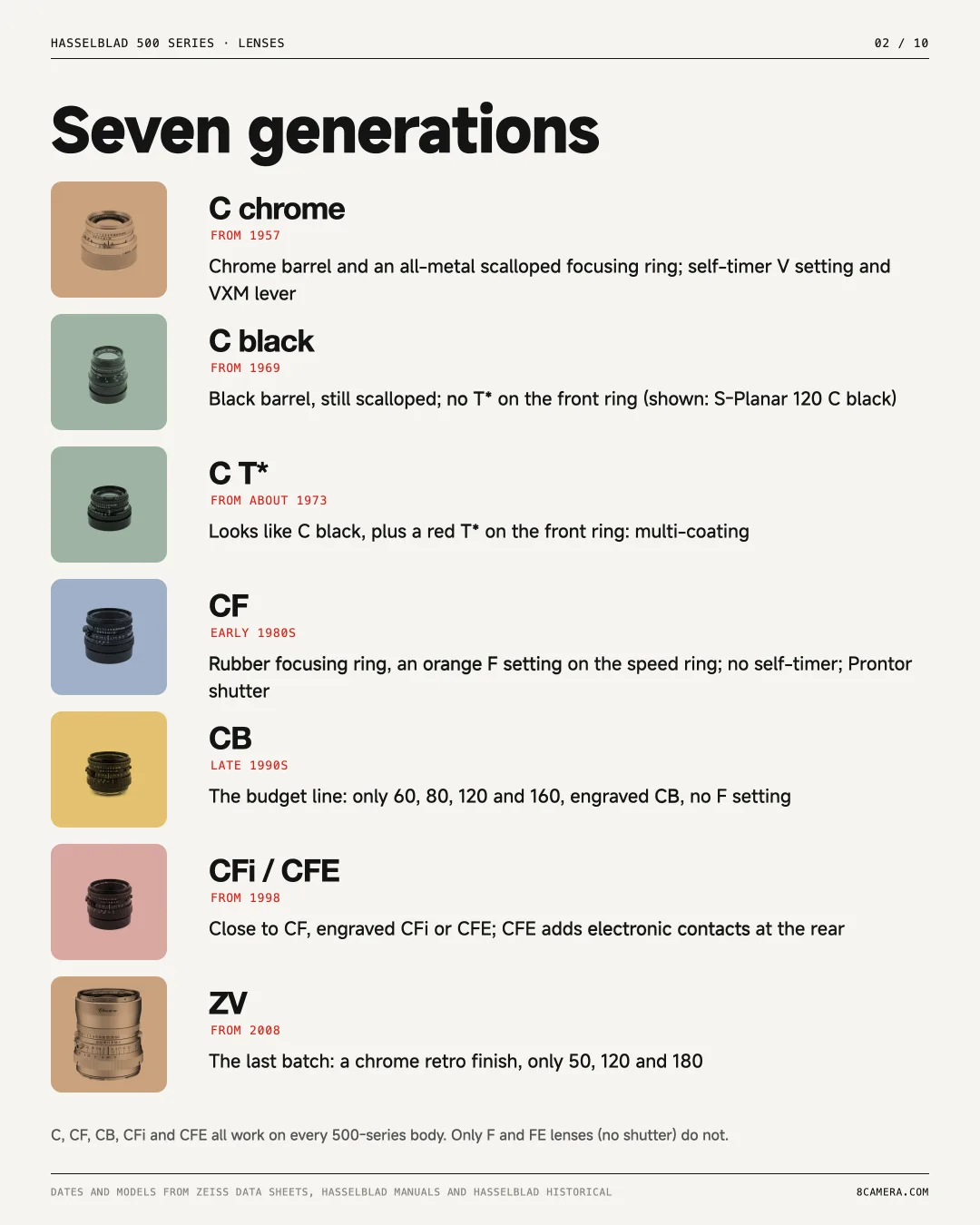
| C | 1957 | Synchro-Compur | All-metal barrel with scalloped focus and speed rings; satin chrome at first, black from 1969 |
| C T\* | around 1973 | Synchro-Compur | Looks like a black C, with a red T\* on the front ring; only the very earliest T\* lenses are chrome |
| CF | early 1980s | Prontor CF | Black, rubber focusing grip, orange F on the speed ring |
| CB | 1996/97 | Prontor CB | Black, engraved CB, no F setting; only four focal lengths |
| CFi | 1998 | Prontor CFi | Close to CF in appearance, engraved CFi |
| CFE | 1998 | Prontor CFE | As CFi, plus a row of electronic contacts on the rear mount |
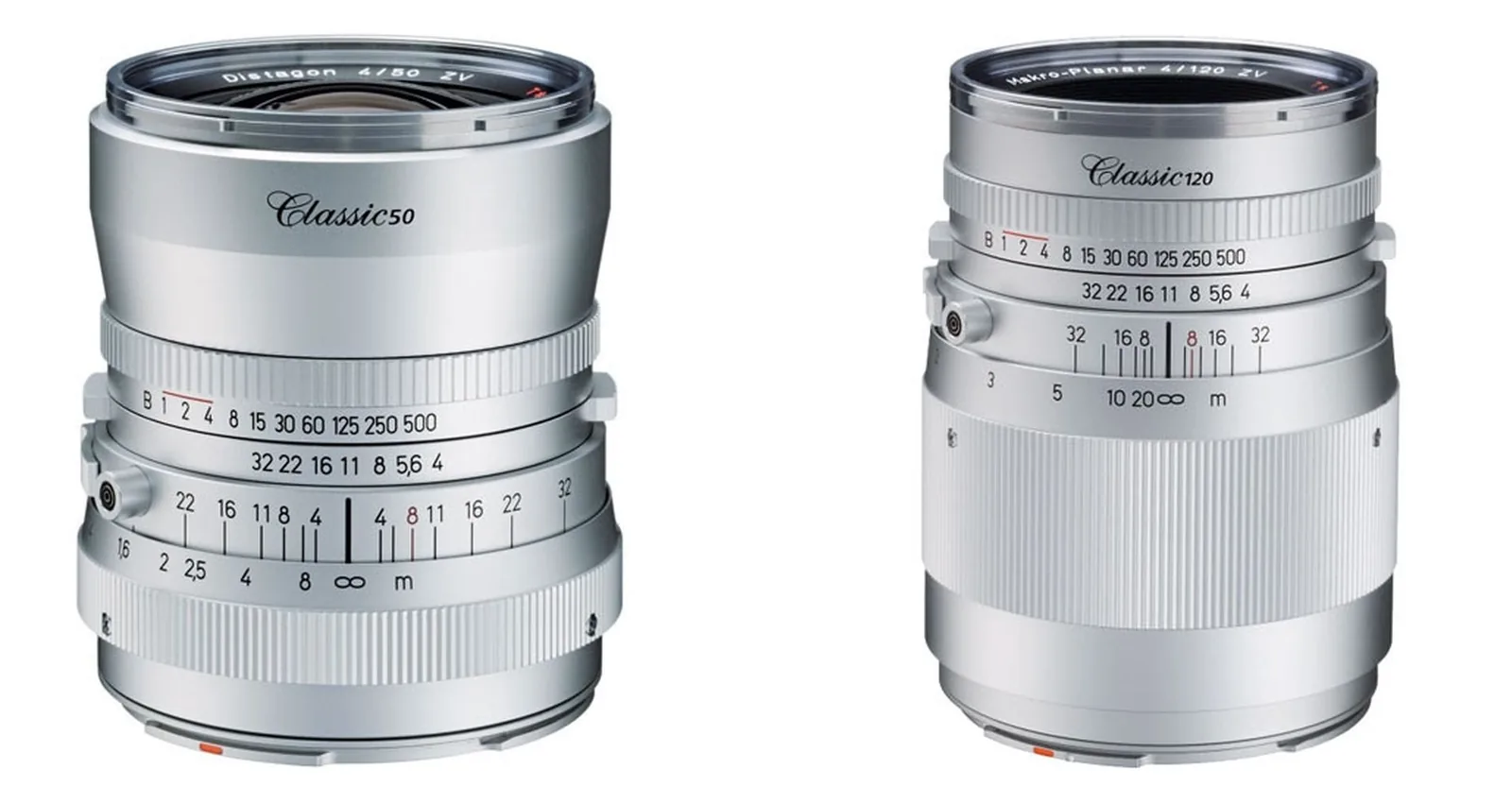
| ZV Classic | 2008 | — | Satin chrome, retro styling; only 50, 120 and 180mm |
On a black lens with scalloped rings, the red T\* on the front ring is what separates C T\* from plain C. On a 40mm or 50mm, a second distance ring at the front means FLE (explained below). Anything engraved F or FE is not a 500 lens.
C vs C T\*: what changed?
Only the coating. The original C lenses have a Synchro-Compur shutter running from 1 second to 1/500 plus B, with flash sync at every speed. They are all-metal, with scalloped rings, and by default the aperture and shutter speed rings are coupled so that you shift both together at a fixed exposure value. They also have two features later lenses dropped: a self-timer (the V setting, about 8–10 seconds according to the 500C manual) and the V-X-M flash lever, which must sit at X for electronic flash.
Barrels went from chrome to black in 1969. Zeiss began adding its T\* multi-coating around 1973, though the 80mm only got it in late 1974. A few lenses never received T\*: the UV-Sonnar 105mm, the Sonnar Superachromat 250mm (Zeiss deliberately left both out) and Schneider's Variogon zoom, which uses Schneider's own coating.
C vs CF: what changed?
From the early 1980s nearly every C lens moved into the new CF barrel. For most focal lengths the optics stayed the same; what changed was the shutter and the handling:
- a Prontor CF shutter in place of the Compur;
- a rubber focusing grip in place of the scalloped metal ring;
- the orange F setting for 200 and 2000-series bodies;
- no self-timer;
- aperture and speed rings no longer coupled by default (you press a button to couple them).
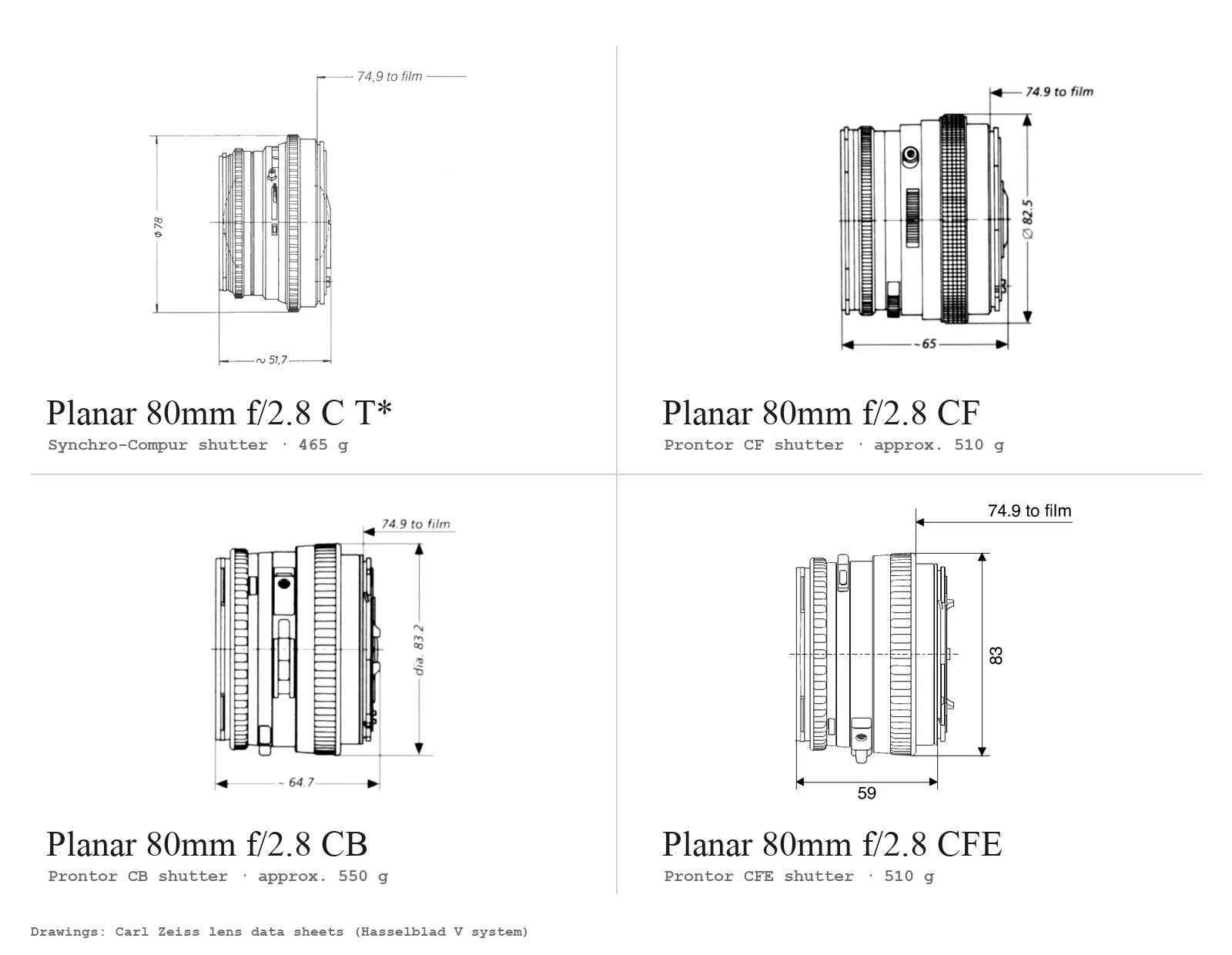
On the 80mm the filter bayonet also went from Series 50 to Series 60. The weight rose a little too: Zeiss lists 465 g for the C T\* 80mm and about 510 g for the CF.
One naming trap: the 80mm sold with the 501C kit from 1994 is called Planar C 2,8/80 in Hasselblad's manual, with no T\* in the name. Despite the C, it is a late lens, not a 1960s one, and it was only supplied with the kit.
CF vs CFi and CFE: what changed?
The CFi and CFE lenses arrived in 1998. Hasselblad's manual lists a PC flash terminal with a safety lock, so the flash lead can no longer pull out mid-shoot. Specialist dealers add a Nivarox mainspring in the shutter, a new focusing helicoid, improved internal anti-reflection treatment and a non-metal front filter ring that does not wear through its paint.
The only difference between CFi and CFE is the "E": a set of electronic contacts. Zeiss's own data sheet for the 80mm CFE says the electronics are there to communicate with Hasselblad cameras with built-in exposure metering. The 500 bodies are mechanical and have no such meter, so on a 500 a CFE behaves like a CFi.
In that era Hasselblad generally made each focal length as either a CFi or a CFE, not both. The 50mm and 100mm came as CFi, the 40mm and 80mm as CFE; the 120mm and 180mm exist in both. After 1998, the 80mm was offered only as a CFE or a CB.
What is a CB lens?
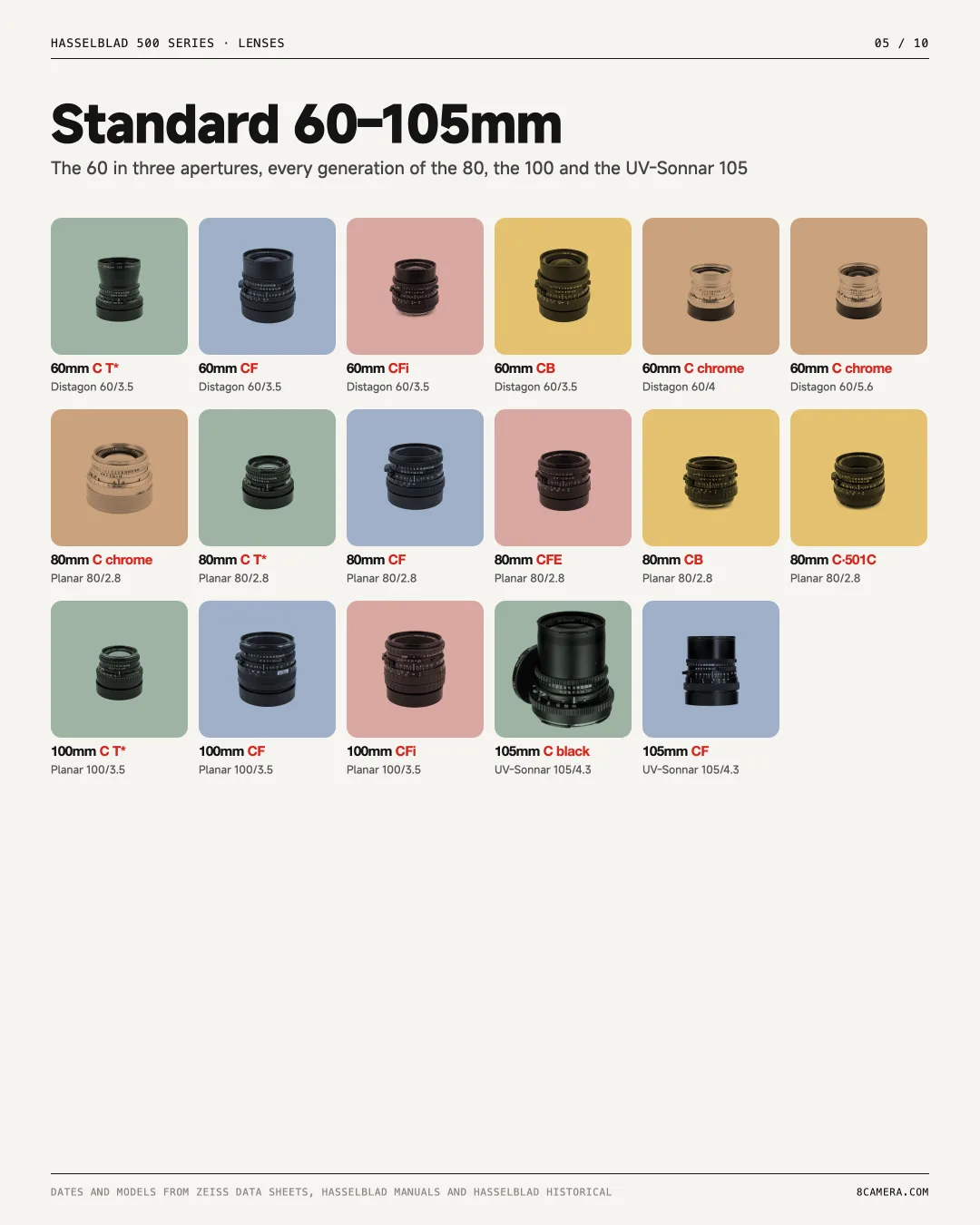
CB was Hasselblad's "basic" line from 1996/97, made in just four focal lengths: the Distagon 60mm f/3.5, Planar 80mm f/2.8, Makro-Planar 120mm f/4 and Tessar 160mm f/4.8. CB lenses have no F setting, which makes no difference on a 500.
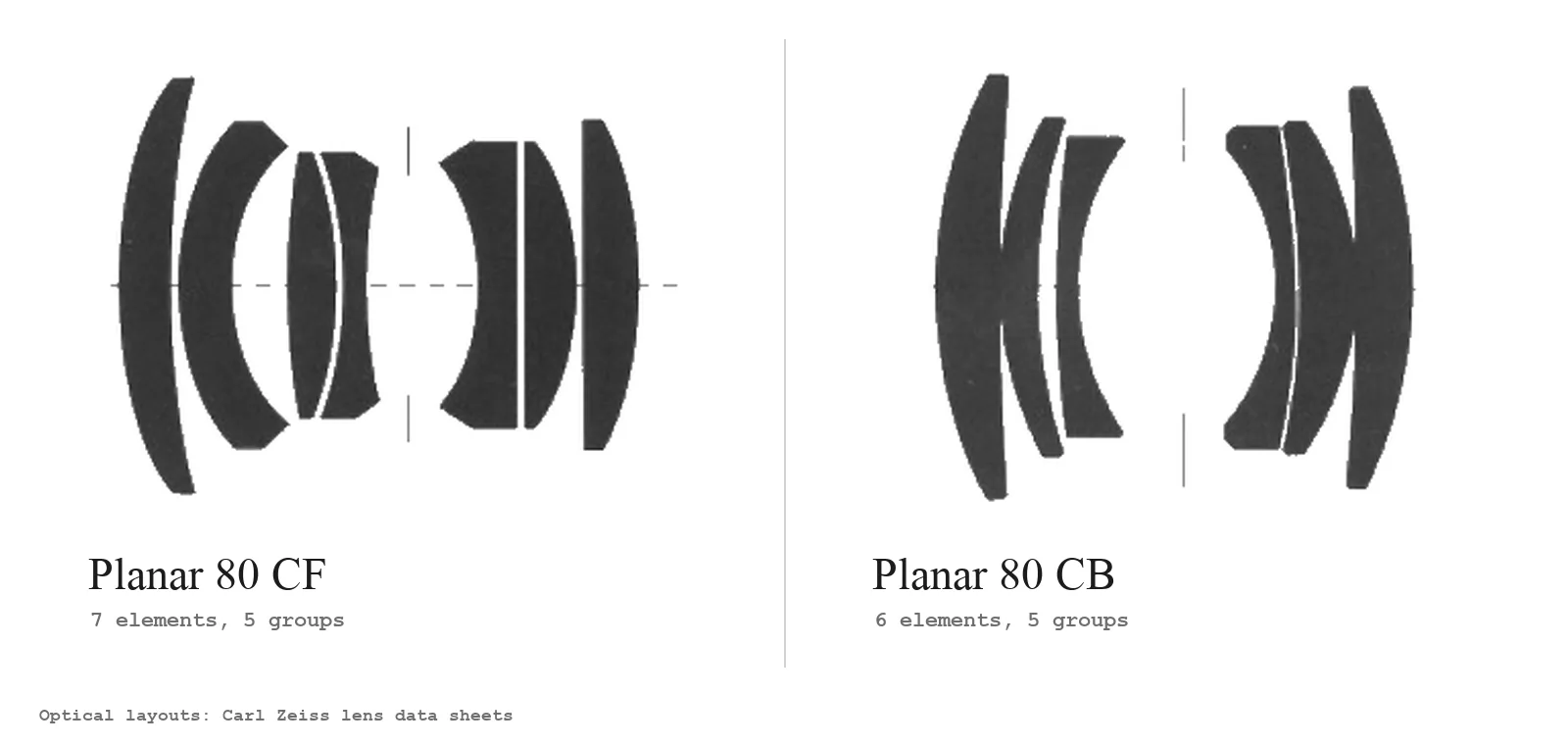
The CB 80mm is not a CF in a cheaper barrel. Zeiss redesigned it with six elements instead of seven, and its data sheet says it reduced scattered light, made the scales easier to read and stiffened the mount compared with the CF. It weighs about 550 g.
What does FLE mean on a Hasselblad lens?
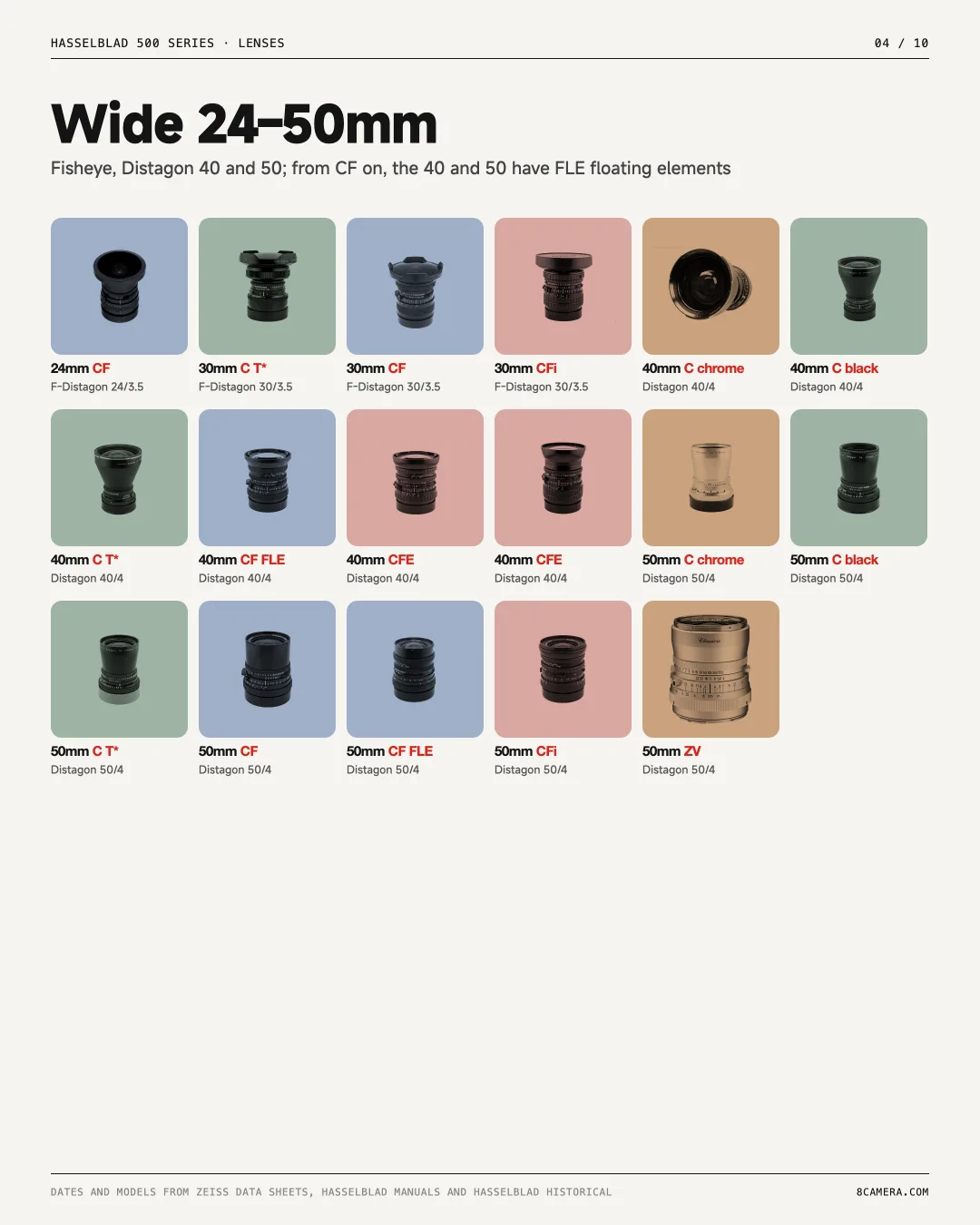
FLE stands for Floating Lens Element. Only two wide-angles have it: the Distagon 40mm f/4 and the Distagon 50mm f/4, in their CF, CFi or CFE versions. You get a second distance ring at the front: set it roughly to your subject distance (three zones on the 40mm, four on the 50mm), then focus as normal. It keeps close-range performance up on these wide designs. The last 40mm, the CFE IF, focuses internally and adjusts the floating group automatically, so it has no FLE ring.
Every Hasselblad V lens for the 500 series
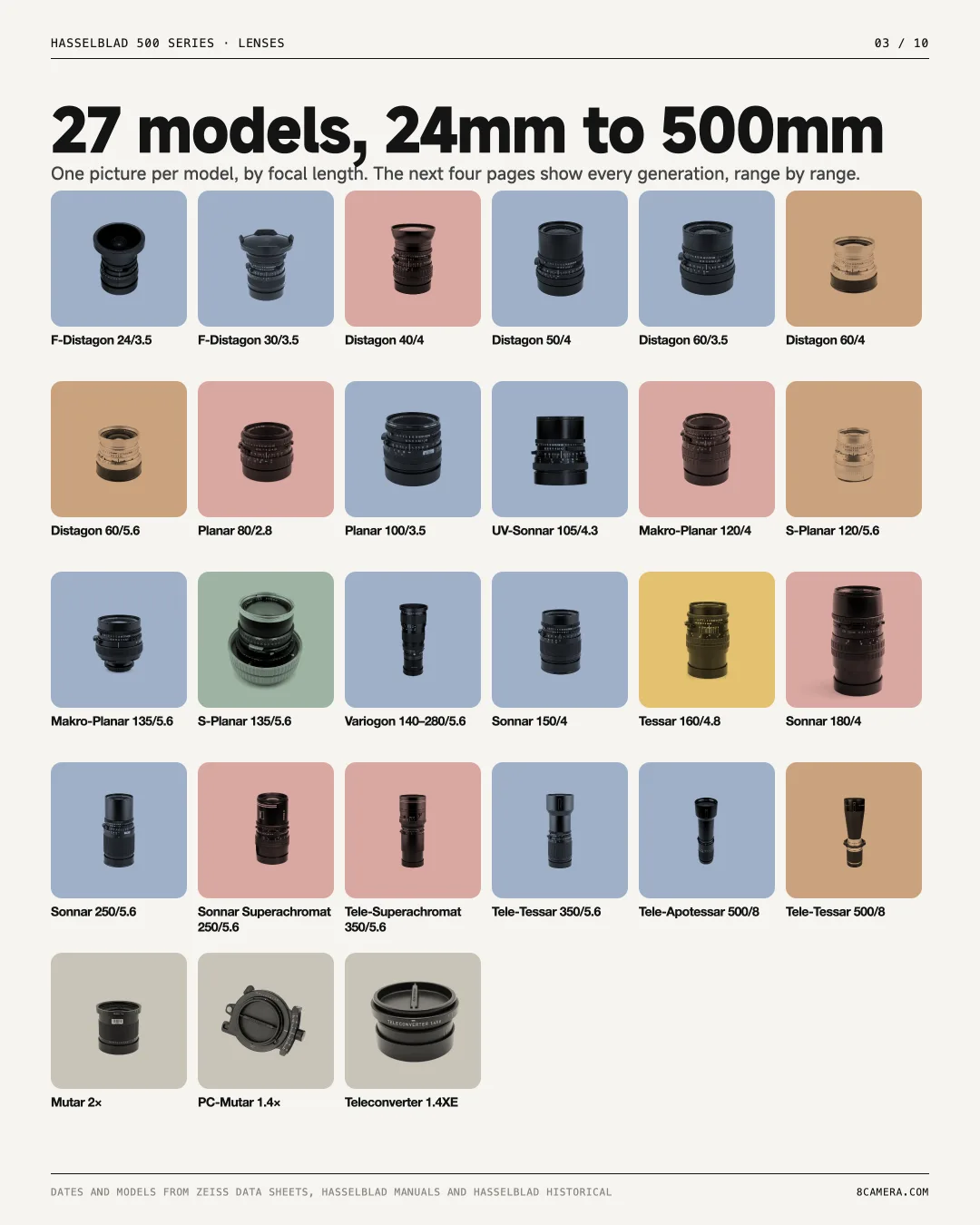
This is the range of shutter lenses that fit 500 bodies, listed by focal length. Generations are the versions confirmed by Zeiss data sheets, Hasselblad manuals or the Hasselblad Historical lens list.
| Focal length | Lens | Generations | Notes |
|---|---|---|---|
| 30mm | F-Distagon f/3.5 (fisheye) | C T\*, CF, CFi | Launched in 1973 already T\*-coated, so no chrome version; built-in filters, and one must always be fitted |
| 40mm | Distagon f/4 | C (chrome and black), C T\*, CF FLE, CFE FLE, CFE IF | Early C is a large lens with a 104mm front |
| 50mm | Distagon f/4 | C (chrome and black), C T\*, CF, CF FLE, CFi FLE, ZV | CFi has a 70mm front and came with a 70–60 adapter ring |
| 60mm | Distagon f/5.6 | C (chrome) | |
| 60mm | Distagon f/4 | C (chrome) | |
| 60mm | Distagon f/3.5 | C T\*, CF, CB, CFi | Zeiss said it outperformed the f/4 in quality and speed |
| 80mm | Planar f/2.8 | C (chrome), C T\*, CF, Planar C (501C kit), CB, CFE | The standard lens |
| 100mm | Planar f/3.5 | C T\*, CF, CFi | Very low distortion |
| 105mm | UV-Sonnar f/4.3 | C (black), CF | Ultraviolet photography; never T\*; rare |
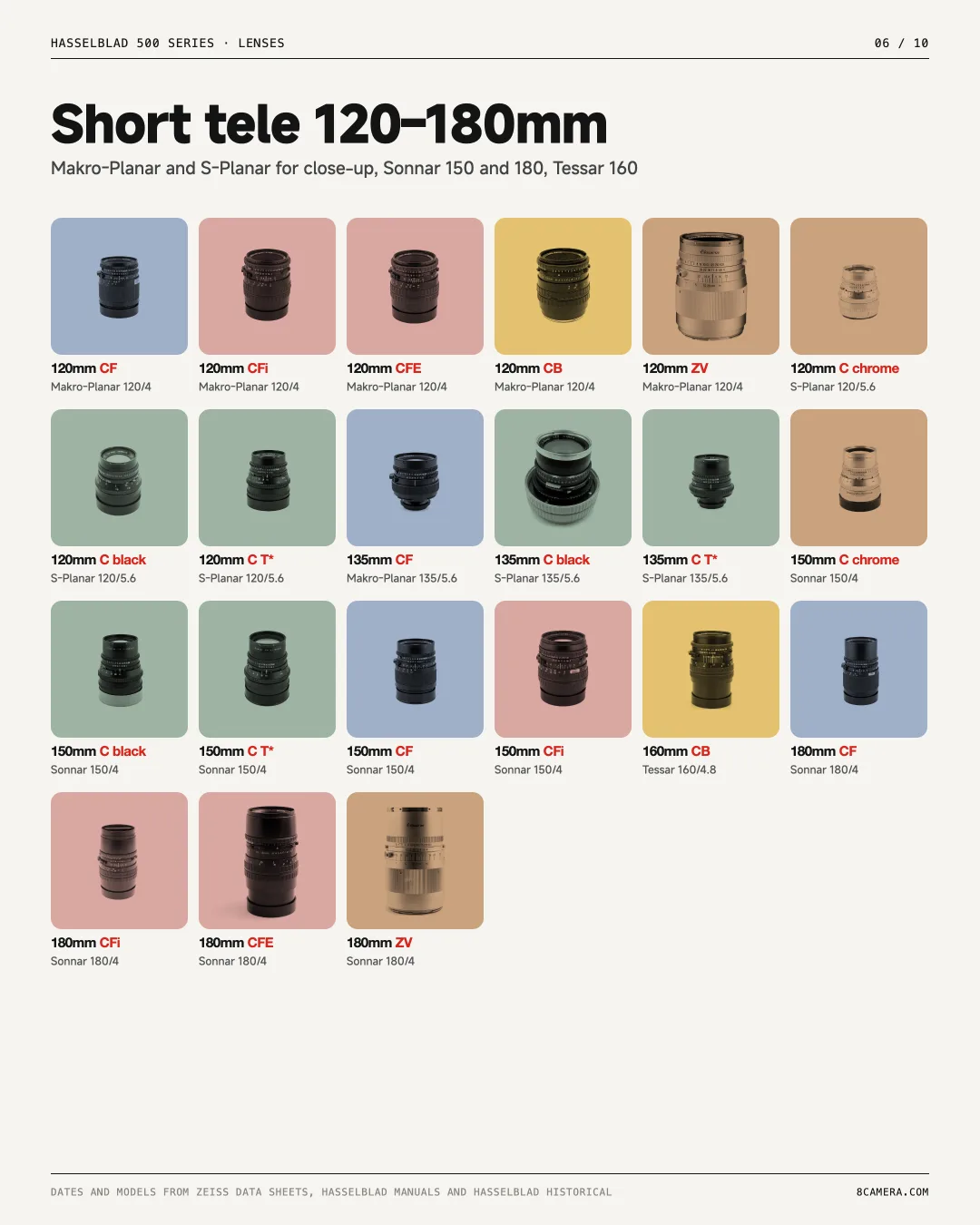
| 120mm | S-Planar f/5.6 | C (chrome and black), C T\* | Close-up and copy work |
| 120mm | Makro-Planar f/4 | CF, CB, CFi, CFE, ZV | Replaced the S-Planar |
| 135mm | S-Planar f/5.6 | C T\* | Bellows only, no focusing helicoid |
| 135mm | Makro-Planar f/5.6 | CF | Bellows or variable extension tube only |
| 150mm | Sonnar f/4 | C (chrome and black), C T\*, CF, CFi | The classic portrait lens |
| 160mm | Tessar f/4.8 | CB | CB only |
| 180mm | Sonnar f/4 | CF, CFi, CFE, ZV | New in the CF era; no C version |
| 250mm | Sonnar f/5.6 | C (chrome and black), C T\*, CF, CFi | |
| 250mm | Sonnar Superachromat f/5.6 | C, CF, CFE | Corrected from 400 to 1000nm, so no refocusing for infrared; rare |
| 350mm | Tele-Tessar f/5.6 | C T\*, CF | Launched in 1973 already T\*-coated |
| 350mm | Tele-Superachromat f/5.6 | CFE | Internal focusing; replaced the Tele-Tessar |
| 500mm | Tele-Tessar f/8 | C (black), C T\* | The longest shutter lens in the system |
| 500mm | Tele-Apotessar f/8 | CF | Apochromatic, with tripod mount; never made as CFi |
| 140–280mm | Schneider Variogon f/5.6 | C, CF | The first production zoom for 6×6 |
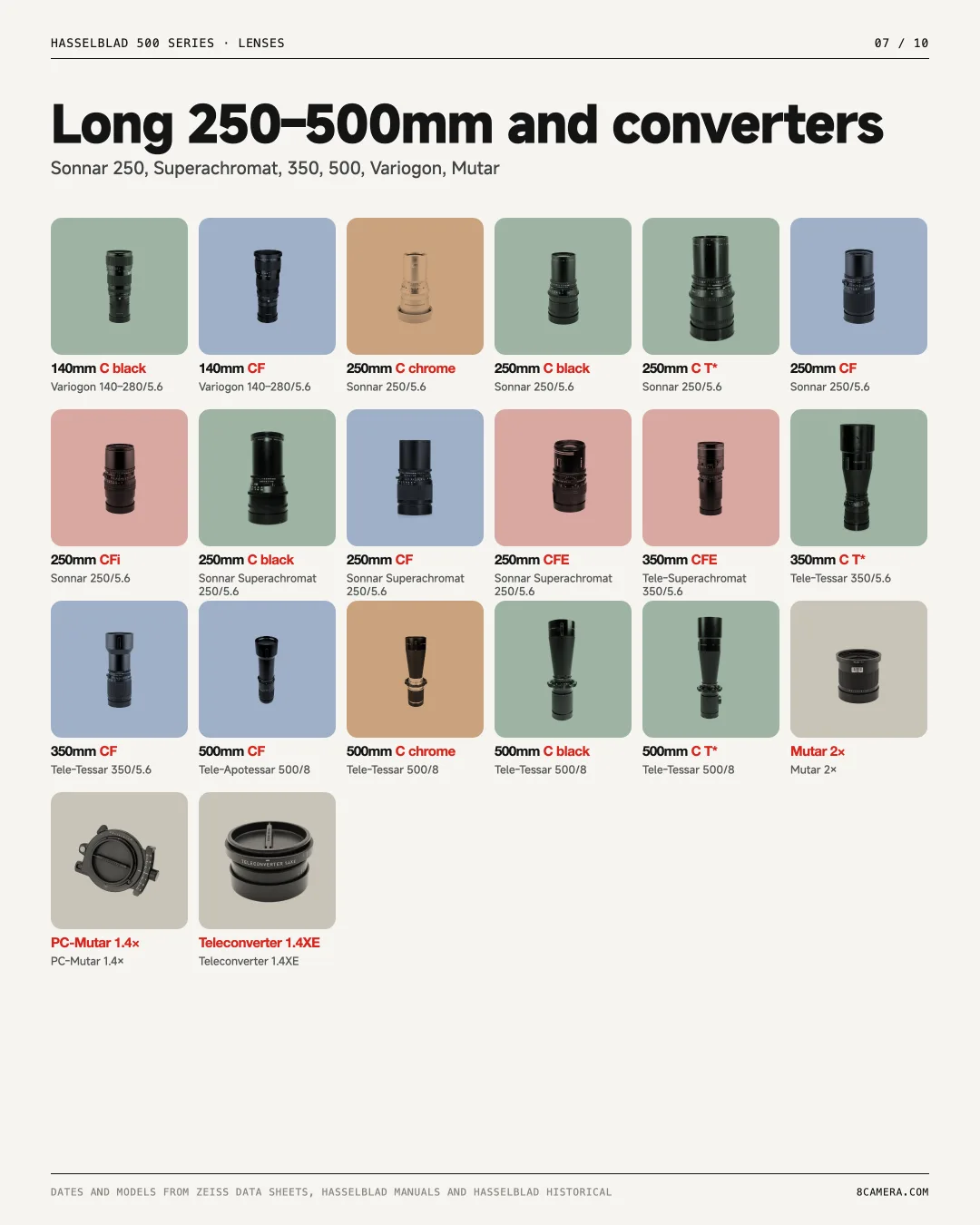
Three converters also fit. The Mutar 2× doubles focal length at a cost of two stops. The PC-Mutar 1.4× shifts as well: it was optimised for the 40mm CF FLE, shifts with lenses up to 80mm and works as a plain converter up to 100mm. The Teleconverter 1.4XE costs one stop, and Hasselblad says it fits every Hasselblad SLR body but is for 100–500mm lenses only (not the 135mm Makro-Planar).
Which Hasselblad lens should I buy first?
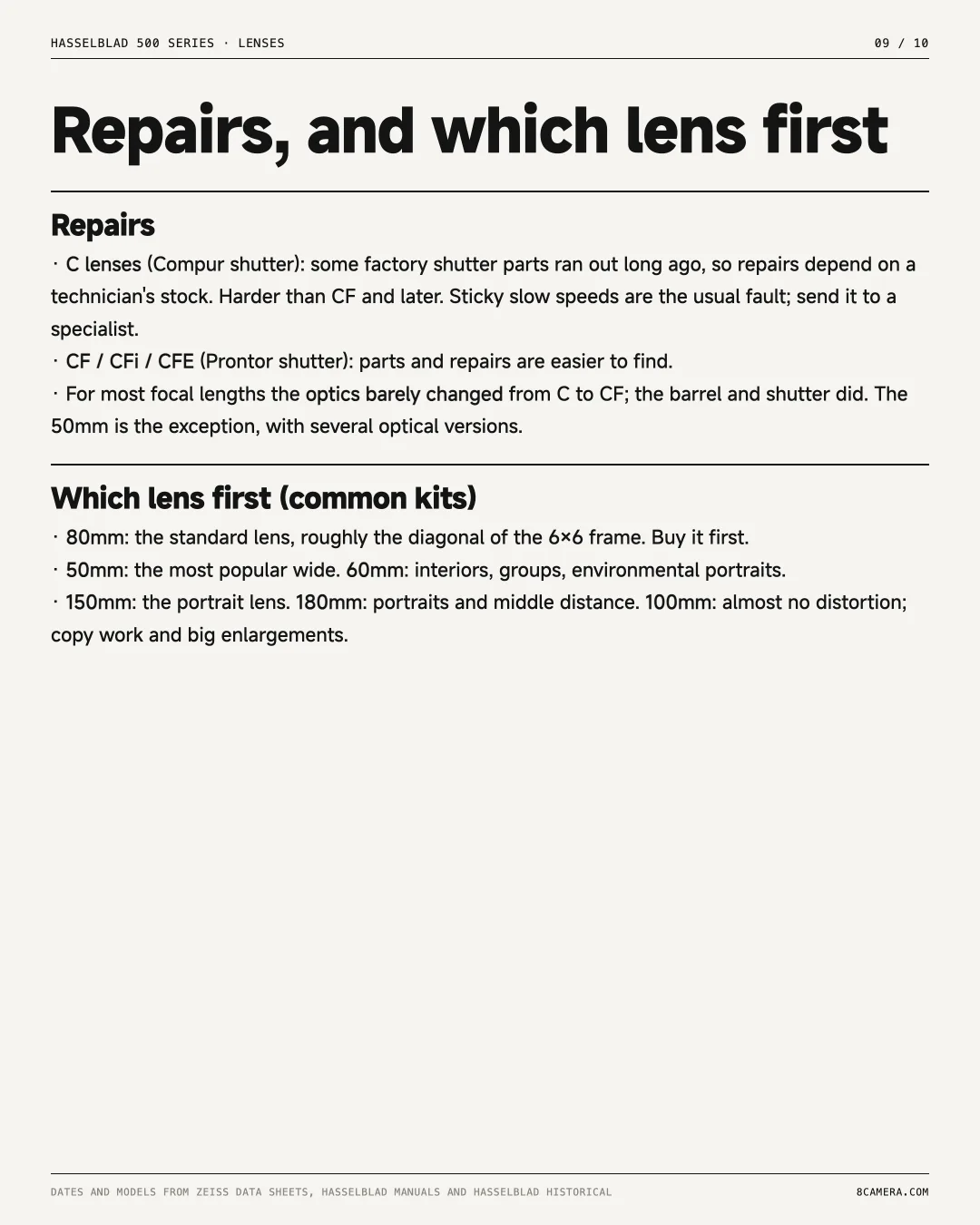
The 80mm Planar is the natural first lens. Zeiss's data sheets point out that its focal length is about the diagonal of the 6×6 frame, which gives a perspective close to normal vision, and it was the standard lens supplied with the cameras from the 500C onwards. If you want a second lens, the usual choices are:
- 50mm Distagon: the most popular wide-angle in the Hasselblad line.
- 60mm Distagon: interiors, groups and environmental portraits. Zeiss's CB 60mm data sheet recommends it for groups indoors and weddings.
- 100mm Planar: exceptionally low distortion, which suits copying, measurement work and big enlargements.
- 150mm Sonnar: the classic portrait lens.
- 180mm Sonnar: portraits and mid-distance nature.
Which generation should you buy? We would usually point people to CF or later. Original C lenses are lovely, but their Compur shutters tend to stick at slow speeds, and some Compur shutter parts are long out of production at Hasselblad, so repairs depend on what a technician has in stock. They can still be serviced, just less easily than the Prontor-shuttered lenses. Between CFi and CFE, buy whichever copy is in better condition, because on a 500 they behave the same.
If you plan to use 150mm or longer, the body matters too: the 501CM and 503CW have a gliding mirror that removes the viewfinder cut-off with lenses longer than 100mm. The 500 series guide explains which bodies have it.
What should I check before buying a Hasselblad lens?
On the bench we check generation first, then the shutter, then the glass.
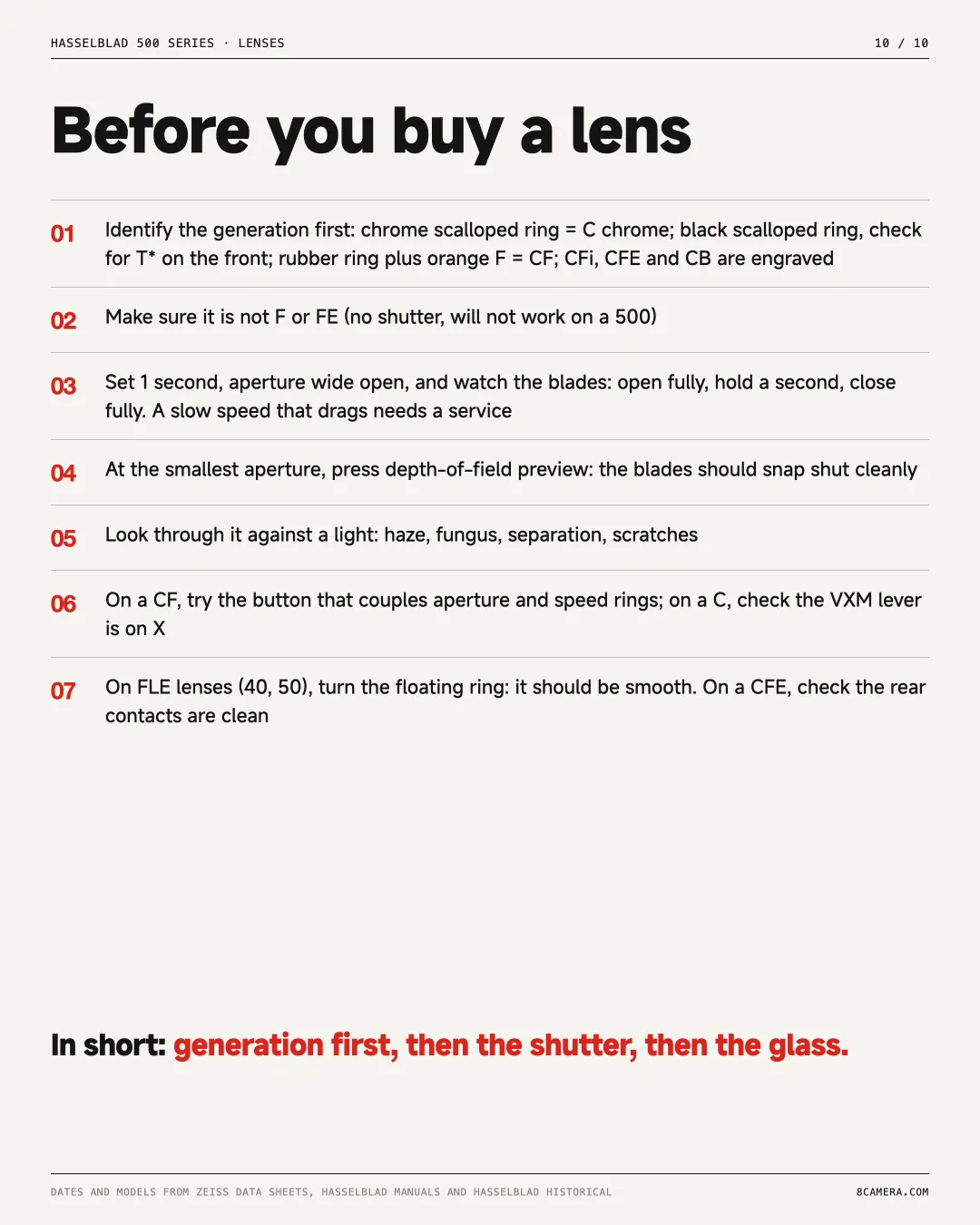
- Identify the generation from the engraving and rings, and make sure it is not an F or FE lens.
- Test the shutter at 1 second, aperture wide open. Look through the lens as you fire it. The blades should snap fully open, hold for a second and close completely. If the slow speeds drag, the shutter needs cleaning.
- Check the aperture. Set the smallest aperture and press the depth-of-field preview: the blades should close down to size in one clean movement.
- Look through the glass against a bright light for haze, fungus, separation between cemented elements and scratches.
- Check the controls. On a CF, try the button that couples the aperture and speed rings. On a C lens, make sure the V-X-M lever moves and sits at X for electronic flash.
- Check flash sync if you use flash. Every 500-series lens syncs at all speeds up to 1/500 through its PC socket. On CFi and CFE lenses the socket has a locking collar; make sure it holds the lead.
- On FLE lenses, turn the floating-element ring through its range. It should move smoothly.
- On CFE lenses, make sure the rear contacts are clean.
Remember too that a lens only comes off a wound body. If a lens will not release, wind the camera rather than forcing the bayonet.
Buying or servicing a Hasselblad lens
Most V-system lenses are now decades old, and the shutter usually decides whether a good-looking lens is also a reliable one. As an official Hasselblad service partner, the checks above are where we start with every V-system lens. You can browse the lenses and bodies we have in our Hasselblad collection and lens collection, read the Hasselblad 500 series guide for bodies, backs and finders, or see Hasselblad repair and servicing if your lens needs attention.