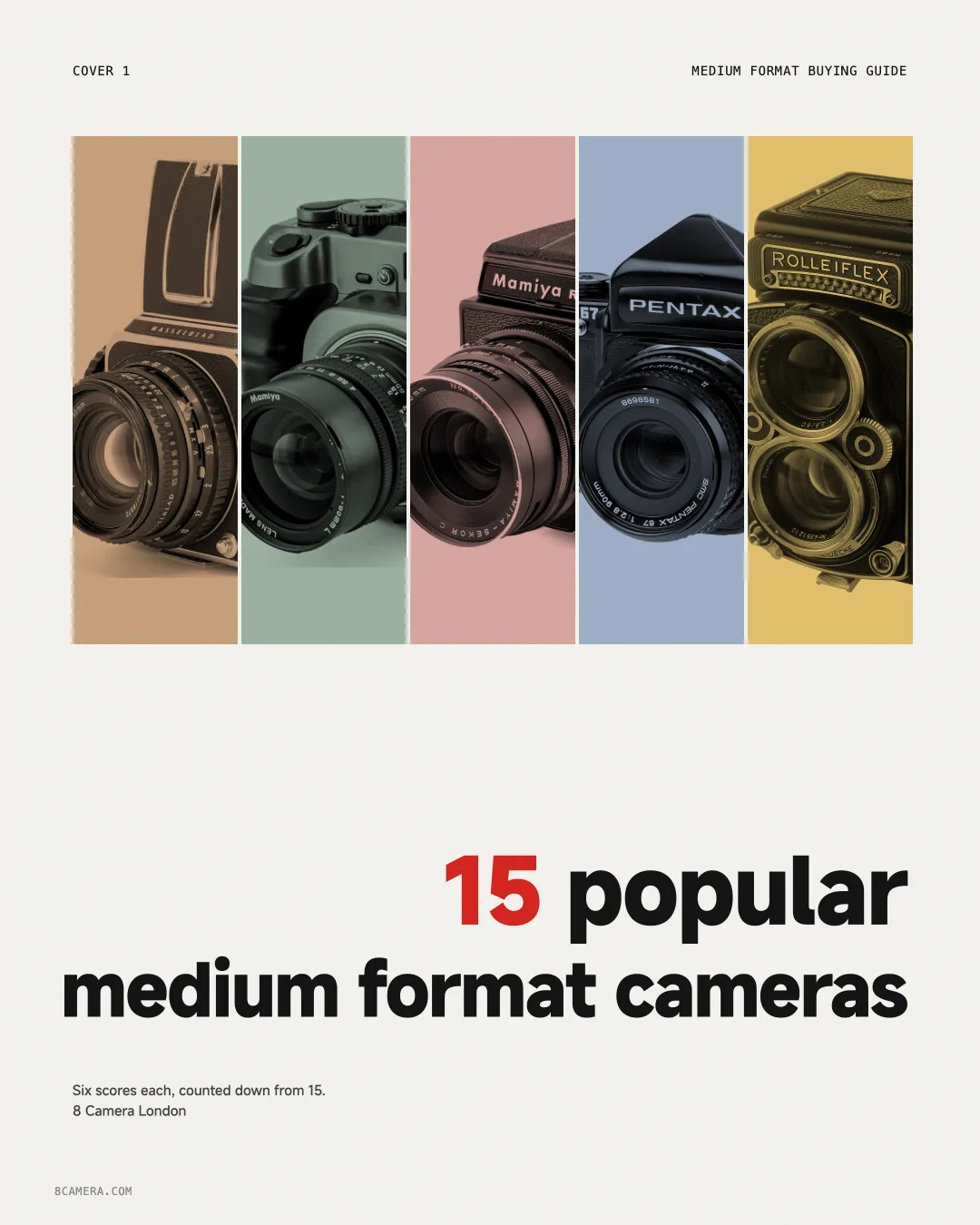
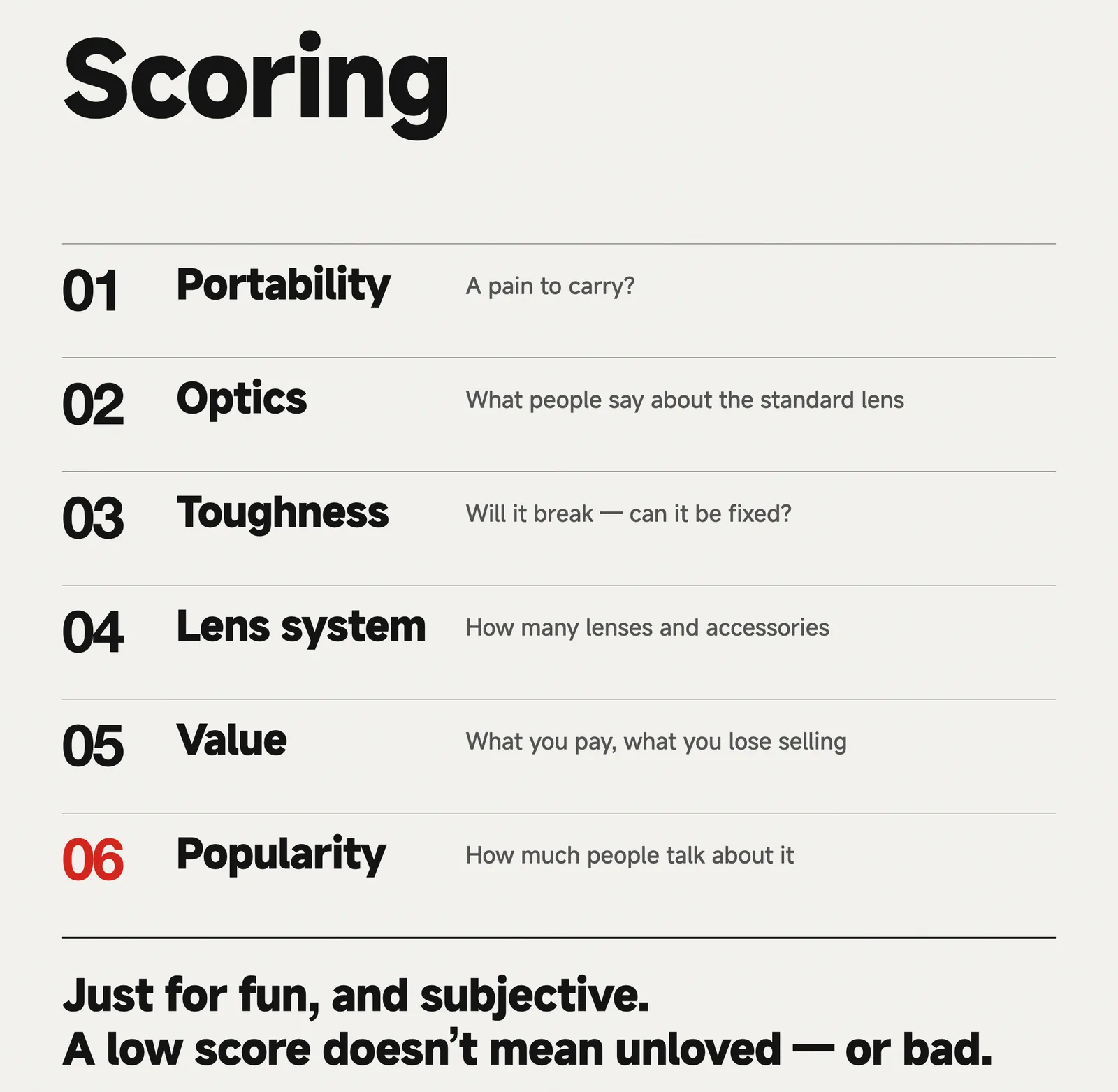
"Which medium format camera should I buy?" is the question we hear more than any other. The honest answer depends on how you shoot, so rather than name one winner we took the fifteen cameras people ask about most and scored each on five things: portability, optics, reliability and ease of repair, the system around it (lenses, backs, finders) and value. We then gave popularity extra weight, because a camera that many people own is also one that many people know how to fix.
The scores are ours and they are subjective. A camera near the bottom can still be the right camera for you, and several of them have devoted followings. What the ranking does show is the trade-off each one asks you to accept.
The ranking at a glance
| Rank | Camera | Format | Type | Needs a battery? | Score /5 |
|---|---|---|---|---|---|
| 1 | Hasselblad 500C/M | 6×6 | SLR | No | 4.8 |
| 2 | Mamiya RB67 | 6×7 | SLR | No | 4.5 |
| 3 | Mamiya 7 II | 6×7 | Rangefinder | Yes | 4.3 |
| 4 | Rolleiflex 2.8F | 6×6 | TLR | No (meter only) | 4.2 |
| 5 | Mamiya 645 Pro TL | 645 | SLR | Yes | 4.2 |
| 6 | Pentax 67 | 6×7 | SLR | Yes | 4.1 |
| 7 | Mamiya RZ67 | 6×7 | SLR | Yes, with a mechanical backup speed | 4.1 |
| 8 | Fujifilm GW690 III | 6×9 | Rangefinder | No | 4.0 |
| 9 | Mamiya C330 | 6×6 | TLR | No | 4.0 |
| 10 | Bronica SQ-A | 6×6 | SLR | Yes, with a mechanical backup speed | 4.0 |
| 11 | Contax 645 | 645 | Autofocus SLR | Yes | 3.8 |
| 12 | Yashica Mat-124G | 6×6 | TLR | Meter only | 3.8 |
| 13 | Minolta Autocord | 6×6 | TLR | No | 3.7 |
| 14 | Fujifilm GA645 | 645 | Autofocus rangefinder | Yes | 3.6 |
| 15 | Plaubel Makina 67 | 6×7 | Folding rangefinder | Meter only | 3.4 |
The battery column matters more than it looks. A fully mechanical camera can usually be serviced by any competent technician for decades. A camera that depends on electronics is only as long-lived as its circuit boards and the spare parts behind them, which is why several optically superb cameras sit lower than you might expect.
Numbers 15 to 11: brilliant, with a catch
15. Plaubel Makina 67
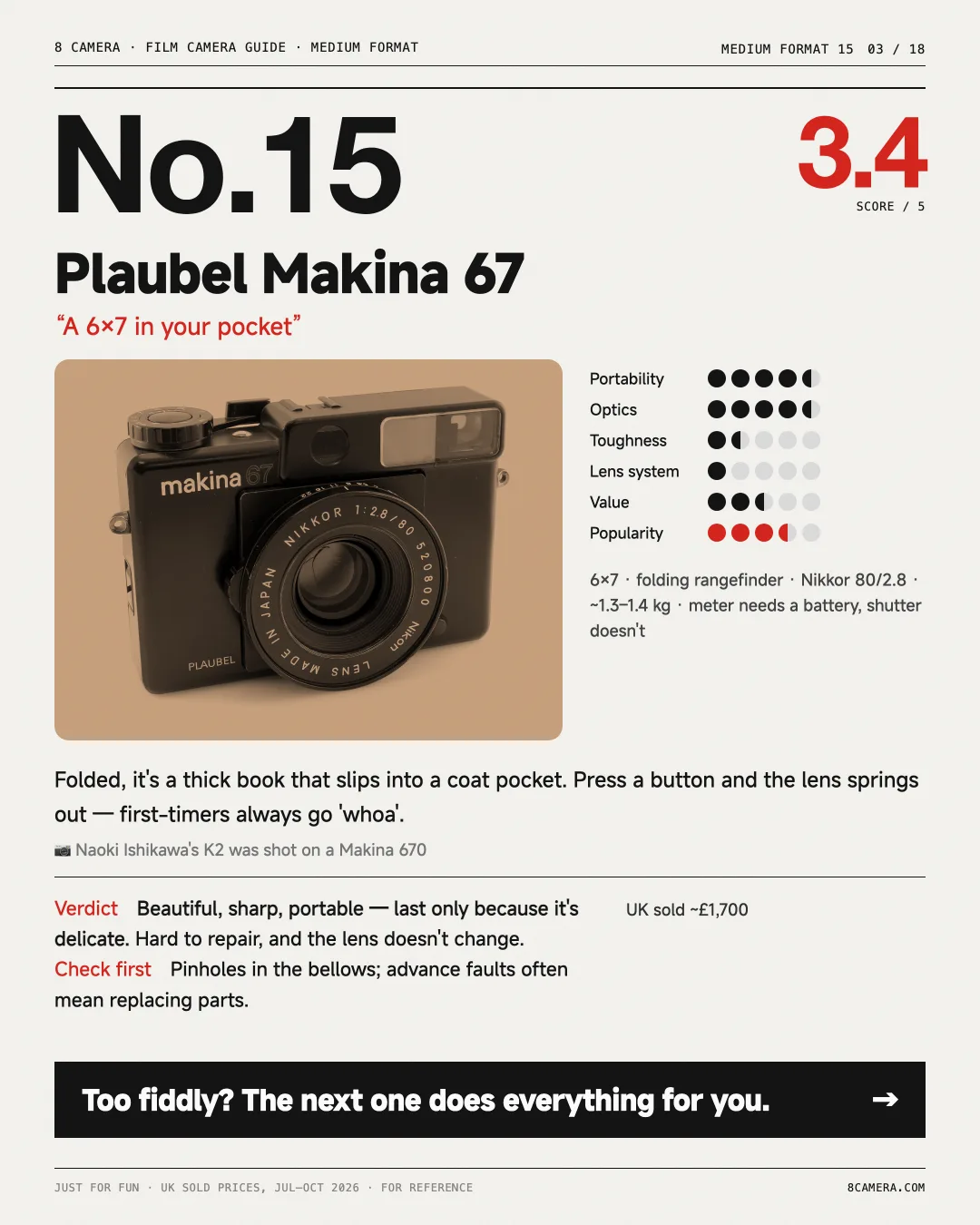
Folded, it is the size of a thick book and goes into a coat pocket; press the button and the lens springs out on its bellows. A 6×7 negative from something this compact is still remarkable, and the fixed Nikkor 80mm f/2.8 is very sharp. Martin Parr turned to a Makina for The Last Resort. It ranks last only because it is delicate. The advance mechanism is its weak point, faults there usually mean replacing parts rather than repairing them, and those parts are hard to find. The shutter is mechanical; only the meter needs a battery.
Check: pinholes in the bellows, a smooth advance, and a working meter. Set focus to infinity before you fold it.
14. Fujifilm GA645
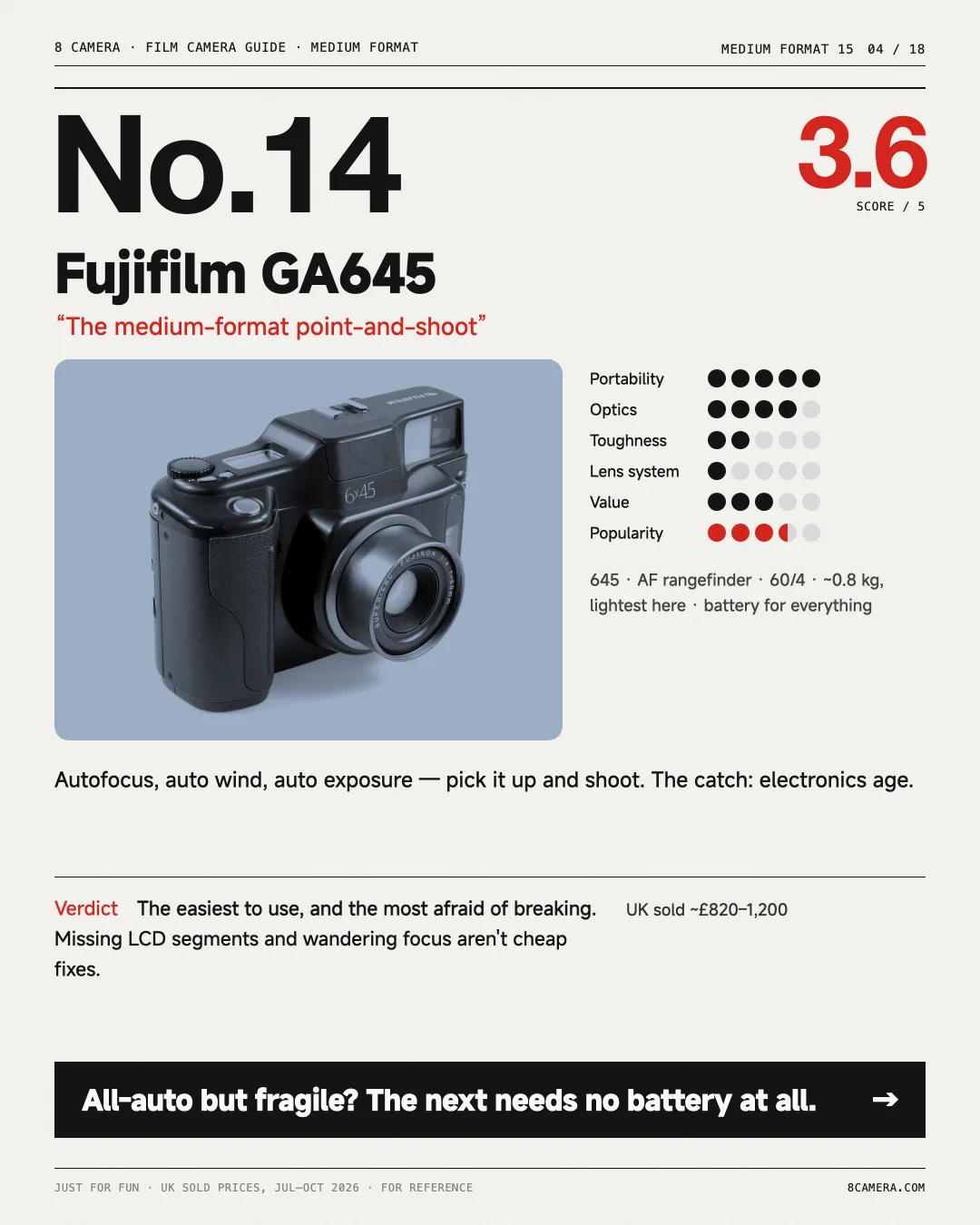
The medium format point-and-shoot: autofocus, automatic film advance and automatic exposure, at around 0.8 kg, the lightest camera here. Everything runs on two CR123A batteries, and that is the catch. Electronics age, and missing segments on the top LCD and wandering focus are the familiar faults. There are also wide (GA645W) and zoom (GA645Zi) versions, each with its own fixed lens.
Check: every LCD segment, cracks in the grip, and quiet, consistent focusing.
13. Minolta Autocord
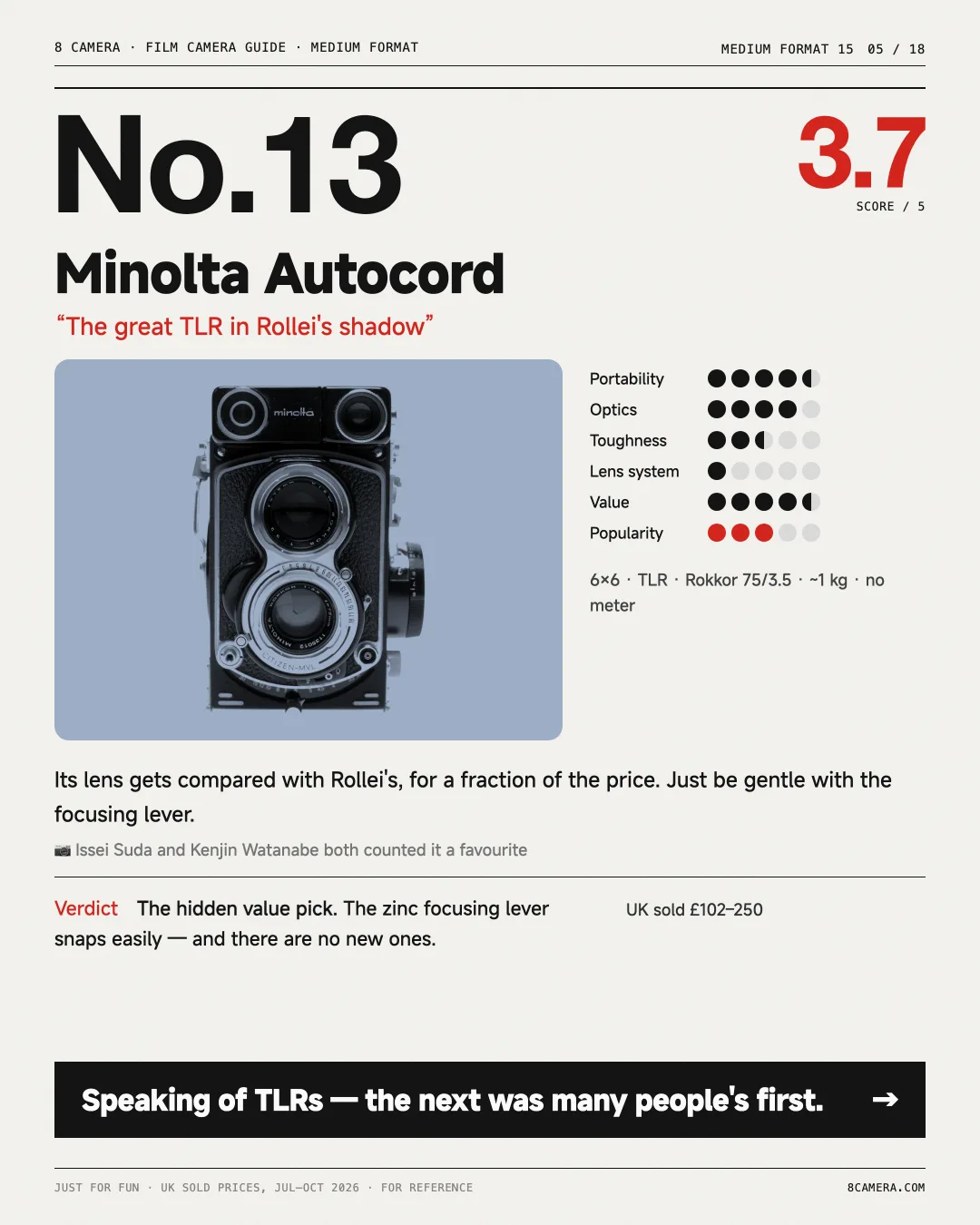
The TLR that has always stood in Rolleiflex's shadow. Its Rokkor 75mm f/3.5 is often compared with the Rollei lenses, and Issei Suda and Kenjin Watanabe both counted it as a favourite camera. It is fully mechanical and light at about 1 kg. Its one real weakness is the focusing lever, which is made of zinc alloy, snaps if forced, and has no new replacements.
Check: be gentle with the focusing lever, and never force the crank when the shutter is locked.
12. Yashica Mat-124G
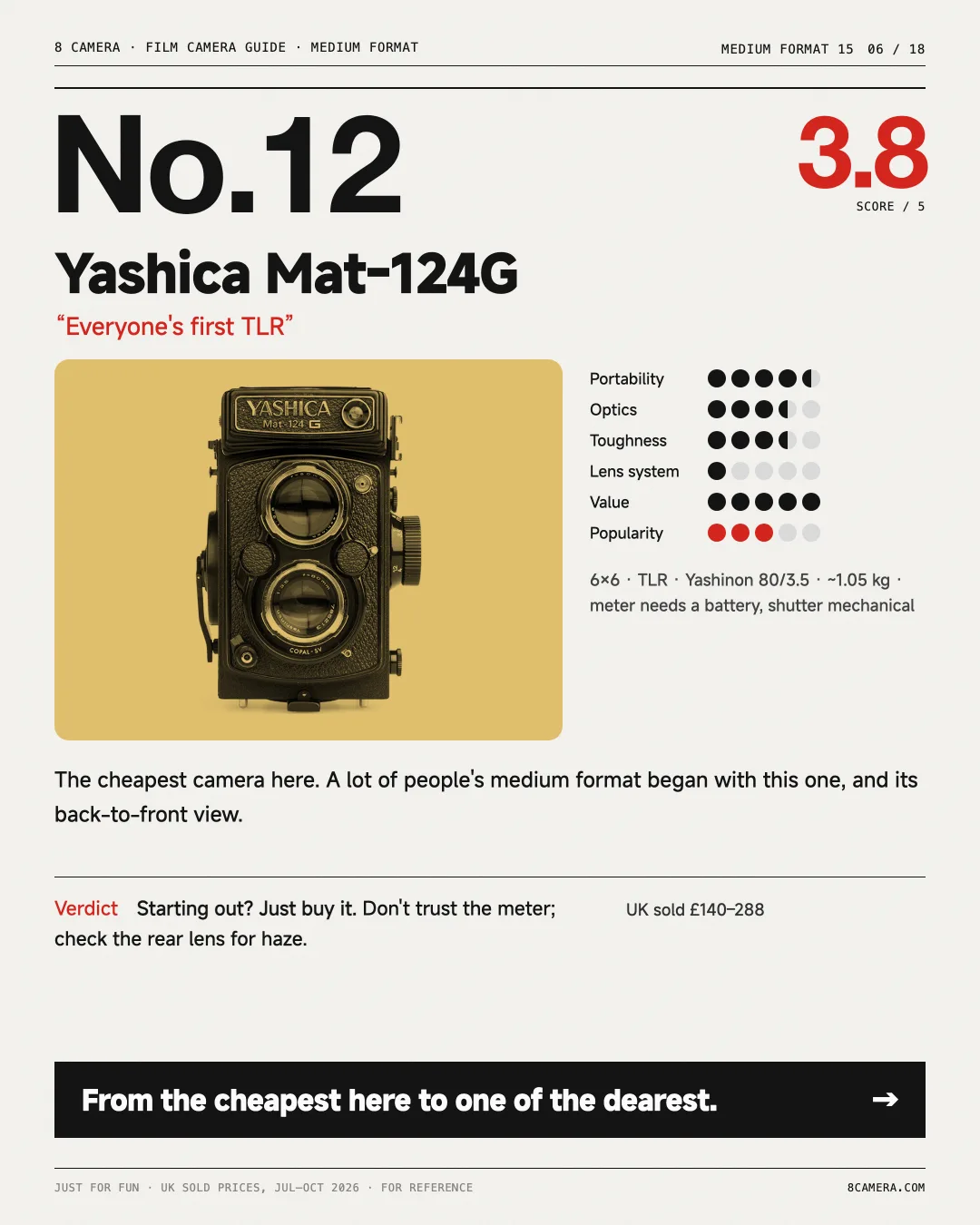
For a great many people this is where medium format began, with that first look into a reversed, square waist-level image. It is light for a TLR at about 1.05 kg, the Yashinon 80mm f/3.5 is sharp stopped down to f/8, and the shutter is mechanical. Later examples use more plastic inside, and the advance is the weakest part. A dead meter is common, often from a corroded battery compartment.
Check: haze on the rear element of the taking lens, and don't rely on the meter.
11. Contax 645
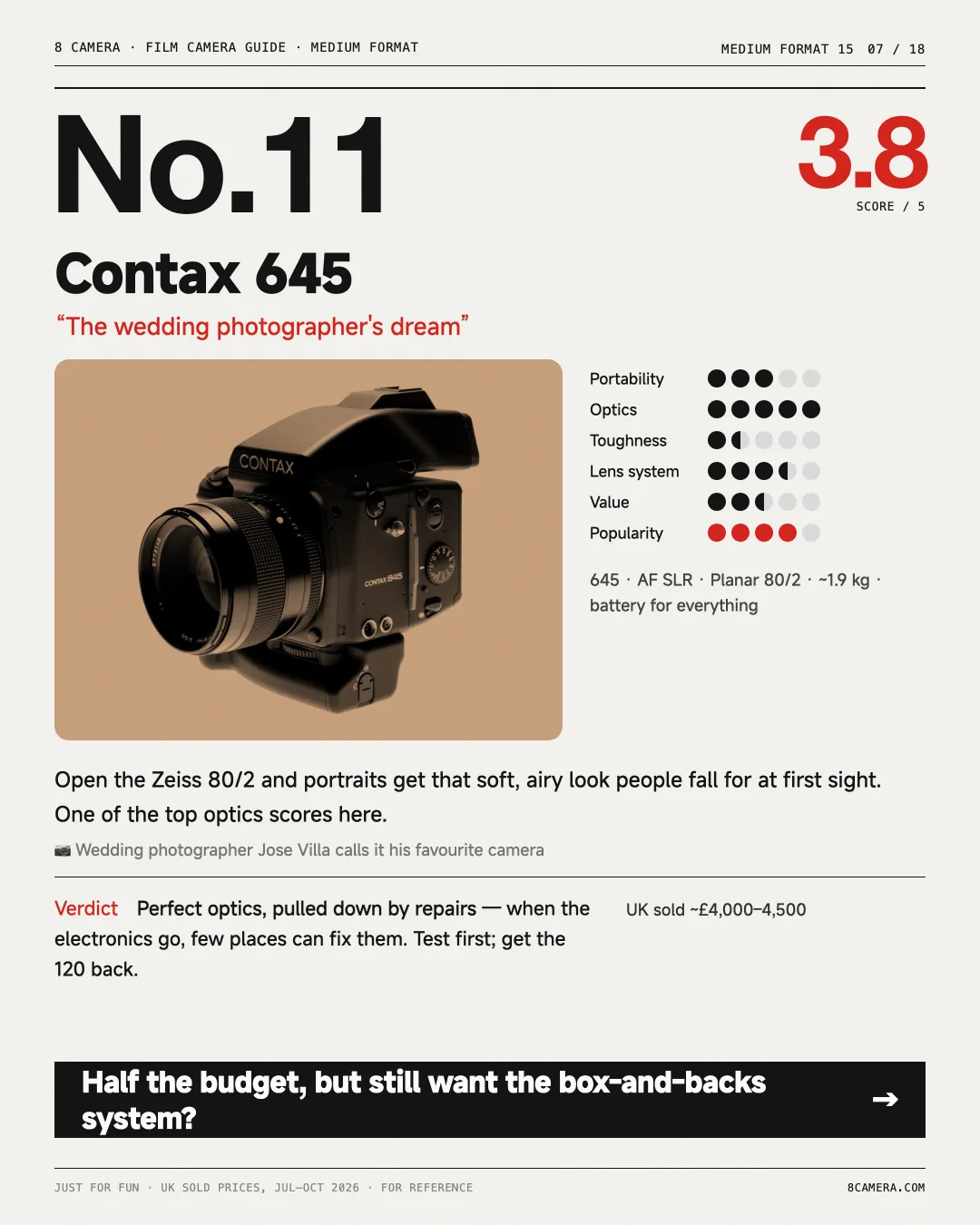
Open the Zeiss Planar 80mm f/2 and you get the soft, airy portraits that made this a wedding photographer's favourite; Jose Villa has called it his favourite camera. On optics it is among the very best here. It drops down the table because it is electronic from end to end: Kyocera stopped making it in 2005, the official repair service closed in 2015, and few workshops can fix the electronics now.
Check: test everything before you buy, and choose the 120 back, since 220 film is no longer made.
Numbers 10 to 6: the workhorses
10. Bronica SQ-A
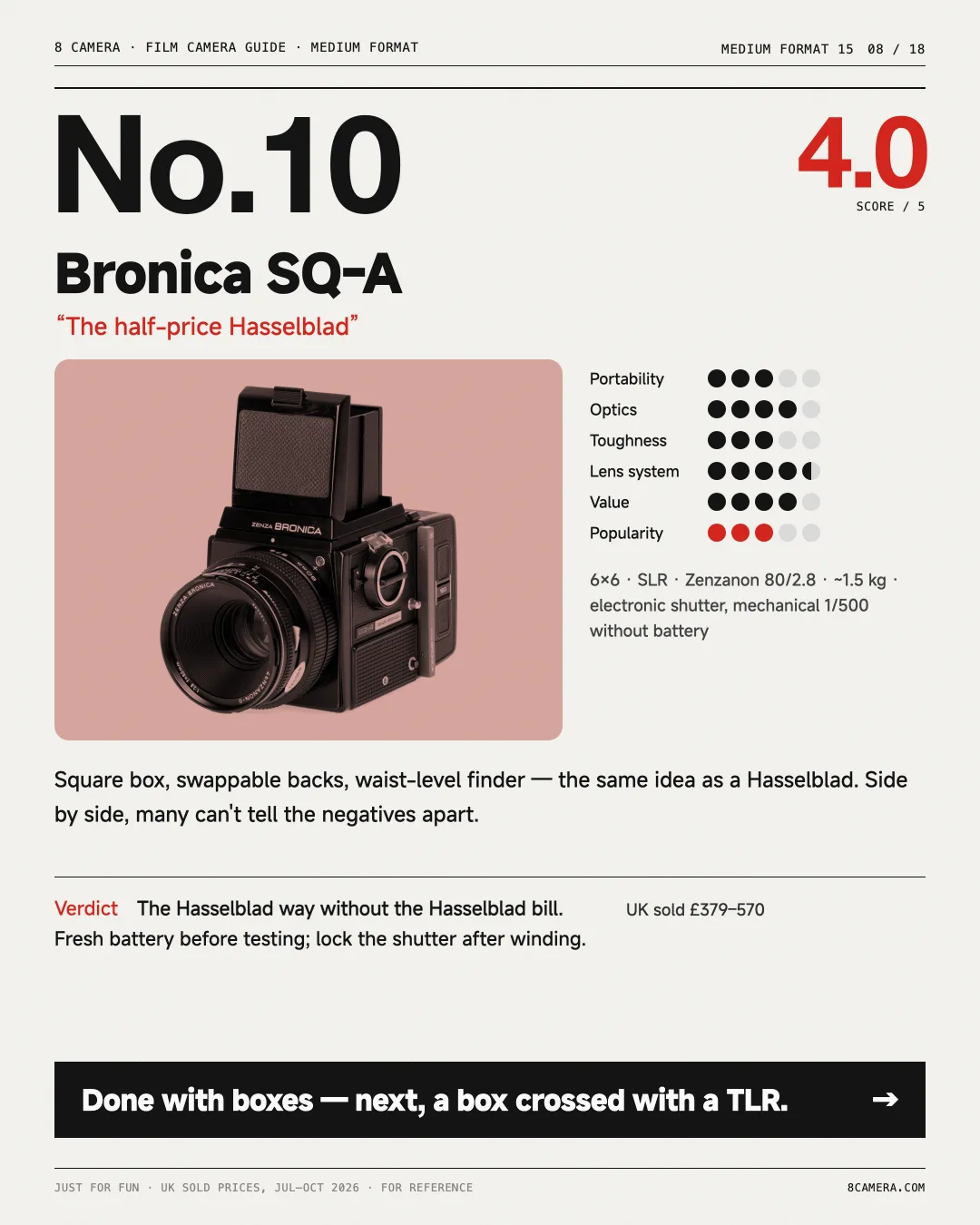
The square box, interchangeable backs and waist-level finder follow the same idea as a Hasselblad, at a fraction of the cost. The system covers roughly fifteen focal lengths from a 35mm fisheye to 500mm. The shutter is electronic, but the SQ-A keeps a mechanical 1/500 for when the battery dies (the later SQ-Ai does not).
Check: fit a fresh battery before testing anything, and expect to replace back seals.
9. Mamiya C330
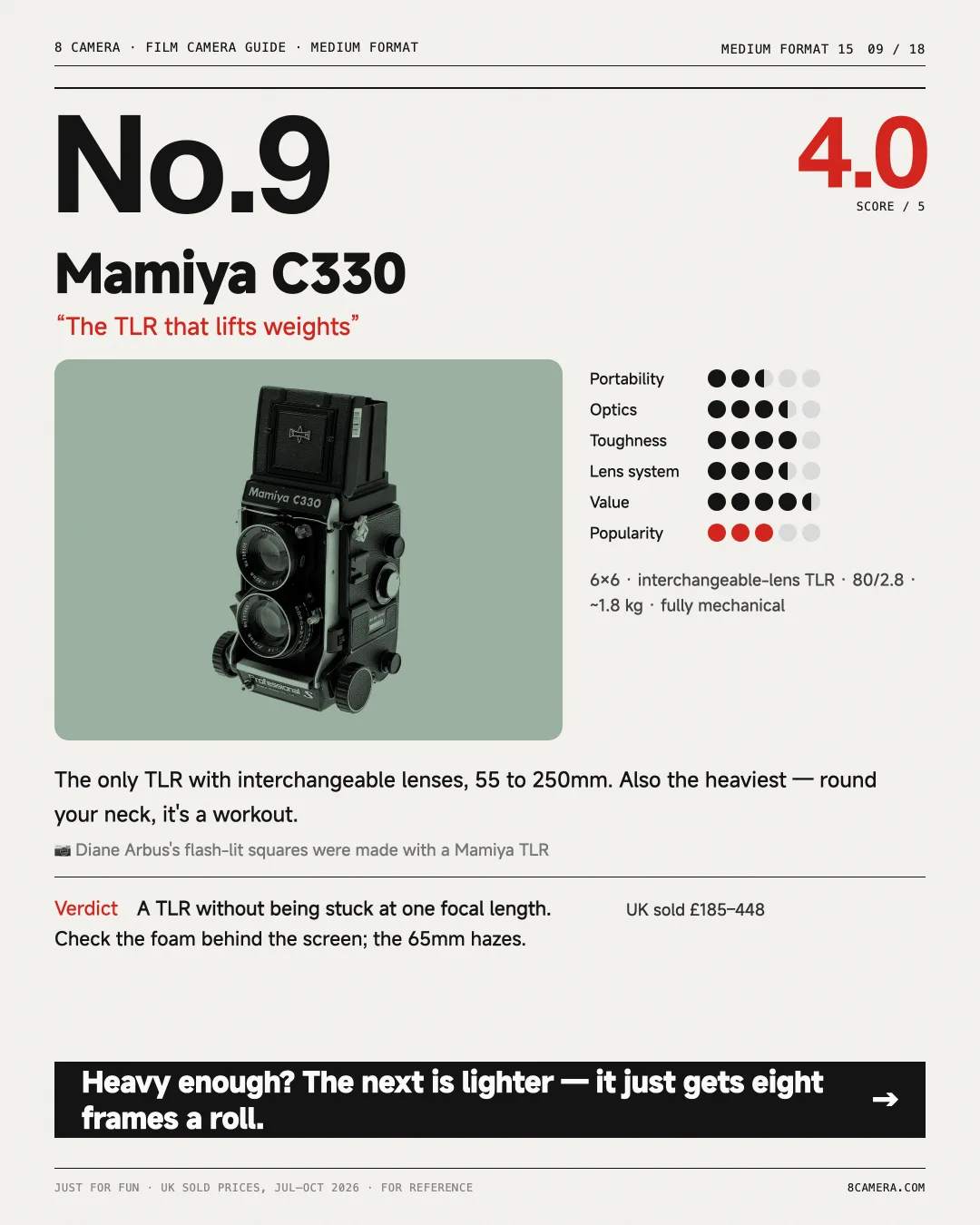
The only TLR with interchangeable lenses, in seven focal lengths from 55mm to 250mm. It is fully mechanical and inexpensive to service, but at about 1.8 kg it is also the heaviest TLR here. Diane Arbus used a Mamiya TLR with flash for her square portraits. There were three versions, the C330, C330f and C330S, and the lenses are shared between them.
Check: the foam behind the focusing screen, and haze in the 65mm lens in particular.
8. Fujifilm GW690 III
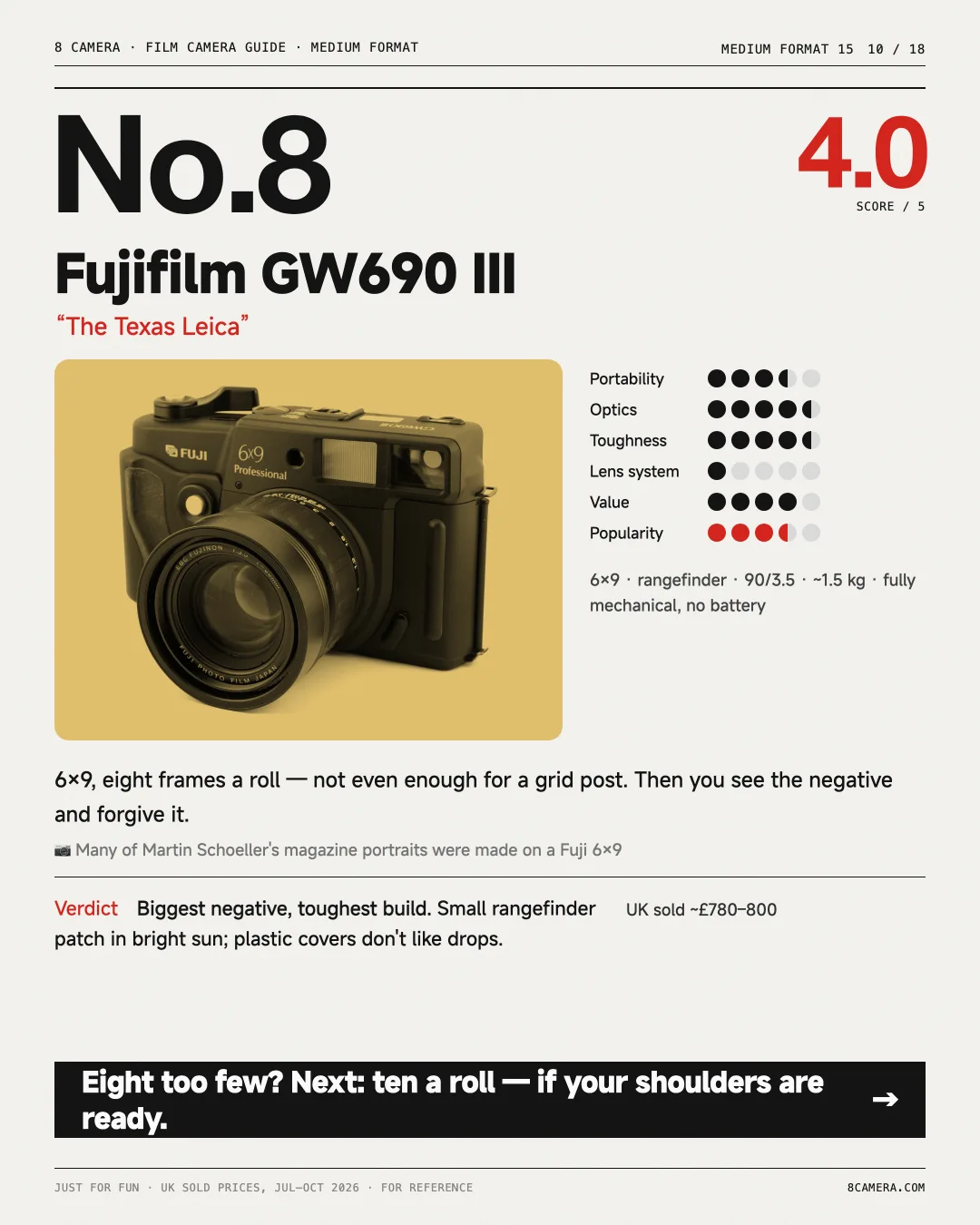
Known as the "Texas Leica". It shoots 6×9, so you get only eight frames on a roll of 120, and the negatives are enormous. The EBC Fujinon 90mm f/3.5 is sharp, and the camera is fully mechanical with no meter and no battery. Martin Schoeller has made many magazine portraits on a Fuji 6×9.
Check: the rangefinder patch is small and hard to see in bright sun, and the plastic top and bottom covers crack if dropped.
7. Mamiya RZ67
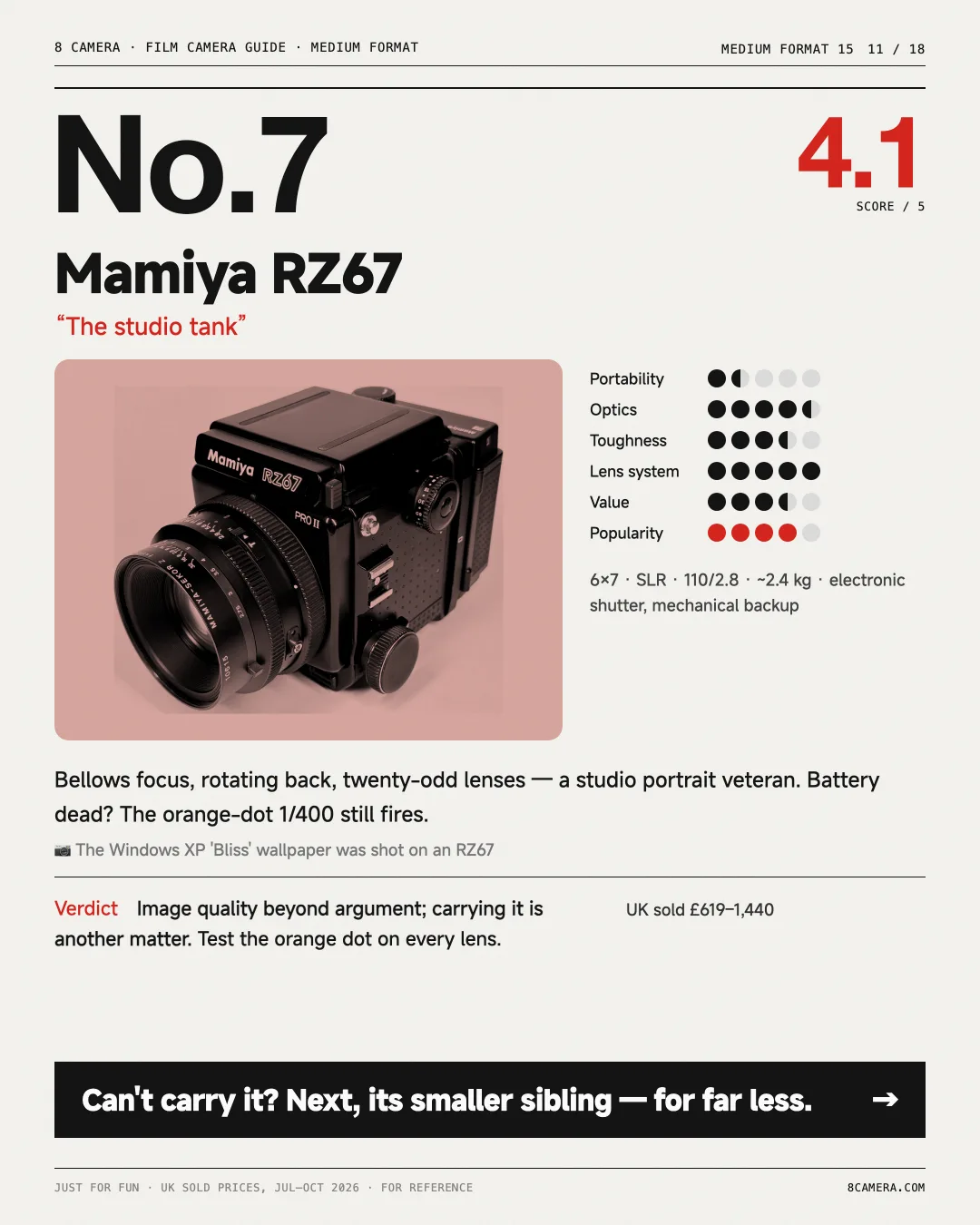
A studio portrait veteran: bellows focusing, a rotating back and a system of 27 lenses from a 37mm fisheye to a 500mm APO. Charles O'Rear made the Windows XP "Bliss" photograph on one. The shutter is electronic, but the release has an orange-dot setting that fires at a mechanical 1/400 without a battery. At around 2.4 kg, it rarely leaves the tripod.
Check: test the orange-dot setting on every lens you are buying.
6. Pentax 67
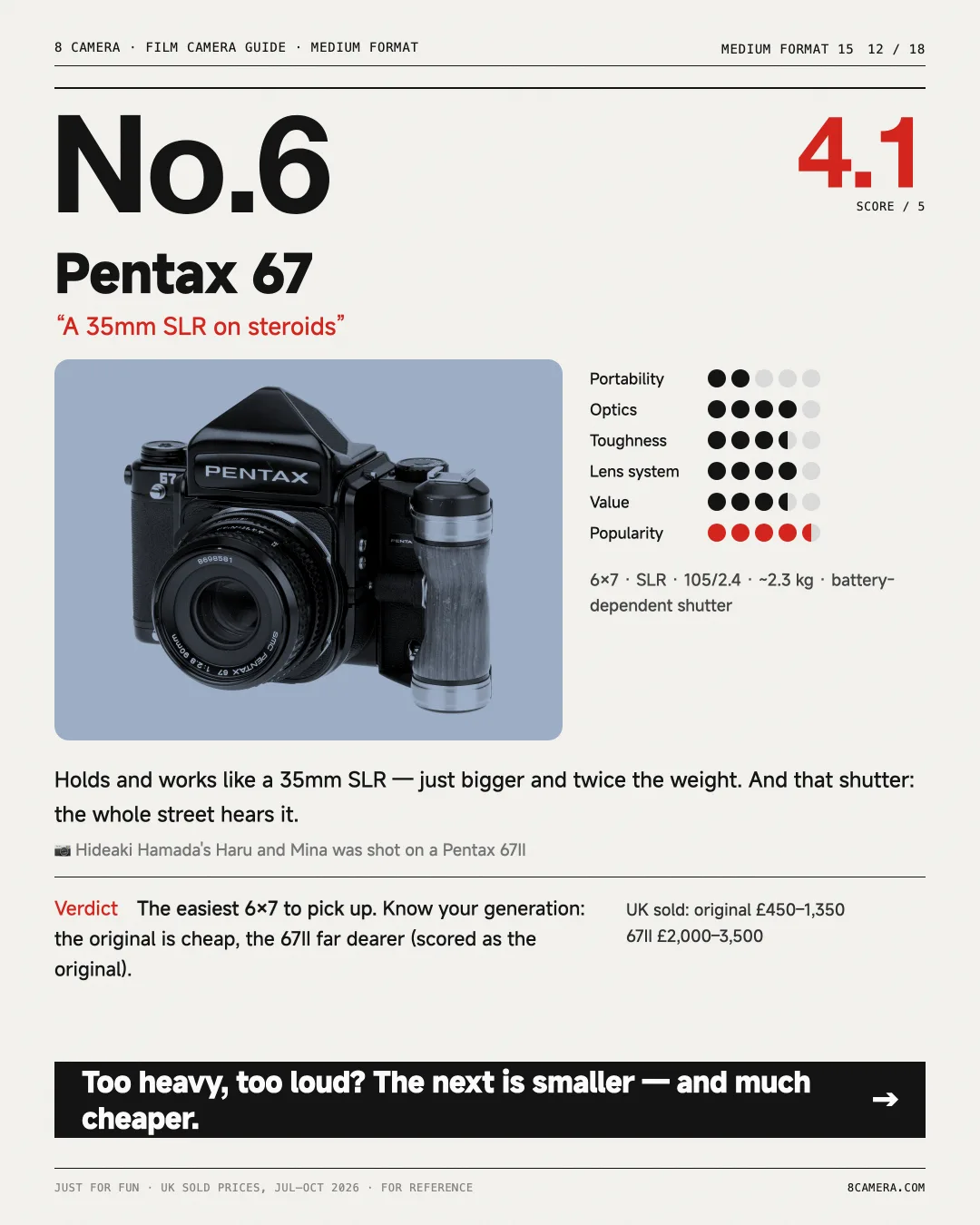
It handles like a 35mm SLR scaled up to about 2.3 kg, which makes it the easiest 6×7 to pick up and use by hand. The 105mm f/2.4 is loved for its smooth rendering, and around 21 lenses run from a 35mm fisheye to 800mm. There are no interchangeable backs, and the shutter will not work without a battery. Hideaki Hamada shot Haru and Mina on a Pentax 67II. The original model and the 67II are very different purchases: the 67II adds electronics that fewer workshops can repair. We scored the original.
Check: know which generation you are buying, and check that the shutter fires reliably on fresh batteries.
The top five
5. Mamiya 645 Pro TL
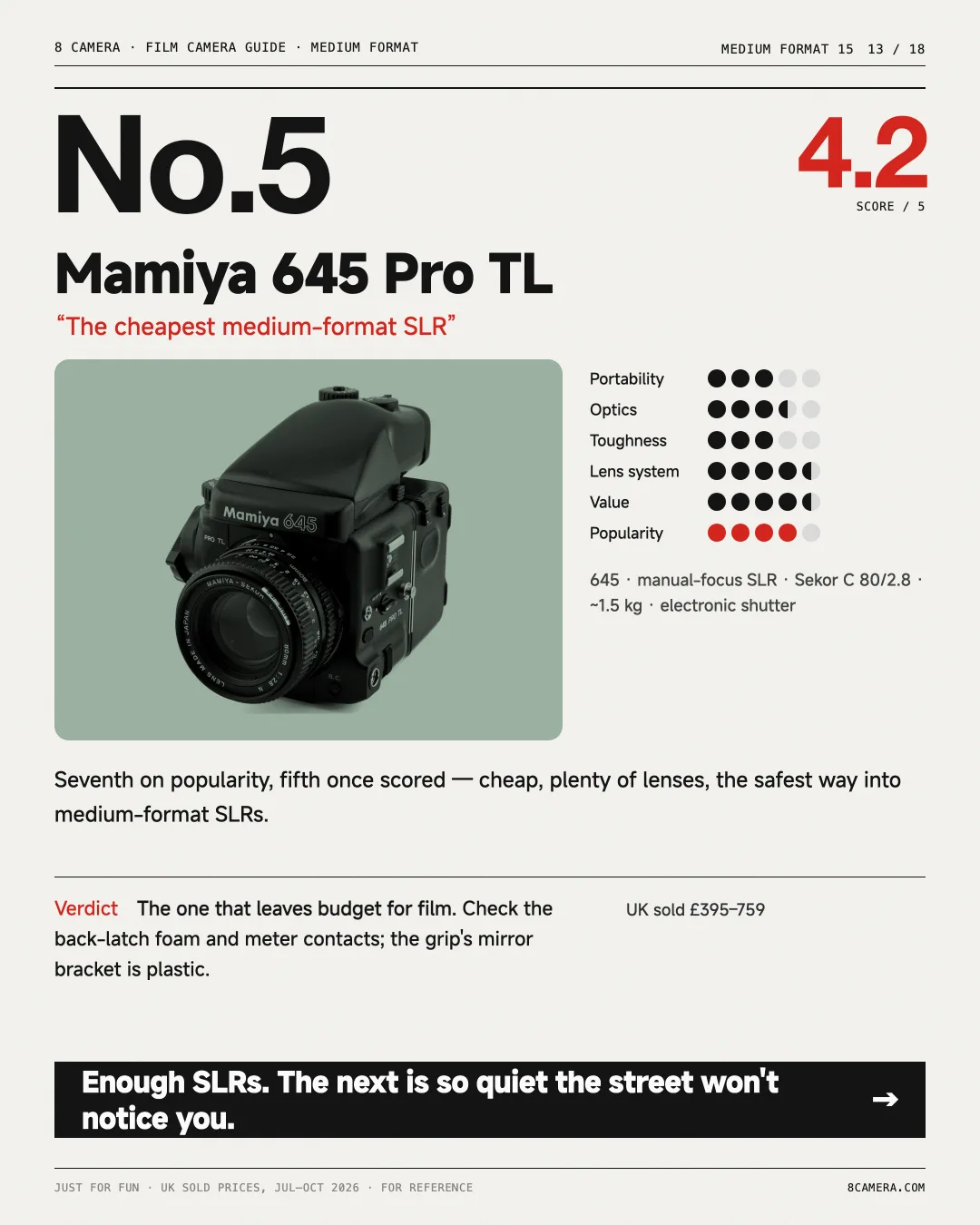
The most affordable way into a medium format SLR system, with around 26 manual-focus lenses from a 24mm fisheye to 500mm, including shift and macro lenses, plus 120, 220, 35mm and instant backs. A complete kit with a metering prism weighs about 1.5 kg. Shutters across the range are electronic, but there are plenty of cameras and donor parts.
Check: foam around the back latches, the contacts between back and body, and the plastic mirror bracket on the power winder grip.
4. Rolleiflex 2.8F
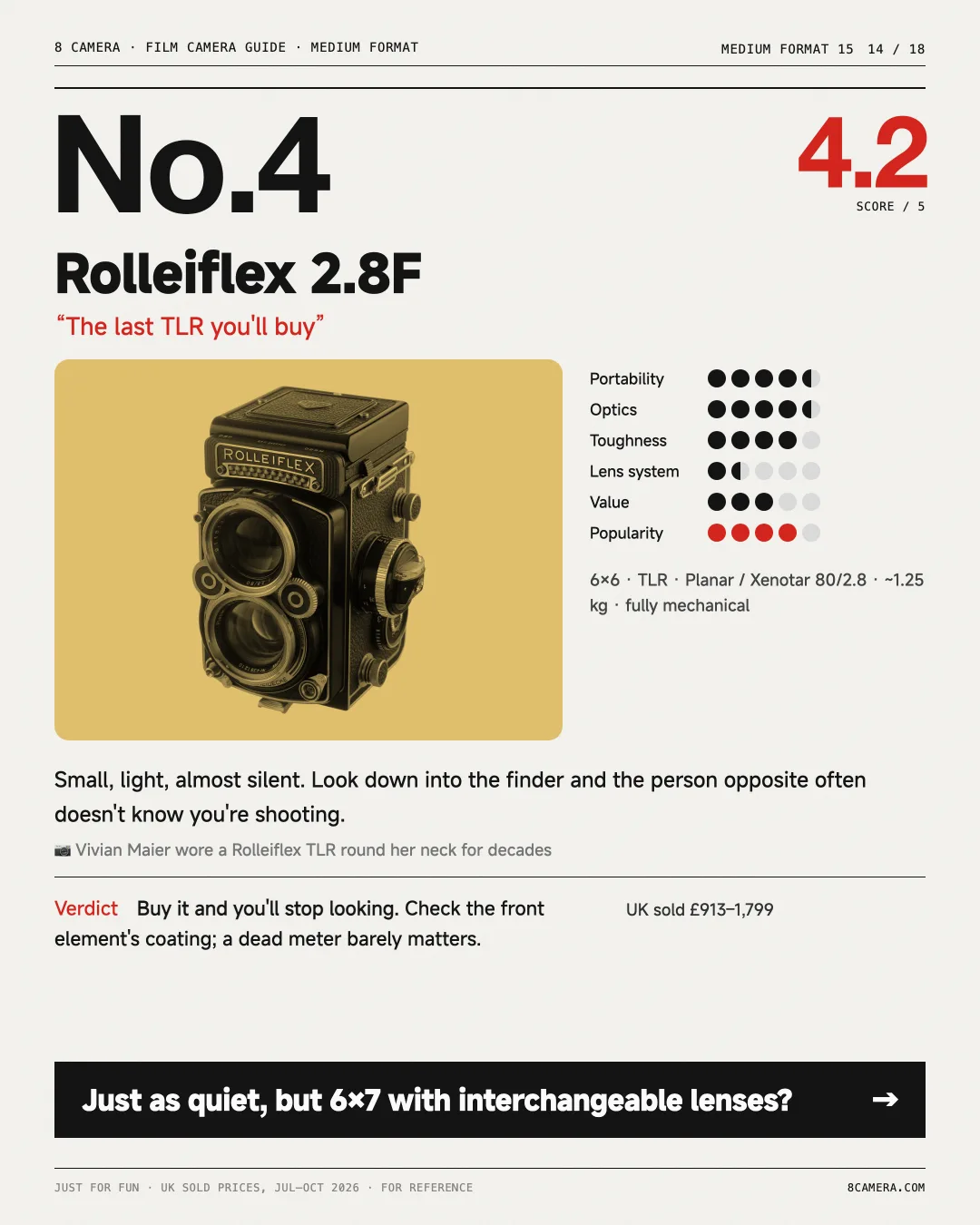
Small, light at about 1.25 kg, and almost silent. When you look down into the finder, the person in front of you often doesn't realise you are taking a picture, which is why Vivian Maier wore a Rolleiflex TLR for decades. The lens is a Zeiss Planar or a Schneider Xenotar 80mm f/2.8, and most people can't tell the two apart on film. Fully mechanical and serviceable, though a full overhaul takes time.
Check: the coating on the front element. The selenium meter is often dead, and that barely matters.
3. Mamiya 7 II
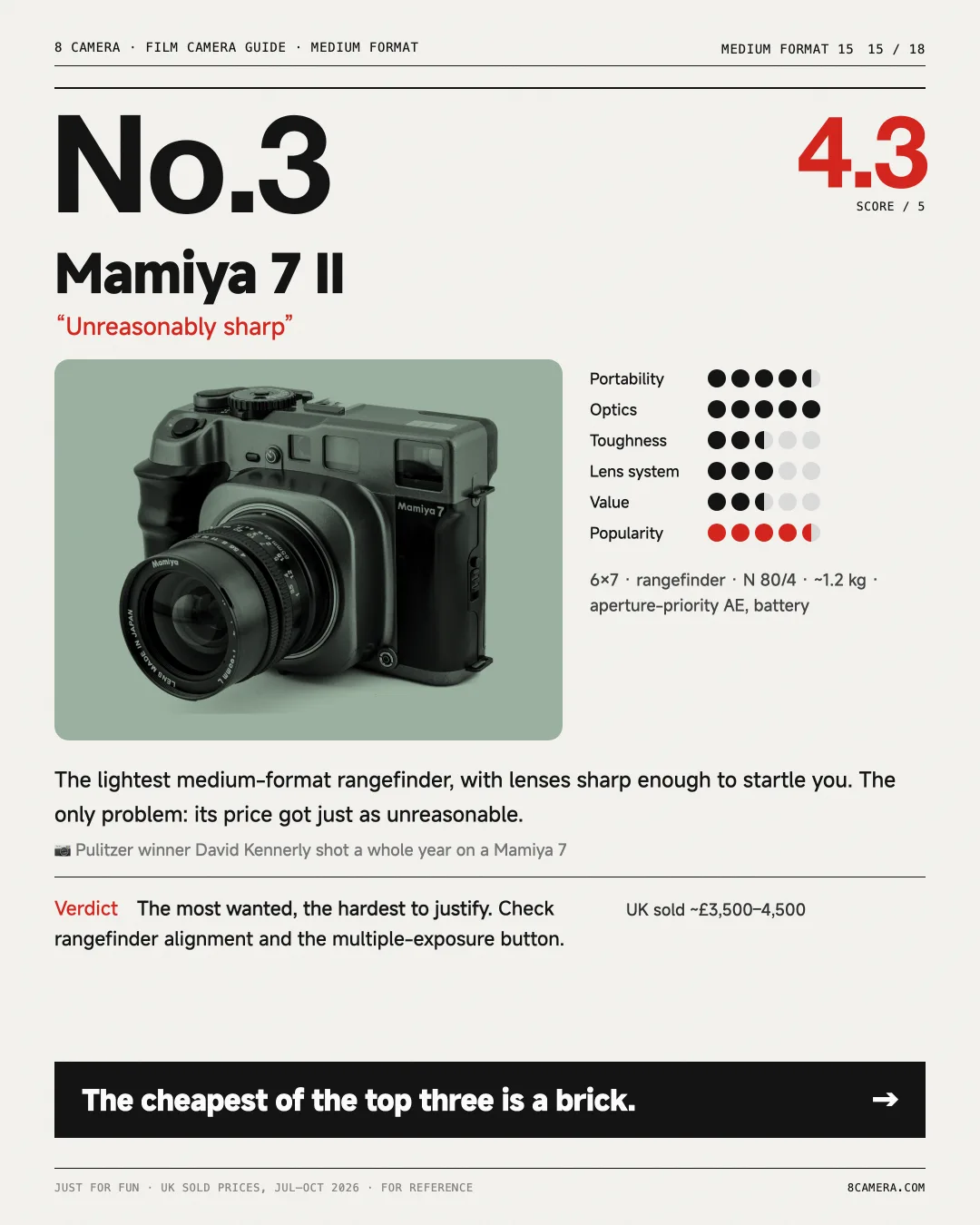
The lightest 6×7 rangefinder, at about 1.2 kg with the 80mm f/4, and its lenses are sharp to the edges. The system has six lenses from 43mm to 210mm. It also needs a battery for its electronic shutter, and spare parts are getting scarce. It is the camera most people want and the hardest to justify. David Hume Kennerly shot a photograph a day for a year on the first-generation Mamiya 7, which shares its lenses.
Check: rangefinder alignment and the multiple-exposure button. Load a roll and shoot past the first frame, because some faults only appear once film is in.
2. Mamiya RB67
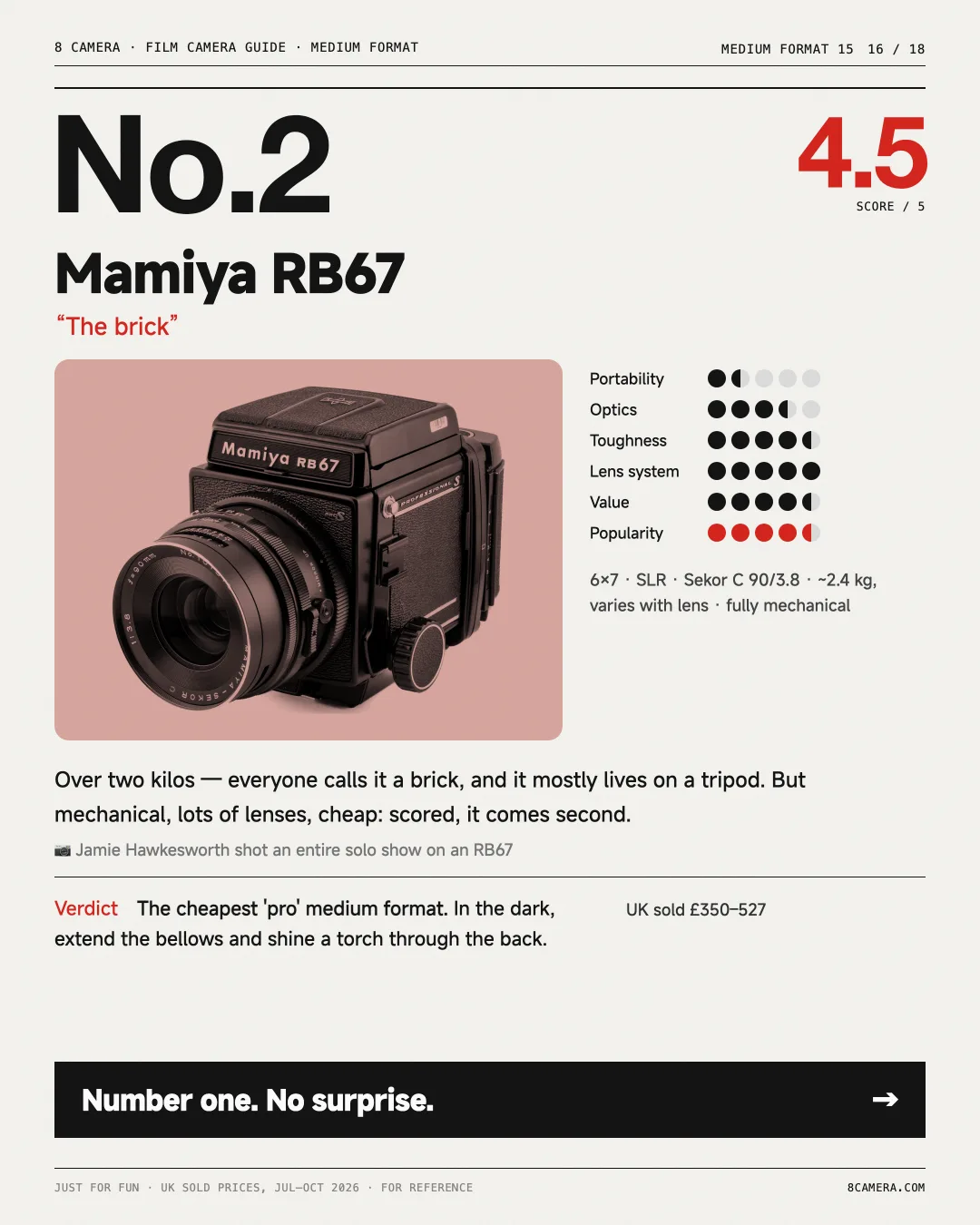
Everyone calls it the brick, and at around 2.4 kg, depending on the lens, it mostly lives on a tripod. But it is fully mechanical, with a leaf shutter in every lens, a huge range of lenses and backs, and it is the most affordable route to a professional 6×7 system. Jamie Hawkesworth shot an entire London solo show on one. Most surviving bodies date from the late 1970s and 1980s, so the bellows and light seals are old.
Check: remove the lens, extend the bellows in a dark room and shine a torch through to find pinholes. Ask which seals have been replaced.
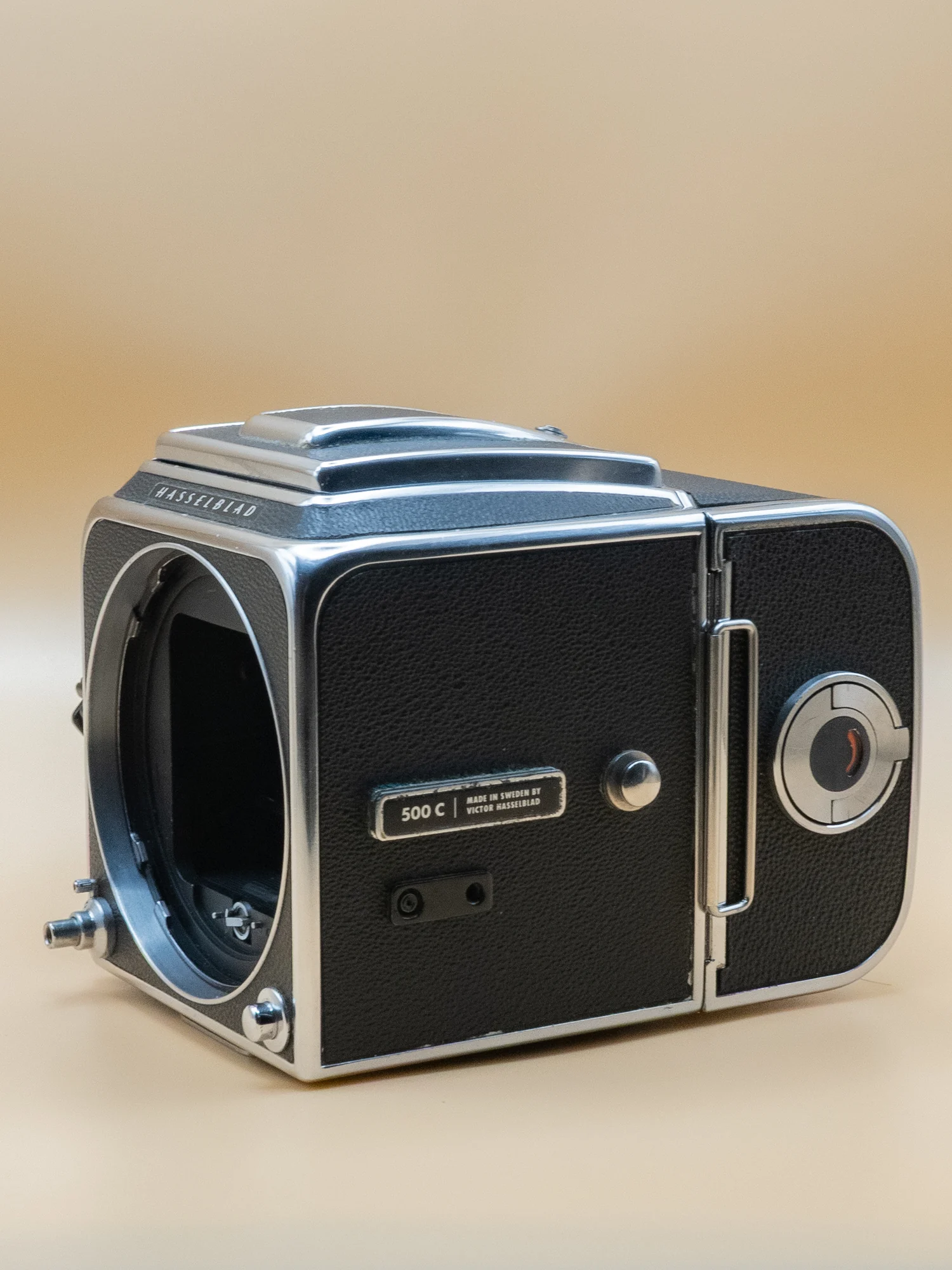
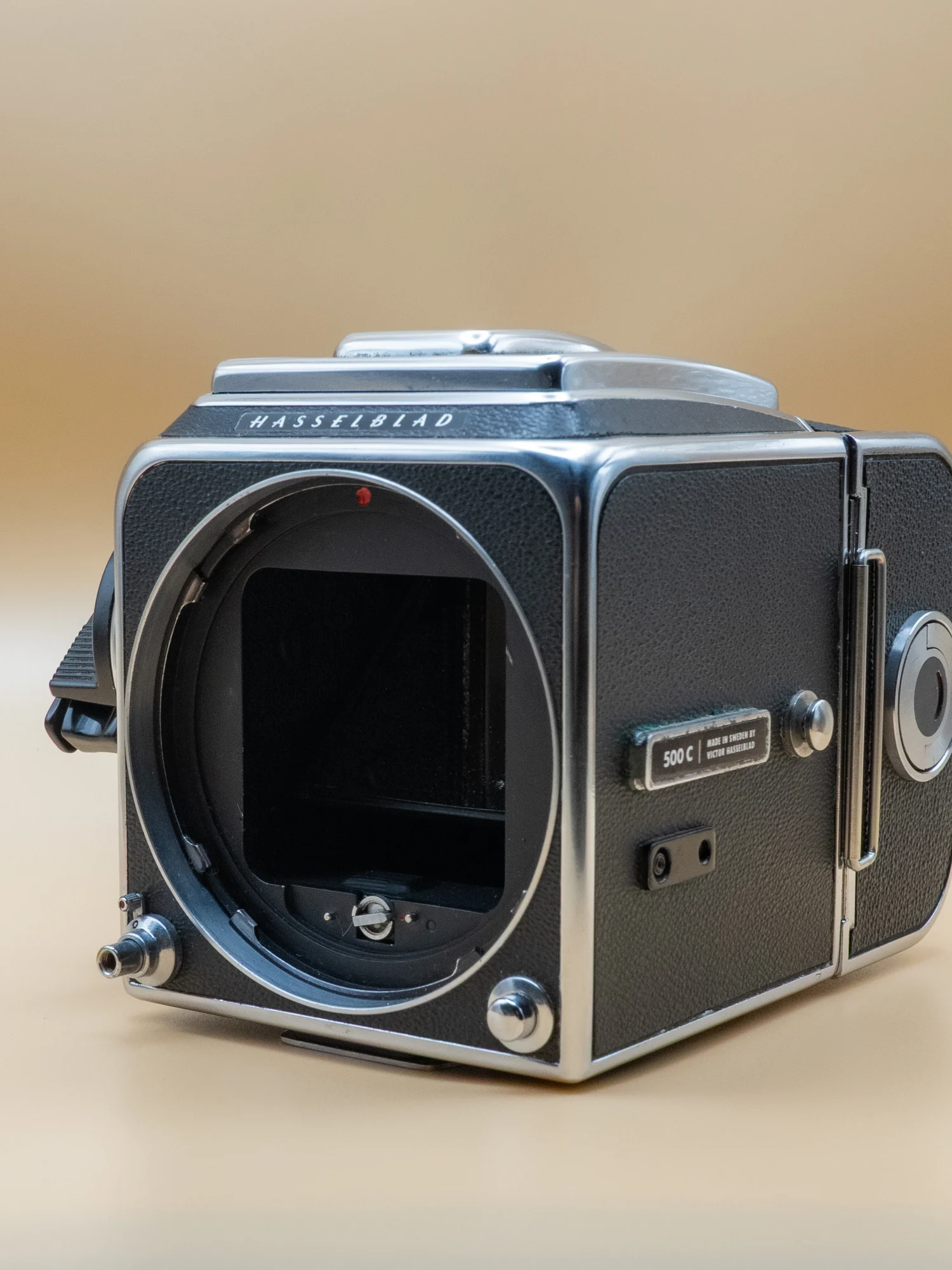
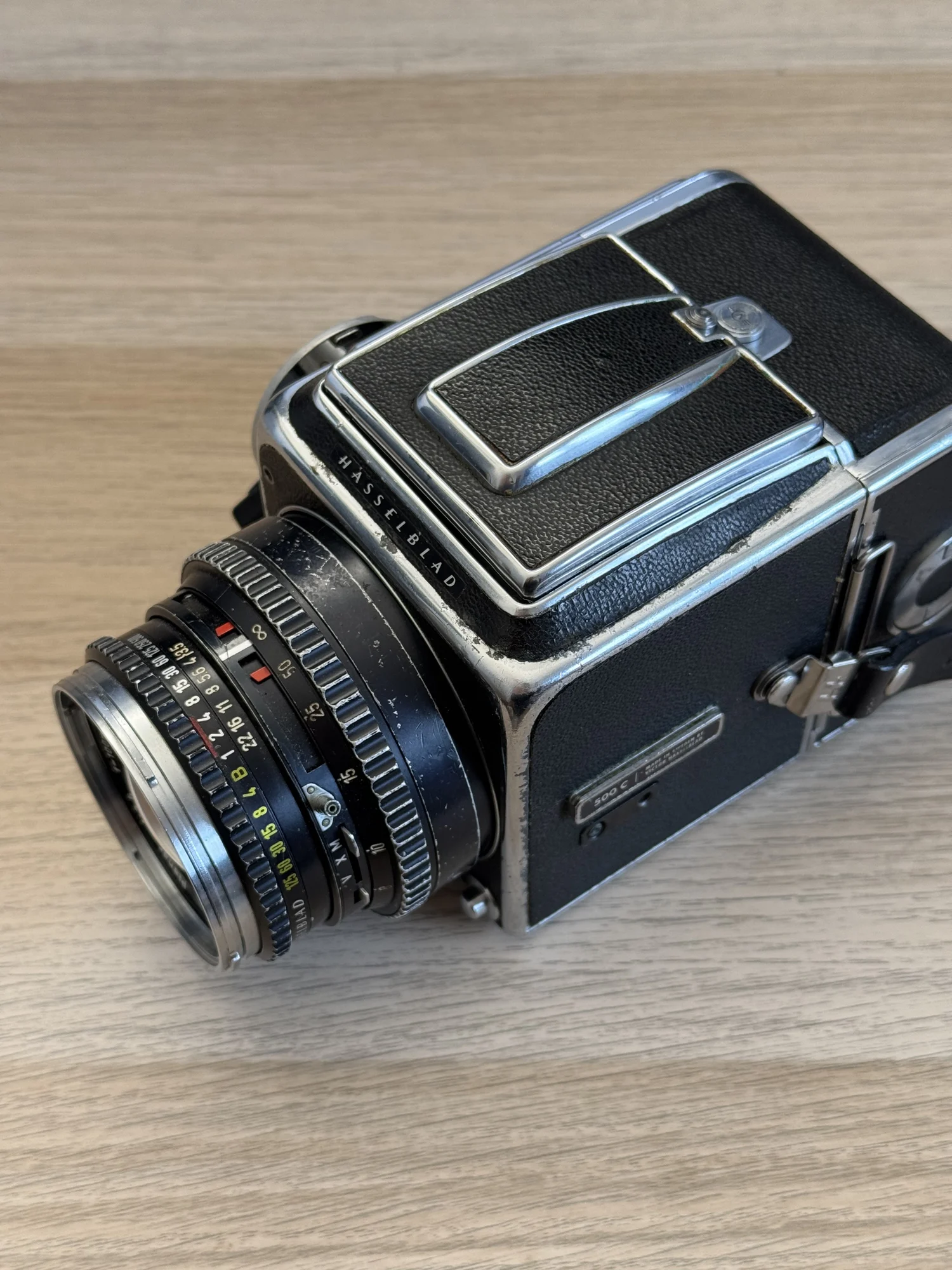
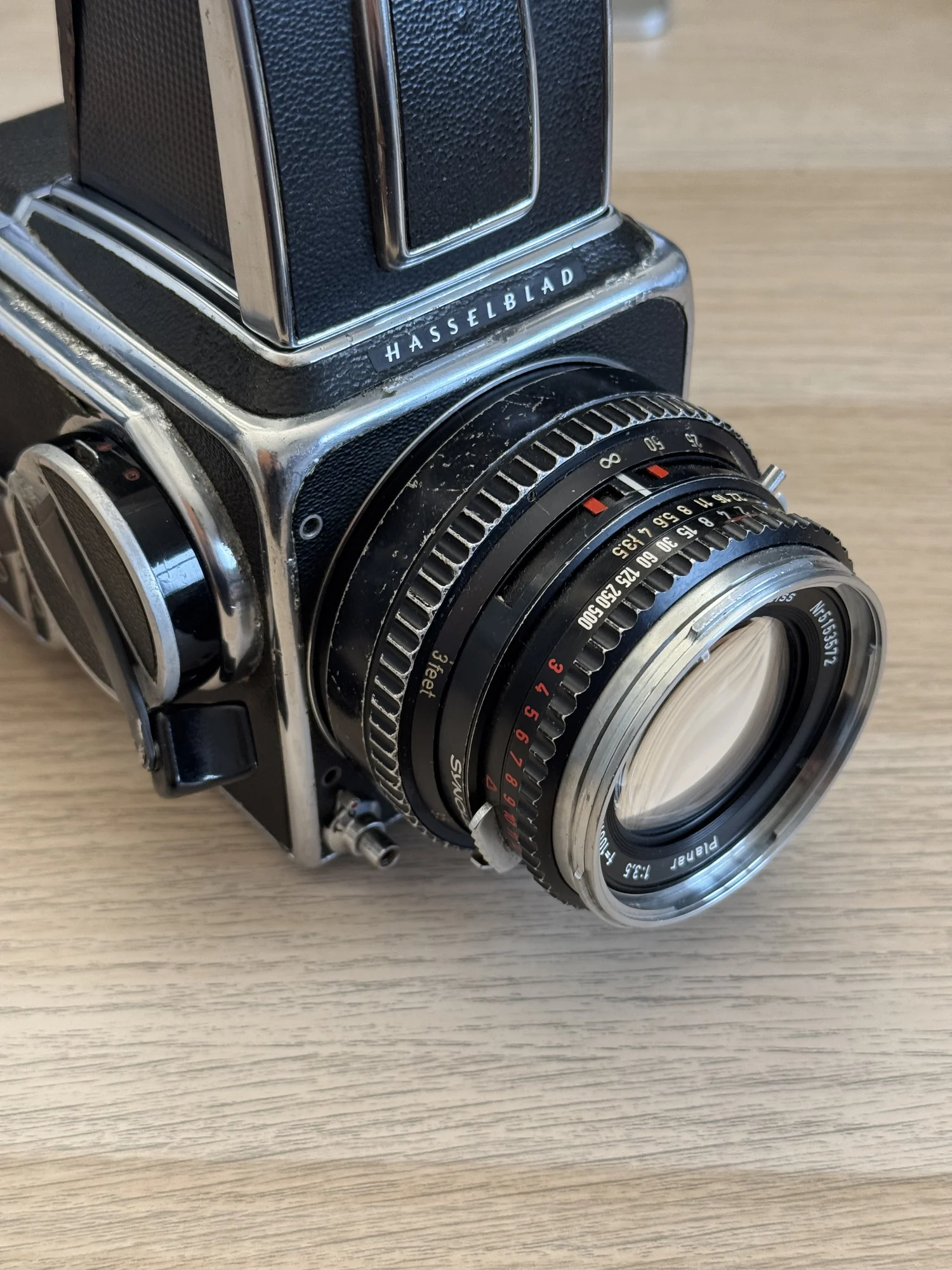
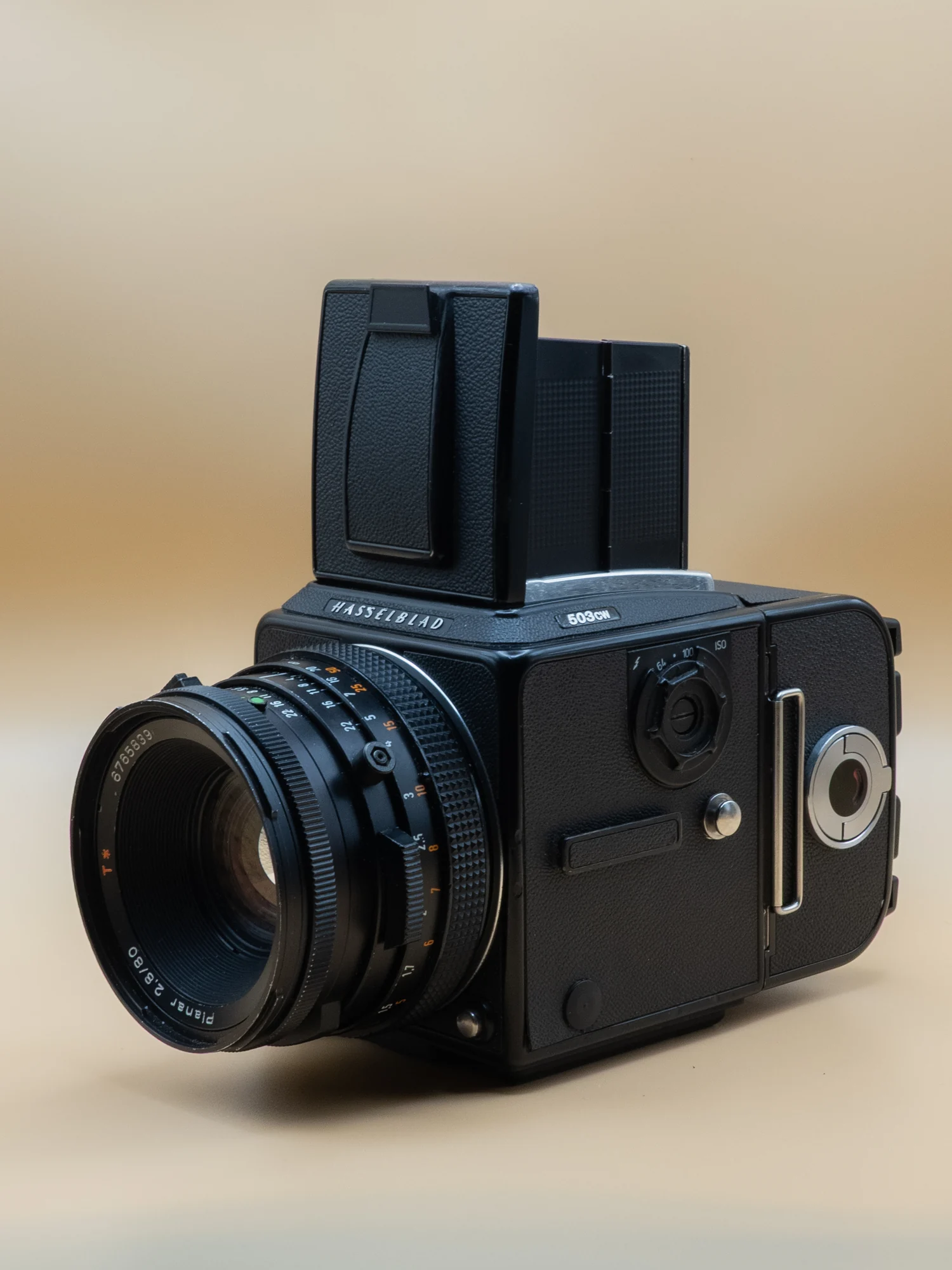
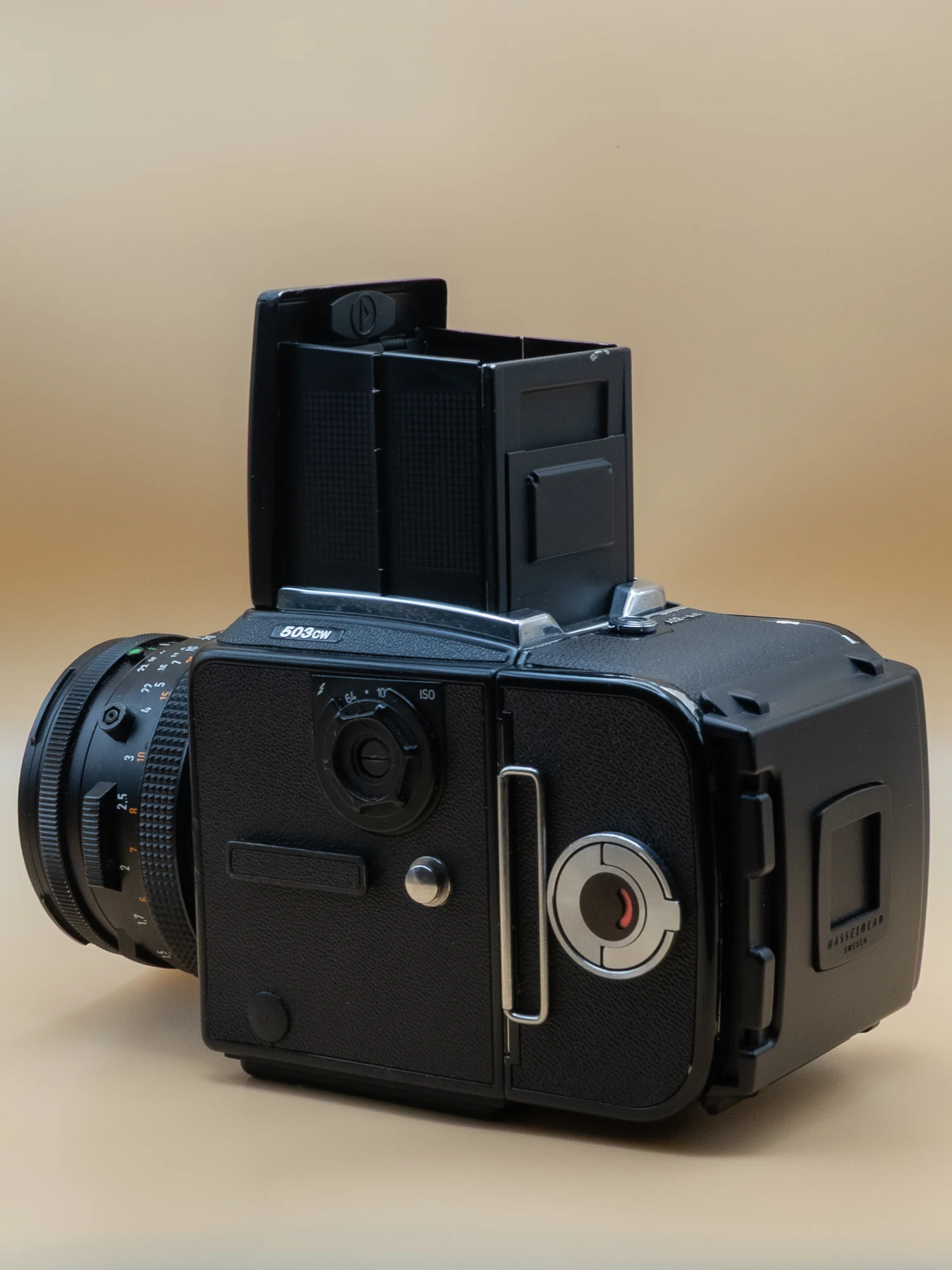
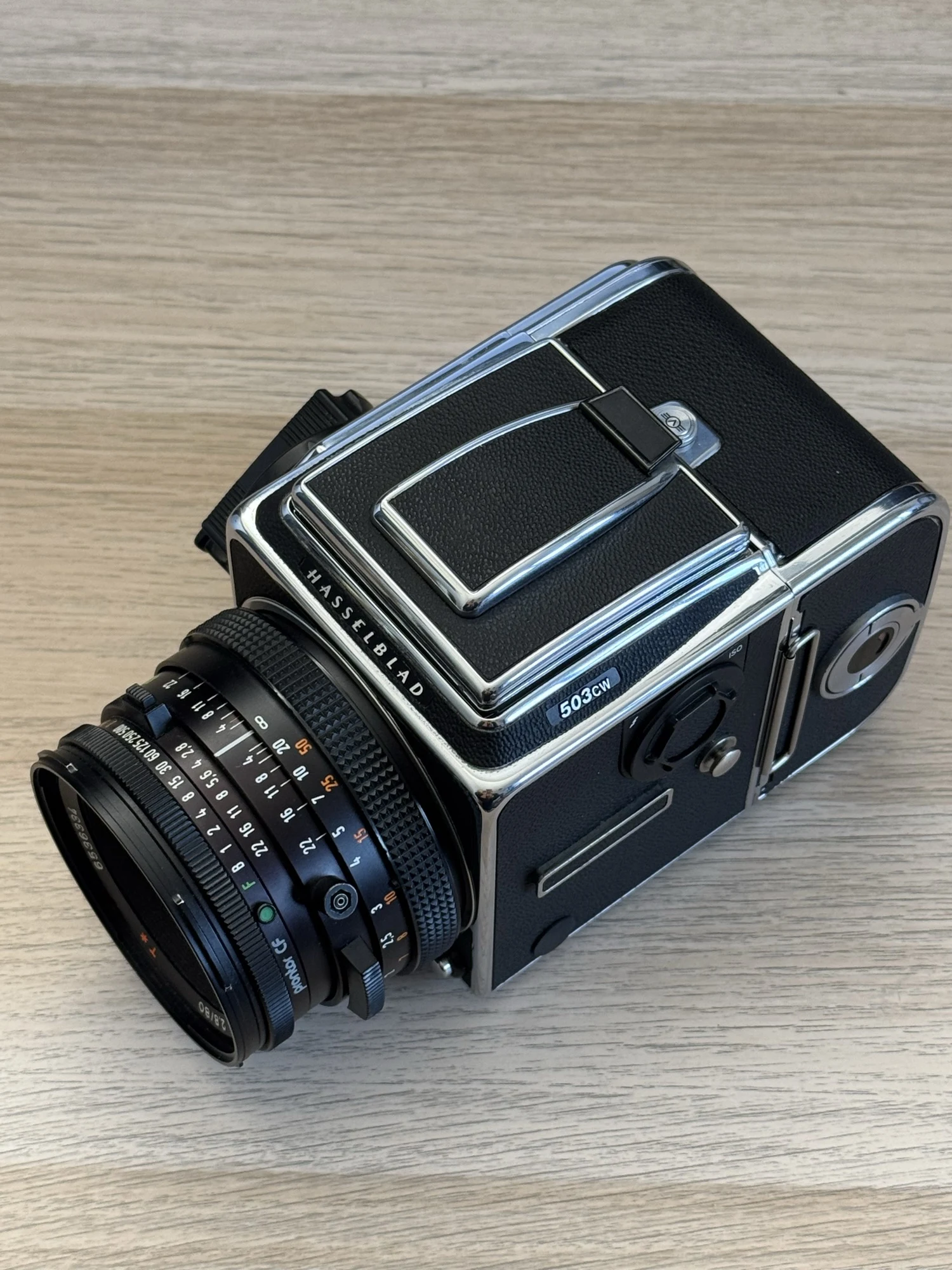
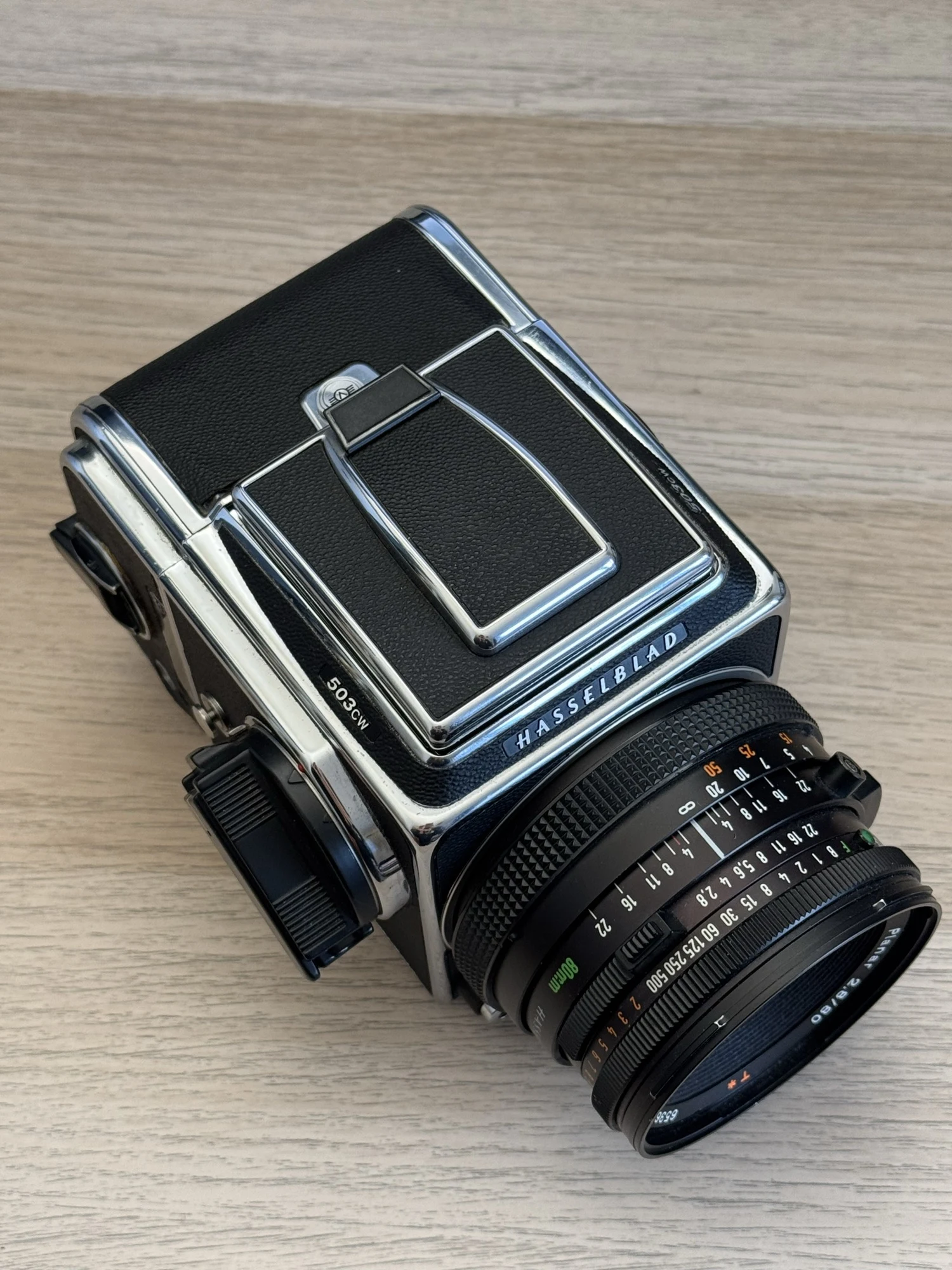
1. Hasselblad 500C/M
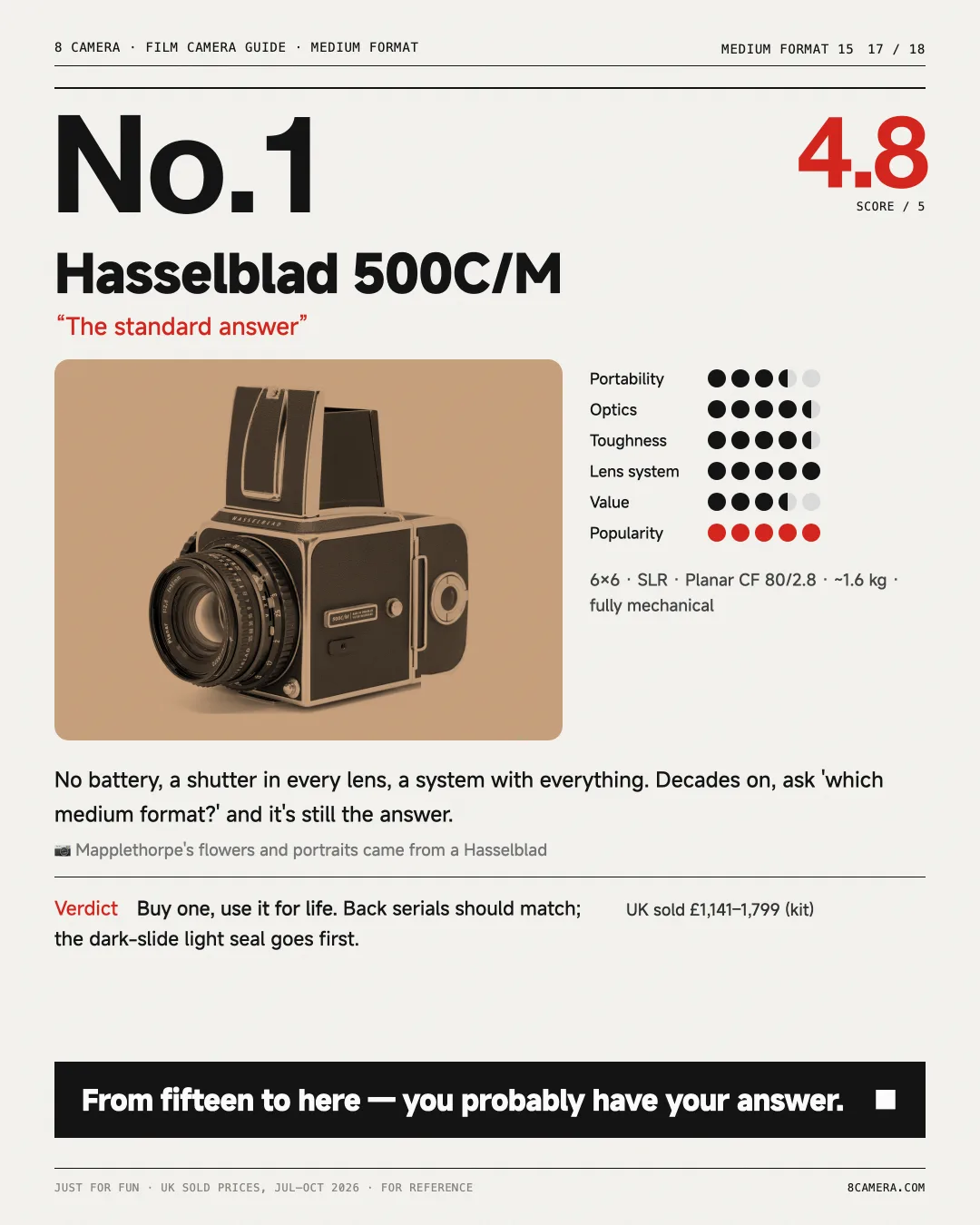
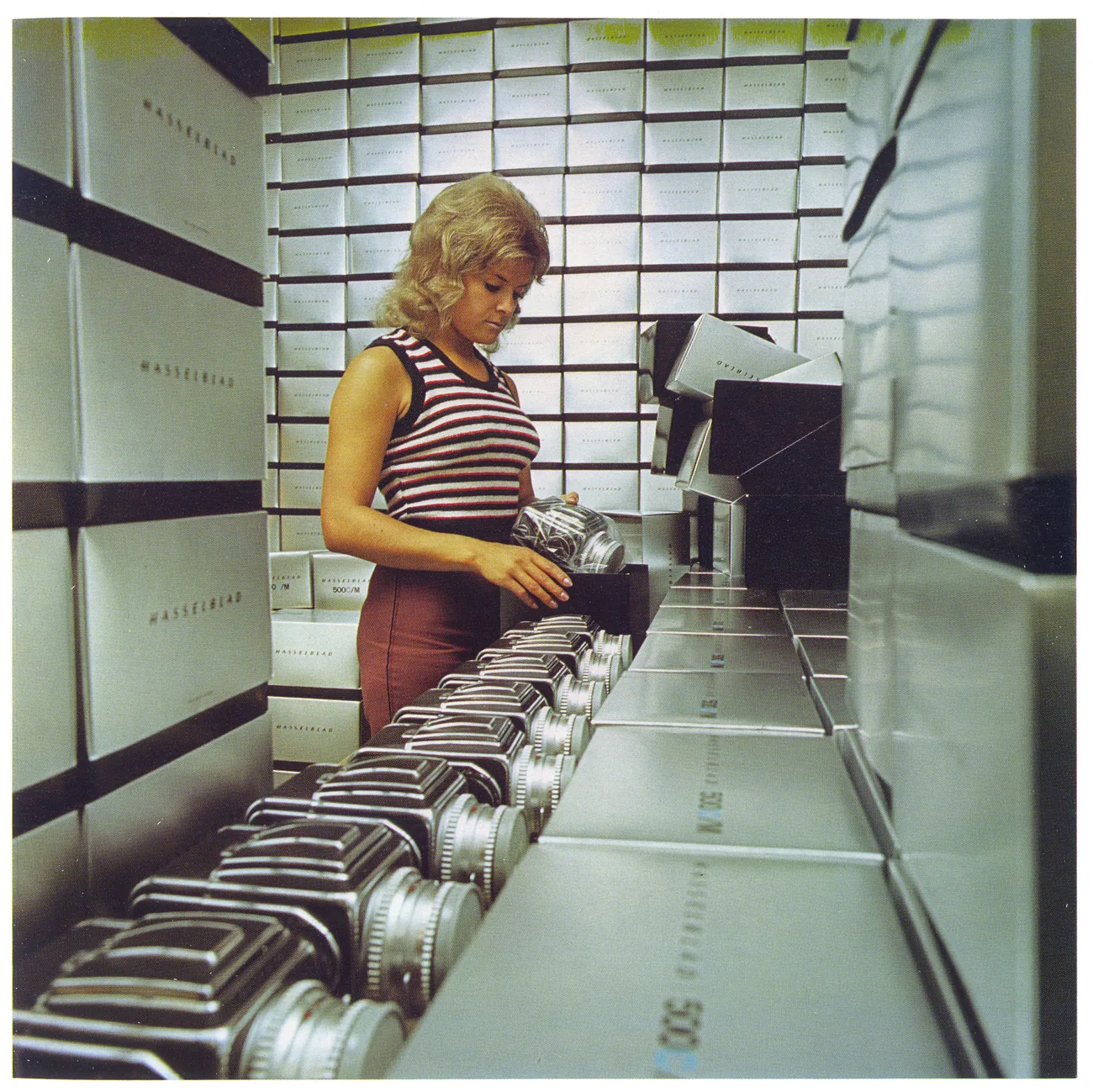
No battery, a leaf shutter in every lens, and a system that covers almost everything: around 19 CF lenses alone, interchangeable magazines and finders. Decades on, when someone asks which medium format camera to buy, it is still the standard answer. Robert Mapplethorpe's flowers and portraits came from a Hasselblad. Well maintained, it will last a lifetime, and plenty of independent technicians can service it.
Check: the serial numbers on the magazine shell and its insert should match. Test every magazine separately, because the dark slide seal is the first place light leaks start.
Which one is right for you?
- Your first medium format camera: the Yashica Mat-124G or the Mamiya 645 Pro TL.
- One camera for life: the Hasselblad 500C/M.
- Travel and walking: the Mamiya 7 II, Plaubel Makina 67 or Fujifilm GA645.
- Quiet street photography: the Rolleiflex 2.8F or Minolta Autocord.
- Studio and portraits: the Mamiya RB67 or RZ67.
- The biggest negative: the Fujifilm GW690 III.
- The Hasselblad way of working for less: the Bronica SQ-A.
What to check when buying any medium format camera
- Light seals and bellows. Foam turns to dust after forty years. Look at the back hinges, the dark slide slot and any bellows.
- Each back on its own. A fault can sit in the magazine, not the body, so test every back you are buying.
- Film in the camera. Wind on and fire several frames with a roll loaded, not only empty.
- The lenses against a light. Shine a torch through each one. Haze is common; rainbow-coloured rings mean the cemented elements are separating.
- The power question. On an electronic camera, test with fresh batteries and ask whether parts are still available. On a mechanical one, ask when it was last serviced.
Find your camera
If you would like to see how these cameras compare in the hand, you can browse what we have now in our medium format cameras, or go straight to the standard answer in our Hasselblad collection.