
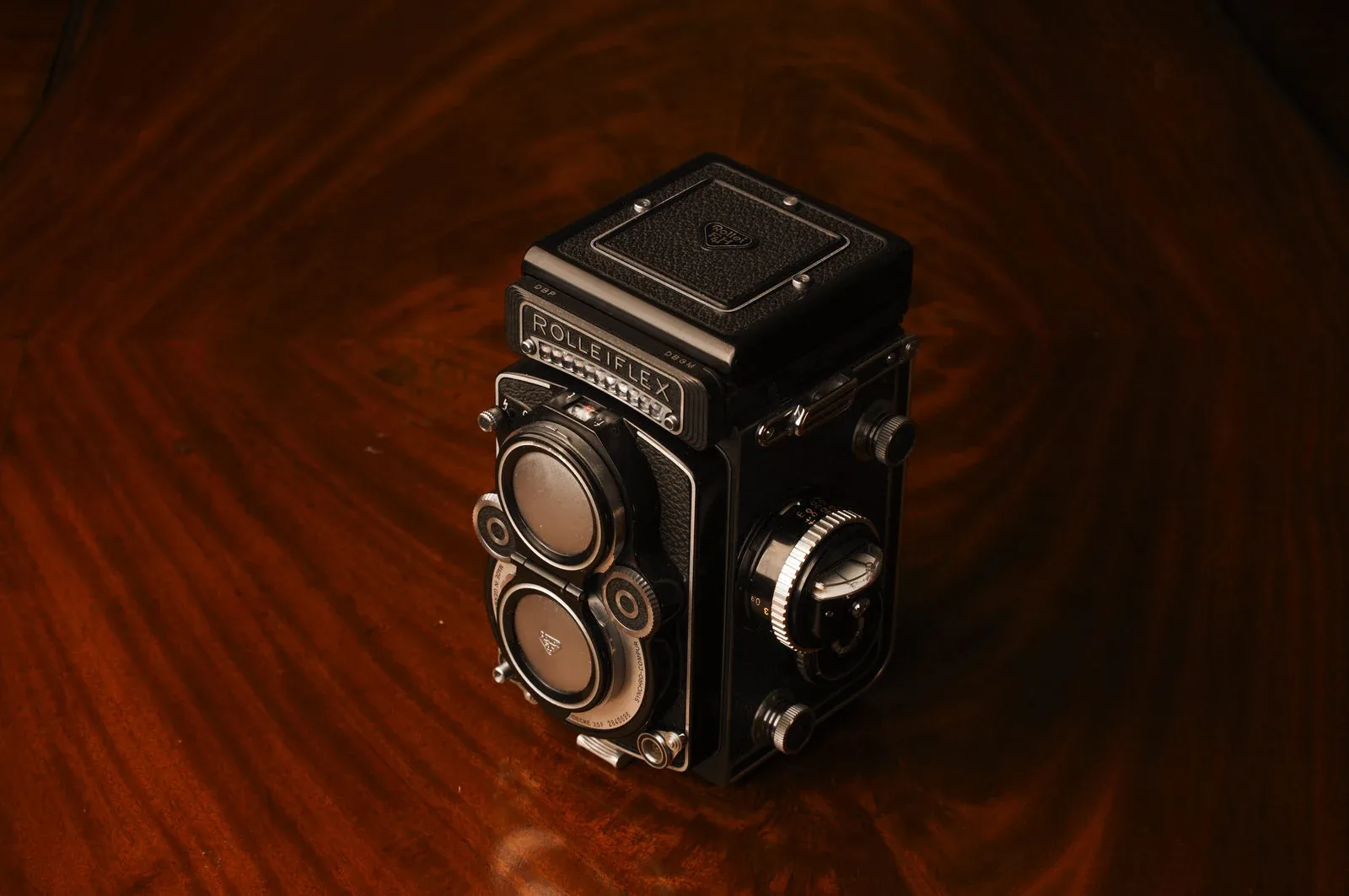
To check a used Rolleiflex, shine a torch through the taking lens (the bottom one) for haze, separation and fungus; run the shutter at 1 second, 1/2 and 1/4 and watch for a pause before the blades open; wind the crank forward to its stop and back through a whole roll to see that it locks, counts to 12 and then turns freely; check that focusing is smooth and that distant objects are sharp at the infinity mark; and treat a built-in meter as a bonus, not something to pay for. On our bench, slow speeds, a stiff transport and a dim screen are what a full CLA (clean, lubricate, adjust) is for. Damaged glass and a bent lens board are not.
Below are each of those checks, the faults that should make you walk away, and short notes on each model. How the camera works comes from Franke & Heidecke's own instruction manuals for the Automat, the T and the 3.5F/2.8F, as kept in the Butkus manual library. Model dates follow Wikipedia's Rolleiflex article; references disagree by a year here and there. Where something comes from our own workshop rather than a manual, we say so.
Which Rolleiflex is which?
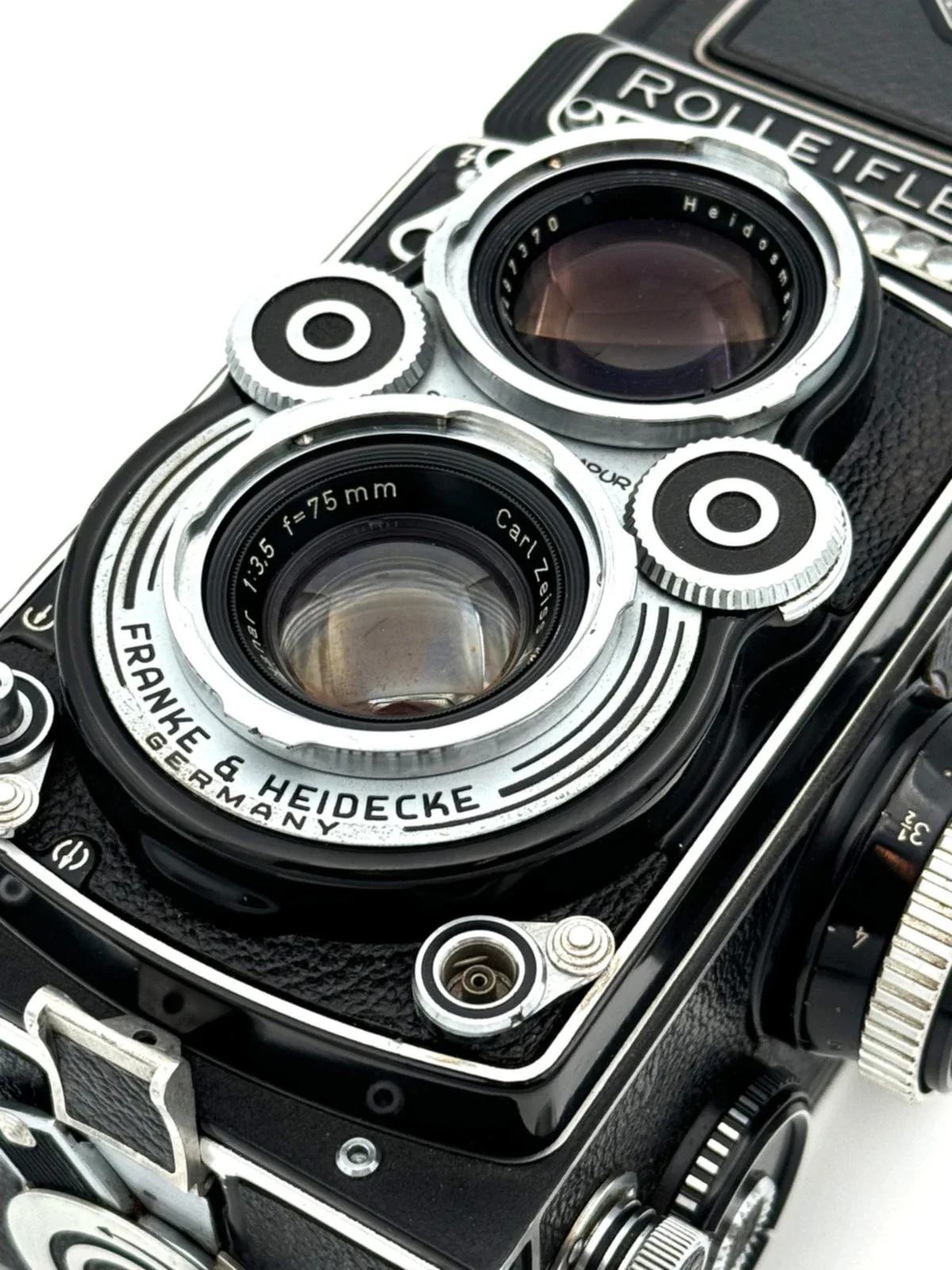
Every Rolleiflex TLR has two lenses of the same focal length. The Automat manual describes it as two cameras joined in one body: the top (viewing) lens feeds a mirror and the focusing screen, and the bottom (taking) lens carries the Synchro-Compur shutter and exposes the film. The 3.5 line has a 75mm lens, the 2.8 line an 80mm. Filters and hoods fit a bayonet on the front of the lens: the 3.5F/2.8F manual gives bayonet size II for the 3.5F and III for the 2.8F, and the T manual gives size I.
| Model | Years | Taking lens | Meter | First frame found by |
|---|---|---|---|---|
| Automat | 1937–56 | Tessar or Xenar 75/3.5 | None | Feeler rollers |
| 2.8C, 2.8D | 1952–56 | Xenotar or Planar 80/2.8 | None | Feeler rollers |
| 2.8E, 3.5E | 1956–65 | Xenotar or Planar 80/2.8 or 75/3.5 | Optional, uncoupled | Feeler rollers |
| 3.5F | 1958–76 | Xenotar or Planar 75/3.5 | Coupled | Feeler rollers |
| 2.8F | 1960–81 | Xenotar or Planar 80/2.8 | Coupled | Feeler rollers |
| T | 1958–76 | Tessar 75/3.5 | Optional, read as an EV | Start marks on the paper |
Planar, Xenotar or Tessar?
The Planar is Zeiss's and the Xenotar Schneider's; Franke & Heidecke fitted either to the same cameras. The Tessar on the Automat and T is the older design Paul Rudolph drew for Zeiss in 1902, with four elements in three groups. An f/2.8 lens lets in about 1.6 times the light of f/3.5, roughly two-thirds of a stop. On our bench we have found little to choose between a good Planar and a good Xenotar, and condition matters far more than the name: a clean Tessar beats a hazy Planar.
Body, hood and viewing lens
- Lens board. The two lenses sit on a front panel that moves in and out as you focus. Look along it from the side: it should be square to the body. In our experience a dent on the corner of the panel or the nameplate usually means a drop, and a drop can knock the two lenses out of agreement.
- Focusing hood. It should spring up cleanly and fold shut without being forced. On the 3.5F and 2.8F, pressing the front panel of the hood inwards raises the magnifier, and pressing it all the way opens the sports finder. The F manual lists magnifiers from +3 to −3 dioptres, so check the one fitted suits your eyes.
- Screen and mirror. Look down into the hood in daylight. Original screens look dim next to a modern camera, but the image should be even. On our bench, blotchy patches or a grey haze across the whole image usually turn out to be a mirror whose silvering has begun to fail, or a dirty screen. We see brighter replacement screens often and don't treat one as a fault.
- Viewing lens. The viewing lens only forms the image on the screen, so haze or a scratch there dims the view without reaching the negative. We treat it as a matter of price, not pictures.
The taking lens
This check decides whether the camera is worth buying, because damaged glass is the one thing a service can't put right cheaply. Our method: with the back open and the shutter held open on B, shine a small torch through the lens and look from both sides at an angle.
- Haze is a fine milky film that only shows when the light catches it. On our bench, light haze on the inner surfaces is usually old lubricant vapour and can often be cleaned.
- Separation shows as a rainbow-coloured or silvery patch at the edge of a cemented pair. We treat it as a reason to walk away, and our own listing for a Tele Rolleiflex graded its Sonnar C− for exactly this reason.
- Fungus looks like fine branching threads. In our experience, fungus that has already etched the glass leaves marks that cleaning won't remove.
- Cleaning marks are fine scratches in the front coating from years of wiping. In our experience light ones rarely show, though they can lower contrast against the light.
The shutter
The Rolleiflexes here use a Synchro-Compur leaf shutter in the taking lens, running from 1 second to 1/500 plus B. On the Automat and the F models, speeds and apertures are set with the two small wheels either side of the lenses and read in one window above the viewing lens; the T uses a lever instead.
- Fire every speed with the back open, looking through the lens at a bright window. From 1/500 down to about 1/30, what we listen for on the bench is a crisp, even snap.
- Then run 1, 1/2 and 1/4. The blades should open the instant you press the release, stay open, and close cleanly. On our bench, a hesitation before they open, a buzz that stops and starts, or blades that hang open almost always trace back to thickened oil in the clockwork that times the slow speeds. It's ordinary CLA work, but price it in.
- Mind 1/500. The Automat manual says a supplementary spring makes 1/500 feel stiffer to set, and that the shutter should be set to or from 1/500 before winding. On an older camera, don't force the wheel to 1/500 with the shutter cocked.
- Try the self-timer. The Automat manual gives about 10 seconds' delay at any speed except B. The 3.5F/2.8F manual says it works with all speeds from 1/500 to 1 second and with flash on X. On the T the self-timer is the V position of the synchro lever. When one stalls halfway, we usually find old oil there too.
- Check the release lock. If the shutter won't fire, check the release guard first.
Film transport, crank and counter
The crank is the most important thing to test after the lens. According to the 3.5F/2.8F manual, one swing forward to the stop and back to the stop cocks the shutter, advances the film and moves the counter on, and the crank will only turn again after the shutter has been released. That interlock is the camera's double-exposure prevention.
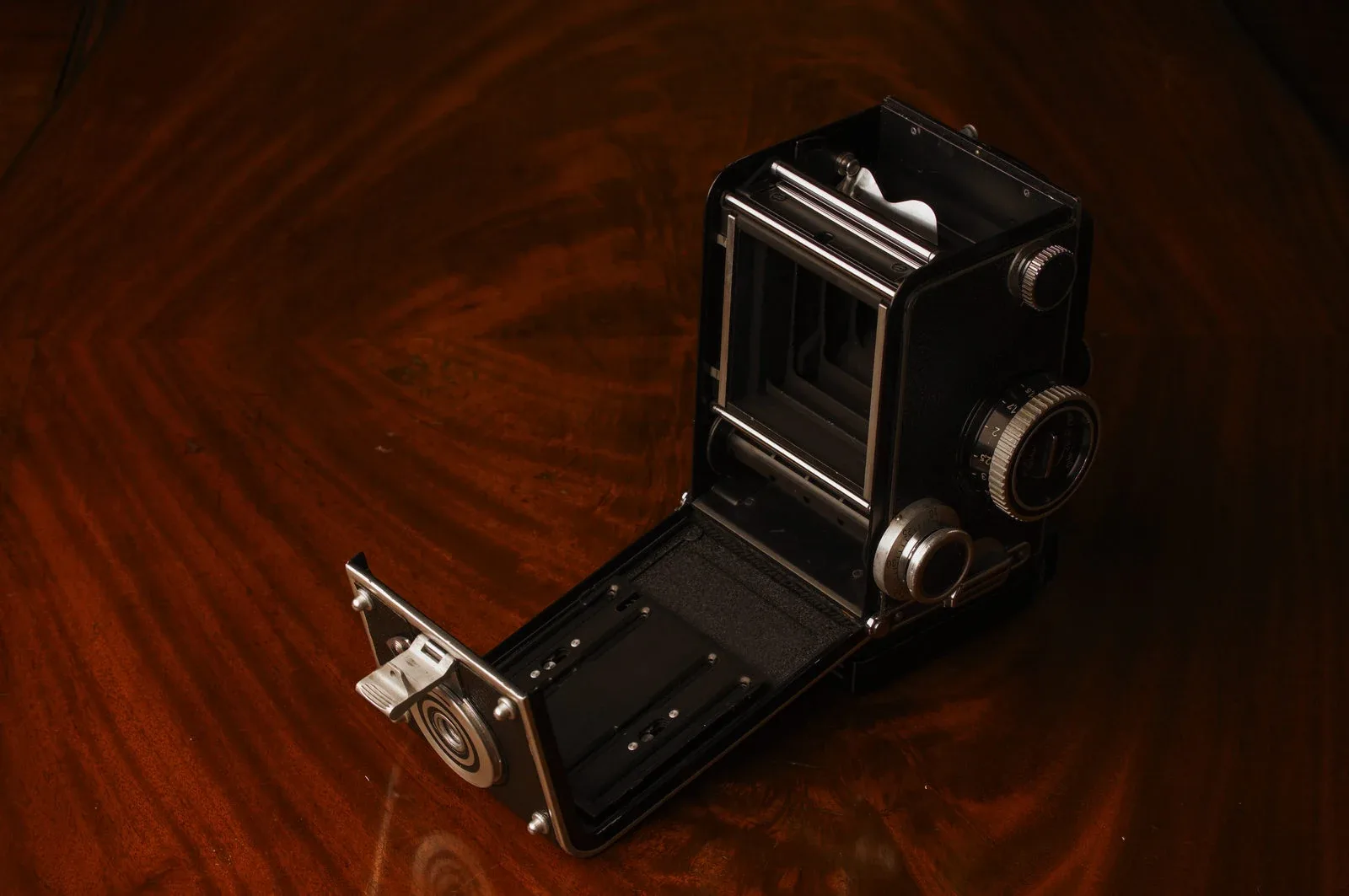
The Automat manual explains how the first frame is found without a red window. You pass the backing paper between two feeler rollers. They let the thin paper through, and when the extra thickness of the film itself arrives, the counter engages and the crank stops at frame 1. The crank's swing shortens through the roll, from about three-quarters of a turn to just under half, to keep spacing even. After frame 12 the counter disengages and the crank turns freely to wind off.
How we test it:
- Use a dummy roll. We use an old 120 backing paper with a short length of film taped on; you can also ask the seller to load one. Watch the crank stop at 1, then work through all 12 frames, firing between each. It should lock after every wind, stop at a consistent point, and run free after 12.
- Feel the stroke. On our bench, grinding, slipping, or a crank that stops early on some frames and late on others has usually meant wear in the transport. Never force a crank that won't move: the manual is clear that it only turns after the shutter has been released, and that is the usual reason.
- Check the pressure plate. Inside the back, the F manual describes a plate that can be set for 120 or for 35mm with the Rolleikin adapter, and for 120 the 2¼ × 2¼ marking must show. We have seen a plate left in the wrong position spoil focus.
- Try a deliberate double exposure on an F: the manual says to move the ring at the base of the crank and turn the crank one full turn backwards. When that hasn't worked on cameras we've seen, the mechanism has needed attention.
The T has no feeler rollers: its manual has you wind until the triangular marks on the backing paper line up with red dots beside the film gate.
Focus and parallax
Turn the focusing knob through its range. On a well-kept camera it feels even and slightly damped, with no tight spots. Then aim at a distant roofline with the knob at the infinity mark: on the cameras we pass, it is sharp on the screen just as the knob reaches infinity, not before or after.
The Automat manual describes a sliding mechanism under the screen that corrects parallax as you focus, so close-ups are framed as you see them. What matters for sharpness is that the two lenses agree; setting that (collimation) is part of the CLA on our repair page.
The meter
The Automat, C and D have no meter, and the E offered an uncoupled one. On the 3.5F and 2.8F the meter is cross-coupled to the speed and aperture wheels: exposure is right, the manual says, when both pointers line up. The F manual describes a photo cell and no battery; our repair page notes that these selenium meters are usually beyond recovery.
The F manual gives a quick test: with the cell completely covered, the needle should rest on the red zero line. Then check a daylight reading against a handheld meter. Because the cells are so often tired, we price a CLA as if there were no meter, and our own listings have called an accurate 3.5F meter rare. Buy as if it doesn't work.
Light leaks
The surest test is a roll of film. On our bench, fogging along one edge of the frame has usually pointed to the back, so check that it closes flat and locks firmly.
Common faults and what a CLA fixes
Our repair page lists the usual complaints on a Rolleiflex that has sat for years: a slow or sticking shutter, a stiff transport, a dim screen and drifted focus. The full CLA overhauls shutter, transport and focus, cleans the screen and sets collimation. Every CLA is quoted after a free inspection; current prices are on our repair pricing page. The table below is what we typically find on the bench.
| Symptom | What we usually find | Fixed by a CLA? |
|---|---|---|
| Slow speeds hesitate or stick | Old oil in the slow-speed clockwork | Yes |
| Stiff focusing knob | Hardened grease in the focusing mount | Yes |
| Crank stiff, slipping or uneven spacing | Dry or worn transport | Usually; worn parts extra |
| Infinity not sharp, lenses disagree | Focus or collimation drift | Yes |
| Dim or dirty screen | Dust, old screen | Cleaned; brighter screen is extra |
| Haze on inner surfaces | Lubricant vapour | Lens cleaning, often |
| Separation, etched fungus | Glass damage | No |
| Dead meter | Aged cell | Usually not |
Red flags
From what we see on the bench, these are the faults that should make you walk away or change the price:
- Separation or etched fungus in the taking lens.
- A dented lens board, nameplate corner or focusing knob: signs of a drop.
- A crank that won't lock, won't stop at frame 1 with film loaded, or turns freely all the time.
- A shutter that won't fire at any speed, or a seller who says it "just needs exercising".
- Infinity sharp well before the infinity mark, or never sharp at all.
- Lens serial plates that look disturbed, or a viewing lens that doesn't match the taking lens.
- A working meter used to justify the price.
Model-by-model notes
Automat (1937–56). Tessar or Xenar, no meter, and the feeler-roller film start described in its manual. Check the slow speeds and the 1/500 setting carefully on these older shutters.
2.8C, 2.8D, 2.8E and 3.5E (1952–65). The first Xenotar and Planar models. The E added an optional uncoupled meter. The hood is fixed; Wikipedia credits the F with the removable one. In our view, if you use a handheld meter anyway, an E is often good value against an F.
3.5F (1958–76) and 2.8F (1960–81). The best-known Rolleiflexes: coupled meter, removable hood, and a 24-exposure setting for 220 film mentioned in the F manual (we have not seen it on every F). Late 3.5Fs have a six-element lens, as one of our listings notes. The meter is the usual weak point.
T (1958–76). The simpler Rolleiflex: Tessar 75/3.5, bayonet size I, start-mark loading instead of feeler rollers, and an exposure-value scale that couples speed and aperture. Its manual offers a meter that could be fitted later, read as an exposure value and set on the scale. A sound T is a fine camera, and in our experience it usually costs less than an F.
Tele and Wide. The Tele Rolleiflex has a Sonnar 135/4 and the Wide a Distagon 55/4. Check the glass first.
2.8GX and 2.8FX (1989 on). Modern Rolleiflexes made long after the F. Fewer decades of wear, but check the meter and transport all the same.
What we check before a Rolleiflex goes on sale
Our stock goes through the same check as our Service Plus before it reaches the shelf: shutter speeds measured on the timer at every setting, a test roll shot and developed, and a written report across four condition axes. Every camera is graded on our five-level scale, and serviced cameras come with a filmed inspection you can verify by QR and a mechanical warranty. Browse what we have in our Rolleiflex collection, see how we grade, or book a Rolleiflex CLA for your own.
Frequently asked questions
Is a Rolleiflex 2.8 better than a 3.5?
Not sharper, just about two-thirds of a stop faster. Buy the one in better condition.
Planar or Xenotar: which is better?
On our bench we have found little to choose between them. Both were fitted to the same cameras, and condition matters far more than the maker.
Does a Rolleiflex need a battery?
Not the Automat, the E, the F or the T. The shutter and transport are mechanical, and the F manual describes its meter's photo cell with no battery.
How do I know the Rolleiflex light meter is working?
Cover the cell: the F manual says the needle should then sit on the red zero line. Then compare a daylight reading with a handheld meter. In our experience most are weak or dead.
How much does a Rolleiflex CLA cost in London?
Every CLA is quoted after a free inspection. Current prices are on our repair pricing page, and the Rolleiflex repair page explains what the work covers.
Why won't my Rolleiflex crank turn?
Usually because the shutter hasn't been fired since the last wind: the F manual says the crank only turns after a release. Press the release (with the lock off), then wind. If it still won't move, don't force it.