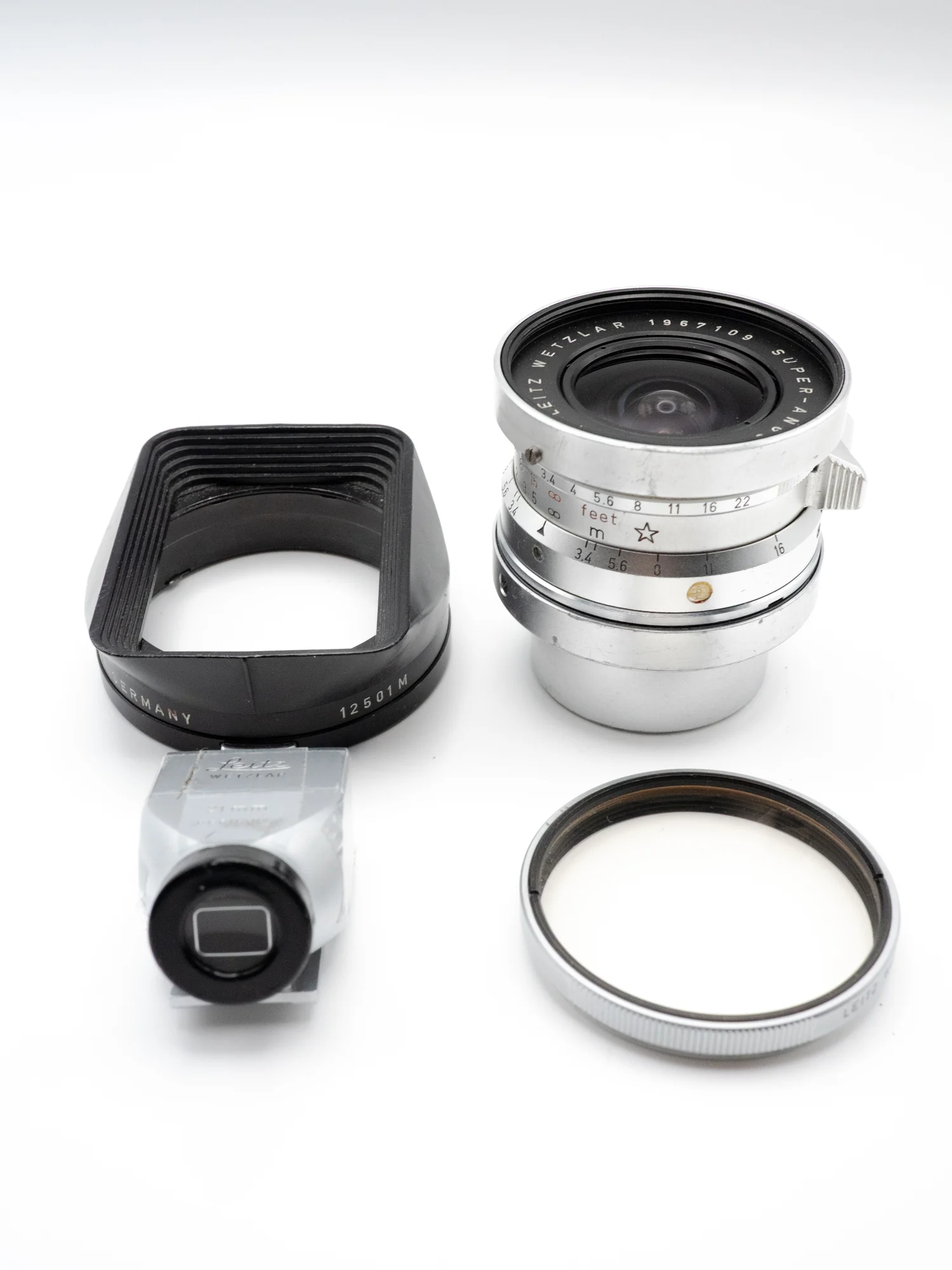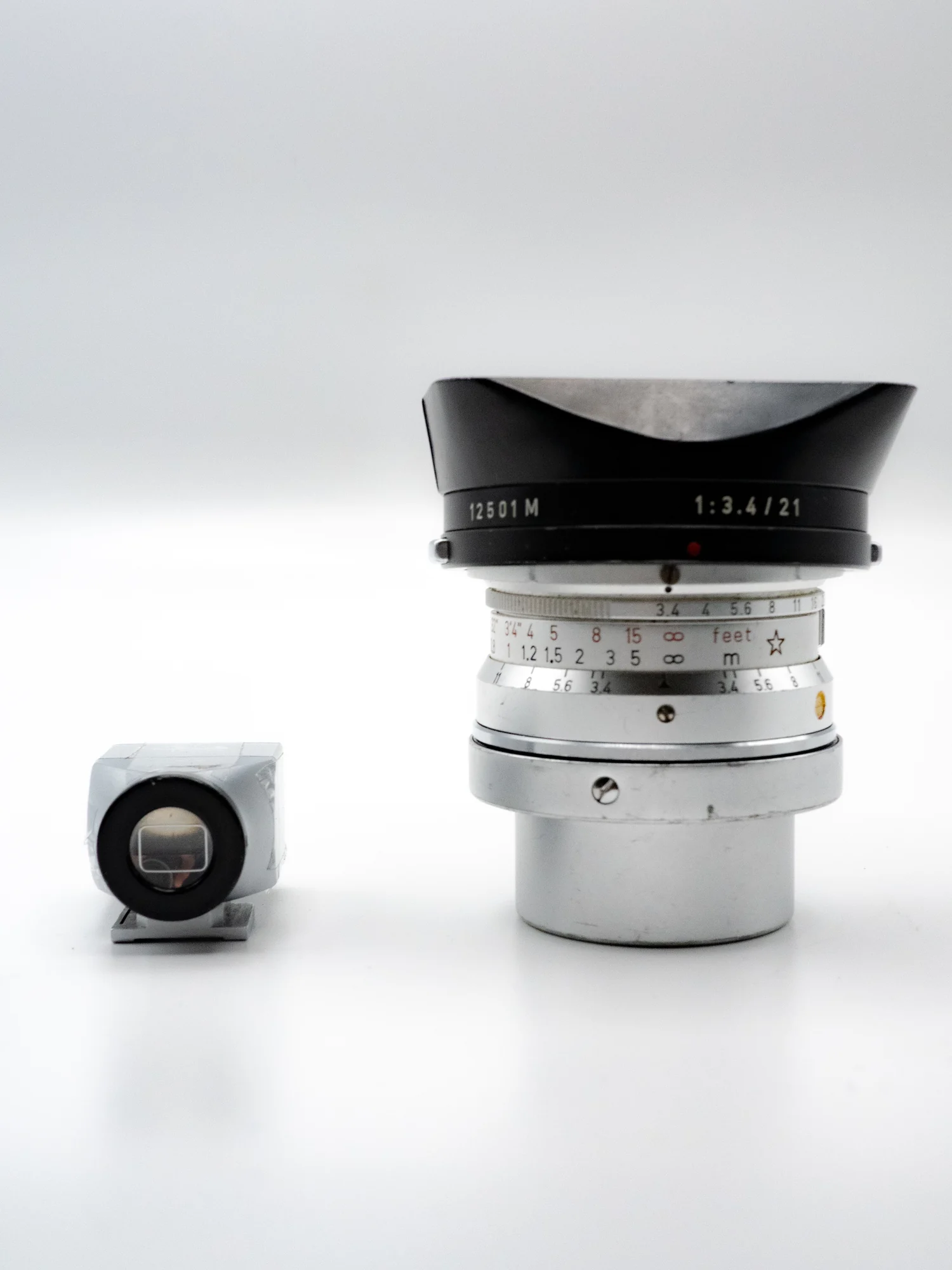
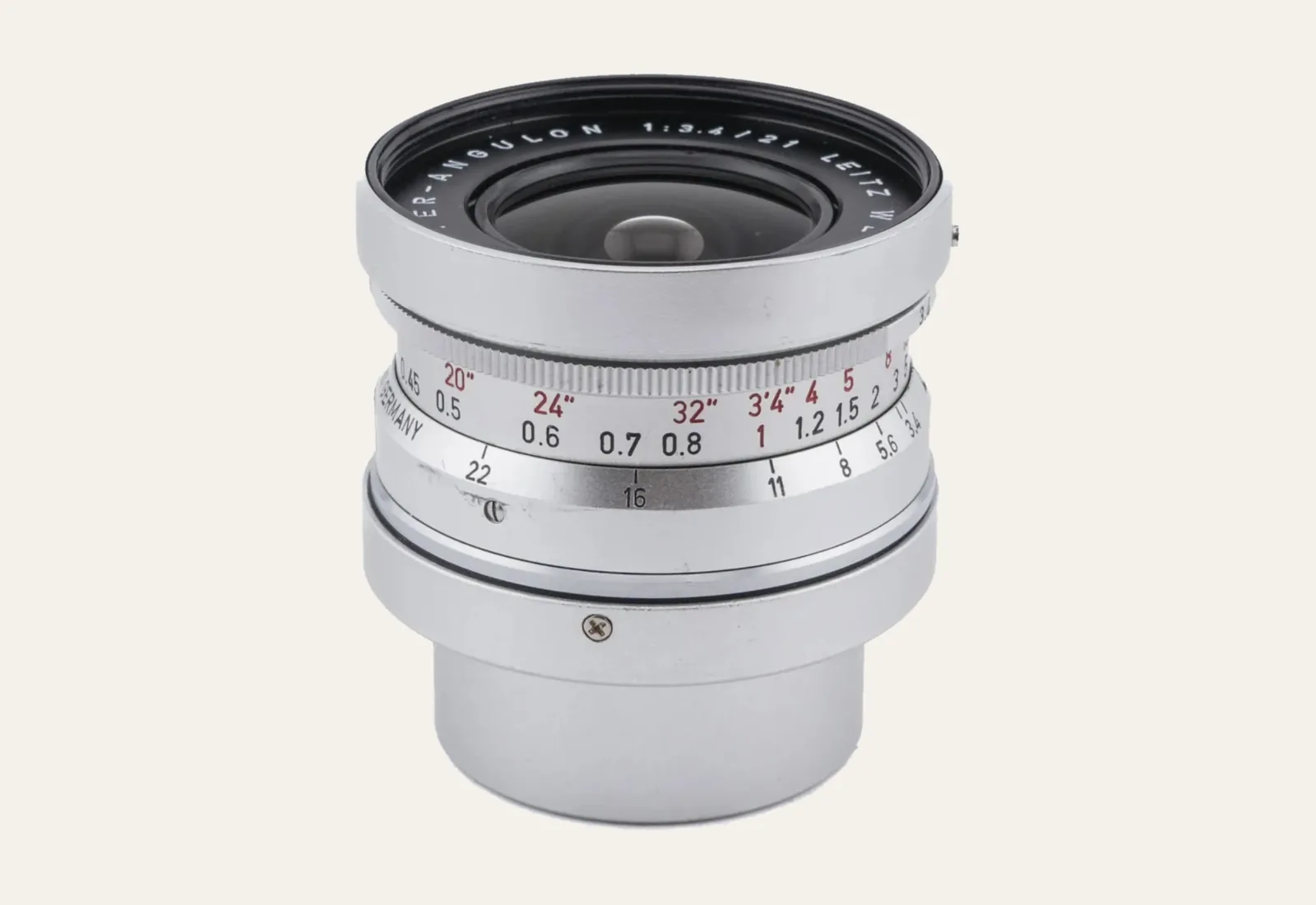
Leitz had its own vocabulary for lenses: Elmar, Elmarit, Summicron, Summilux, Noctilux. They sound as if one person named them, because one house did. Then there is a 21mm lens for the Leica M called the Super-Angulon, and that name doesn't belong to Leitz at all. It is Schneider-Kreuznach's. Schneider had used it for decades on its large-format wide-angles, carrying on from its earlier Angulon line. Leica left the name alone because the lens was Schneider's, inside and out.
This article covers where the Super-Angulon came from and what the design costs you in use. It also explains the notch that lets it fit an M5, and what to look for if you want to buy one.
Why does a Leica lens carry Schneider's name?
1954: Zeiss had the 21mm, Leica didn't
In 1954 Zeiss released the Biogon 21mm f/4.5, the first 21mm made in real numbers. Ludwig Bertele had designed the Biogon in 1934 and reworked it for 21mm in 1951. Zeiss sold it for the Contax rangefinder, and it was also available for Leica screw-mount bodies.
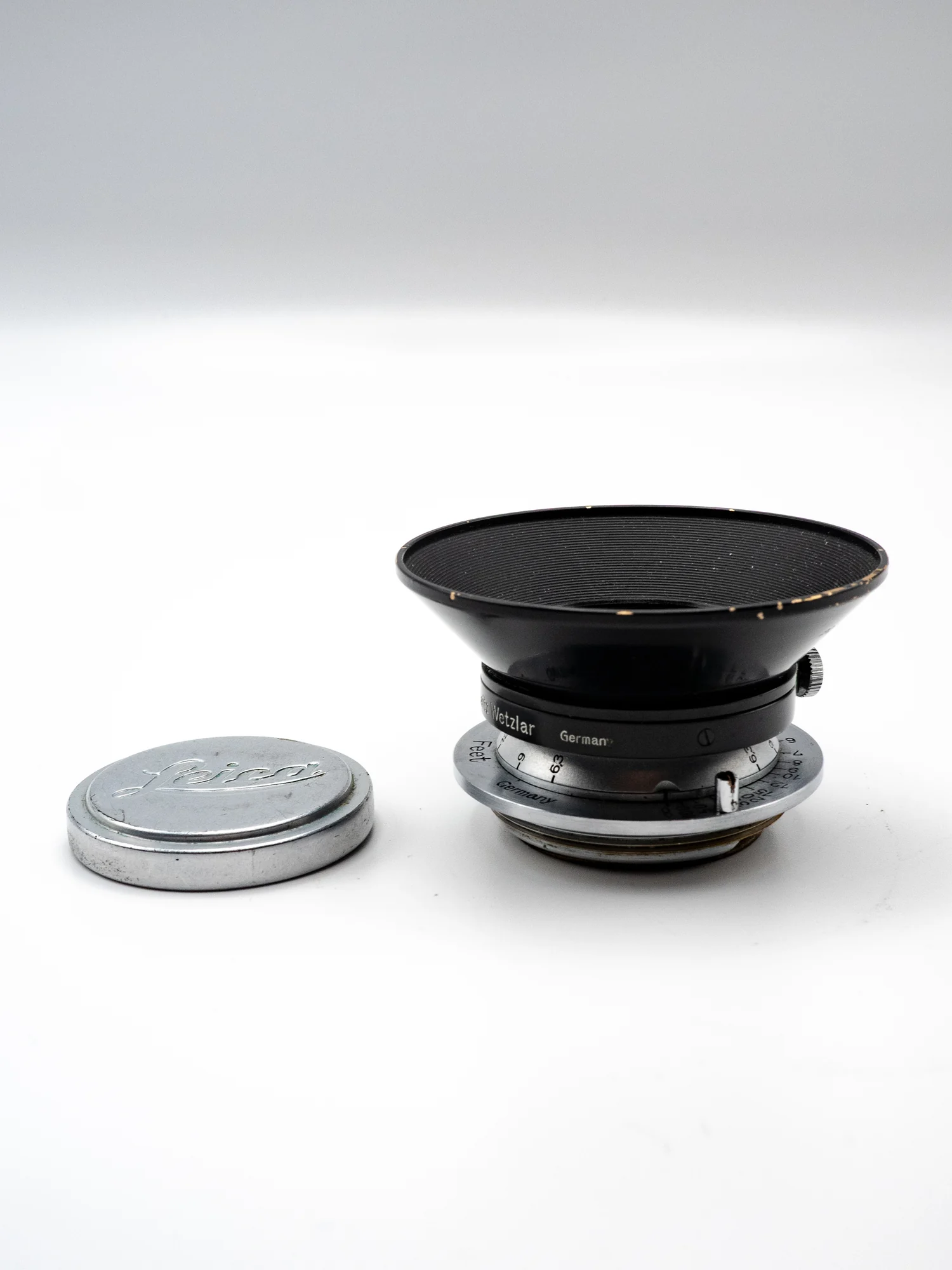
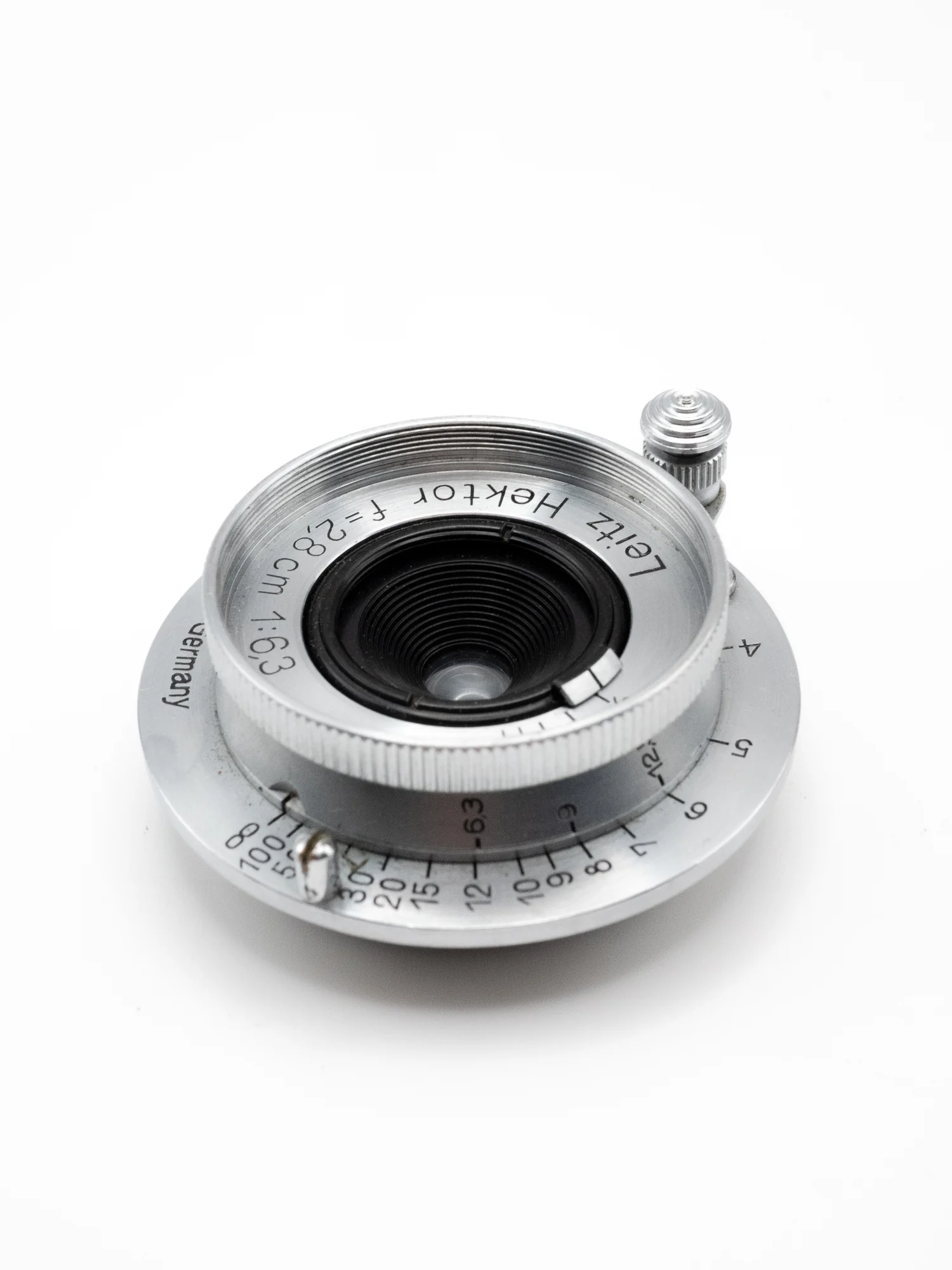
So in 1954, if you wanted to shoot 21mm on a Leica, you bought a Zeiss lens. Leica's own widest lens was still the 28mm Hektor f/6.3 from 1935, which was a stop slower than the Zeiss.
The design wasn't German to begin with
In 1935 the Soviet designer Mikhail Rusinov came up with the basic ultra-wide layout used in this family of lenses. Its big achievement was roughly doubling the illumination at the edges of the frame, so it went a long way towards solving the dark corners that had always plagued wide-angles. The war held up his patent. He filed in the United States in 1946 (US 2,516,724), and it was granted in 1950.
Bertele's Aviogon for Wild (1950) and his 90-degree Biogon for Zeiss (1951) both came after Rusinov, and Bertele never held the base patent on the meniscus arrangement. In 1954 Günter Klemt at Schneider filed the Super-Angulon patent, US 2,781,695, which was granted in 1957 and cites Rusinov's work as prior art. According to a biography written by Bertele's son, Bertele wanted to sue Schneider for copying when he saw the Super-Angulon. His lawyers told him he would lose, because the Super-Angulon really was different from the original Biogon. Rodenstock's Grandagon later grew from the same root. That makes four makers in three countries, and none of them could fairly call the design entirely their own.
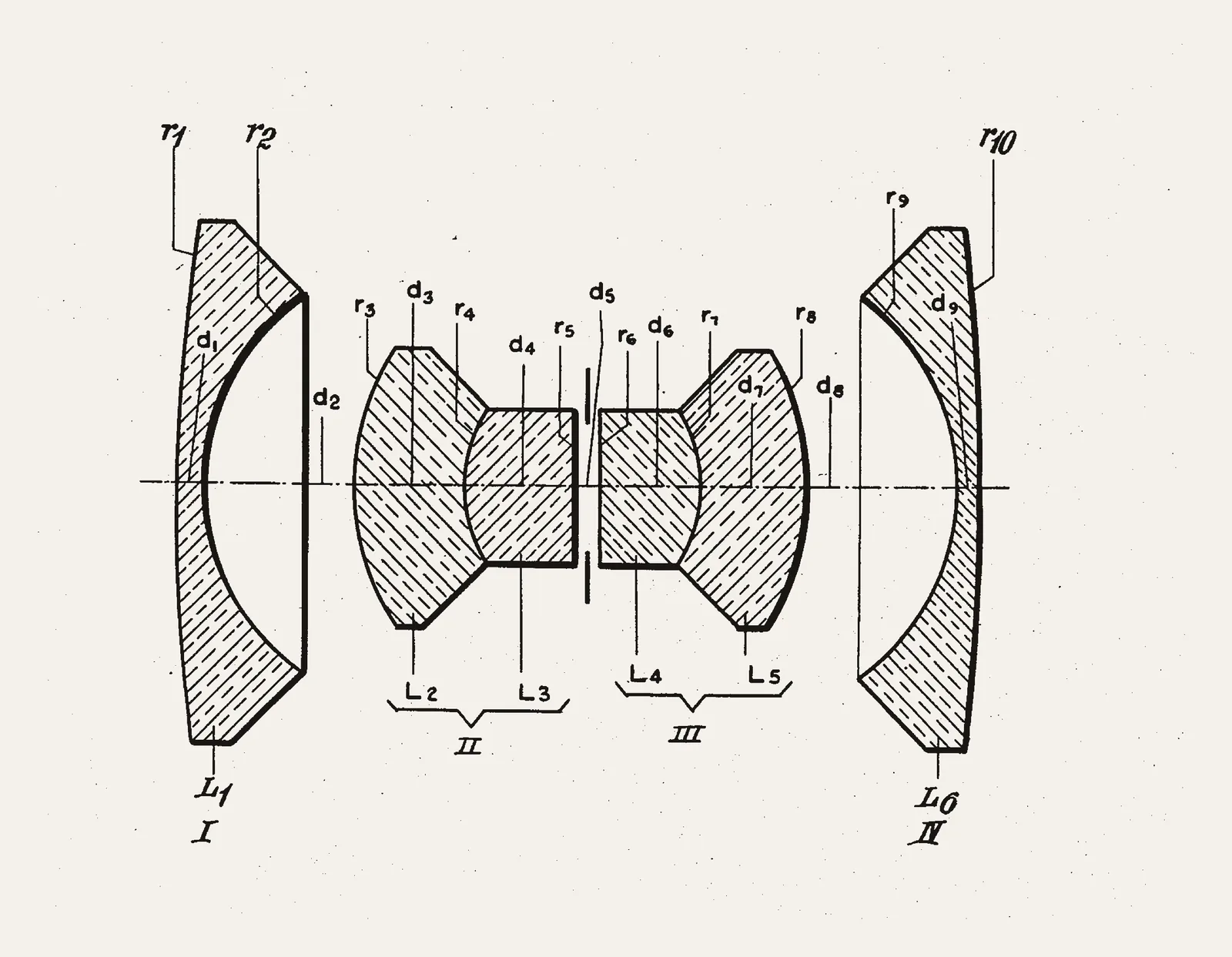
Schneider's patent figure shows the base design of six elements in four groups, with a cemented doublet in each inner group. The production 21mm f/3.4 goes one step further: each inner group becomes a cemented triplet, giving eight elements in four groups. So the patent shows the architecture, not the exact prescription of the lens you buy.
Why a symmetrical design, and why Schneider?
At very short focal lengths the problem is distortion. The symmetrical answer is to make the groups in front of and behind the aperture mirror images of each other. Each half distorts in the opposite direction, the two cancel out, and straight lines stay straight. Schneider had spent decades refining exactly this in large format. At the time Leitz had no ultra-wide design of its own, so it went to Schneider.
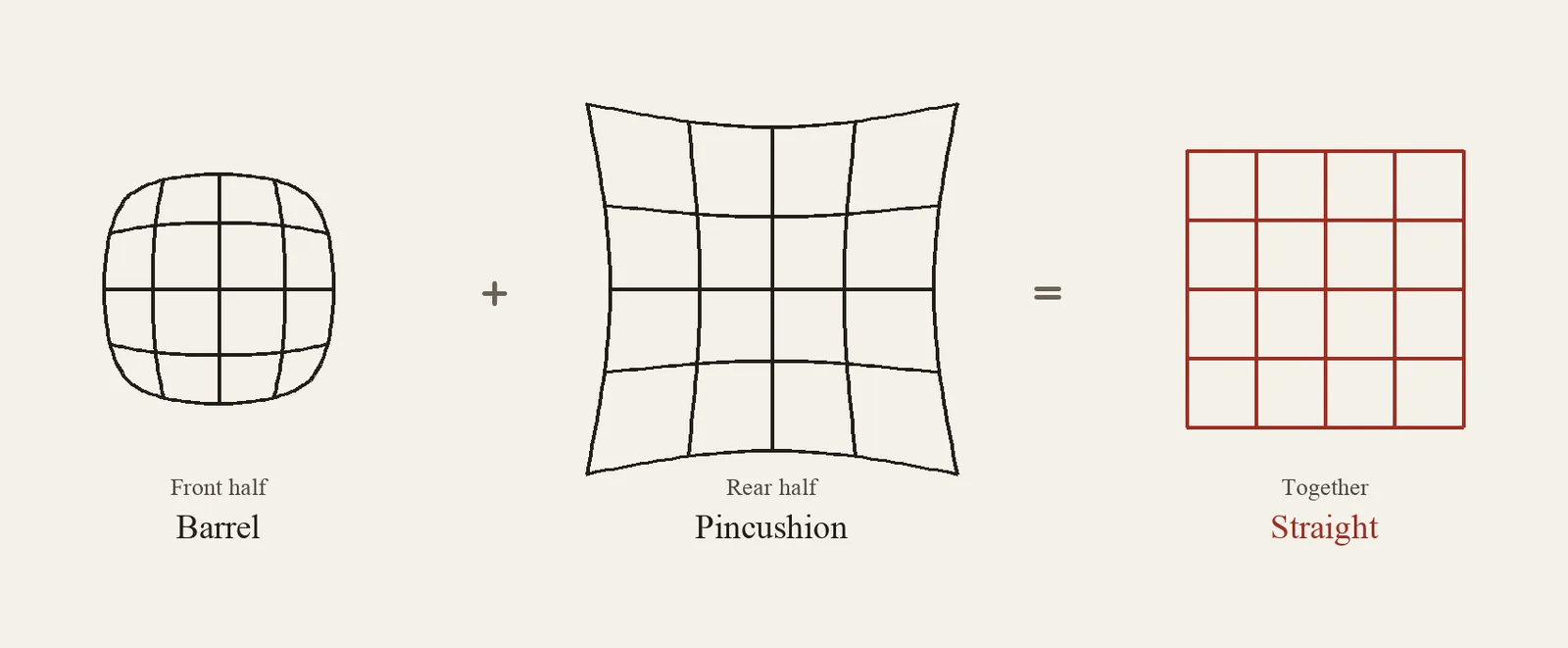
Schneider made the optical units in Bad Kreuznach, and Leitz built them into M-mount focusing mounts in Wetzlar. Schneider's name stayed on the lens.
Super-Angulon 21mm f/4 vs f/3.4: what's the difference?
There are two generations, and they are different lenses.
| 21mm f/4 | 21mm f/3.4 | |
|---|---|---|
| Made | 1958–1963 | 1963–1980 |
| Construction | 9 elements, 4 groups | 8 elements, 4 groups, quasi-symmetrical |
| Aperture blades | 9 | 4 |
| Mount | Screw mount and M | M only |
| Finish | Chrome only | Chrome until 1967, black after |
| Filter | 39mm | 48mm thread, or Series VII in the hood |
| Weight | 251 g | 301 g |
| Close focus | 0.4 m | 0.4 m |
| Order number | 11002 (screw), 11102 (M) | 11103 |
The f/3.4 was launched at Photokina in Cologne in March 1963. An odd number like f/3.4 isn't a full stop, and the argument over it has never been settled. The line at the time was that you got a little extra speed and slightly better optics as well. Others felt the f/4 was already good enough, and that dropping from nine blades to four was a step backwards. Those four blades turn the sun into a four-pointed star, which has become one of the lens's signatures.
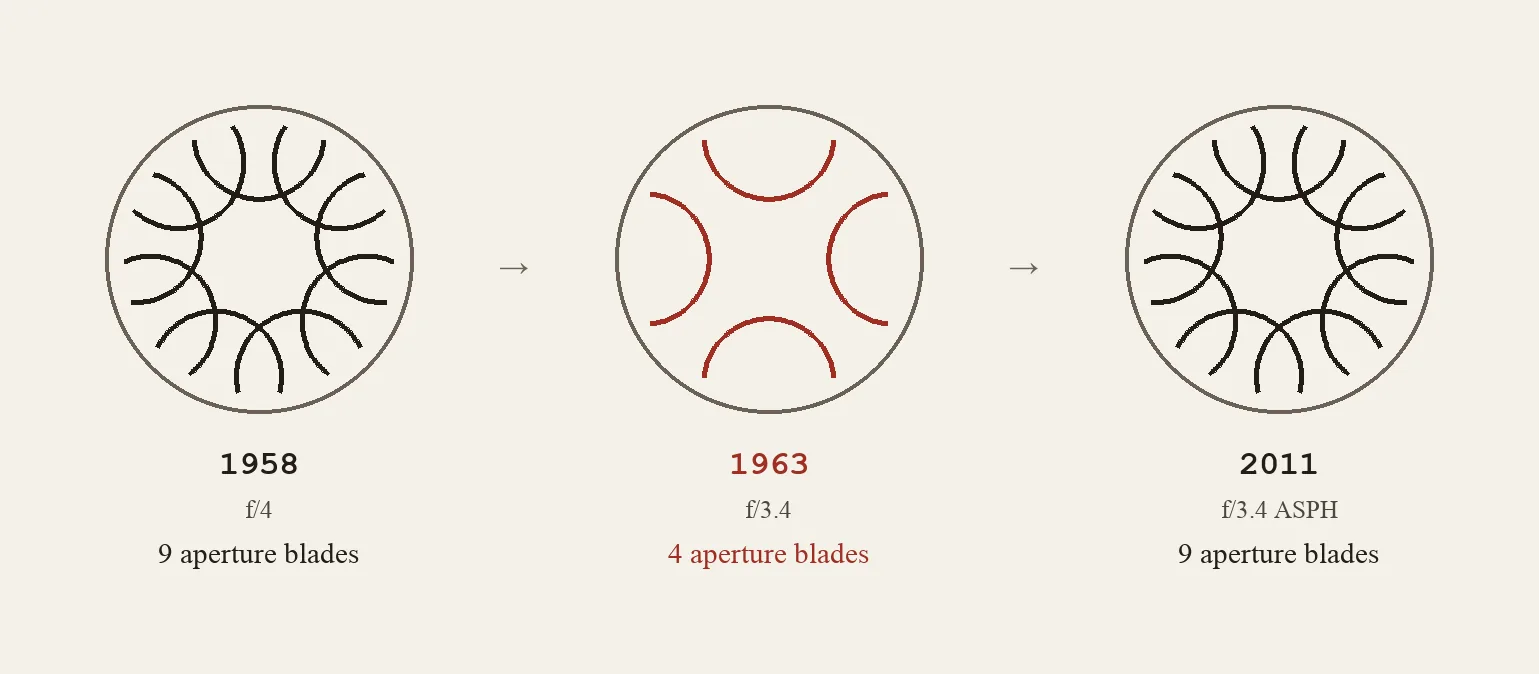
The trade: a rear group that goes inside the camera
For a quasi-symmetrical design to work at 21mm without going retrofocus, the rear group has to sit very close to the film. On a Leica M that means it crosses the flange and reaches well inside the body. Mounted on a camera, that lump of glass at the back is properly inside the camera.
What you gain is almost no distortion, so lines come out as straight as if drawn with a ruler, in a lens barrel only 51mm long. What you pay is that deep rear group. Every problem below comes from it.
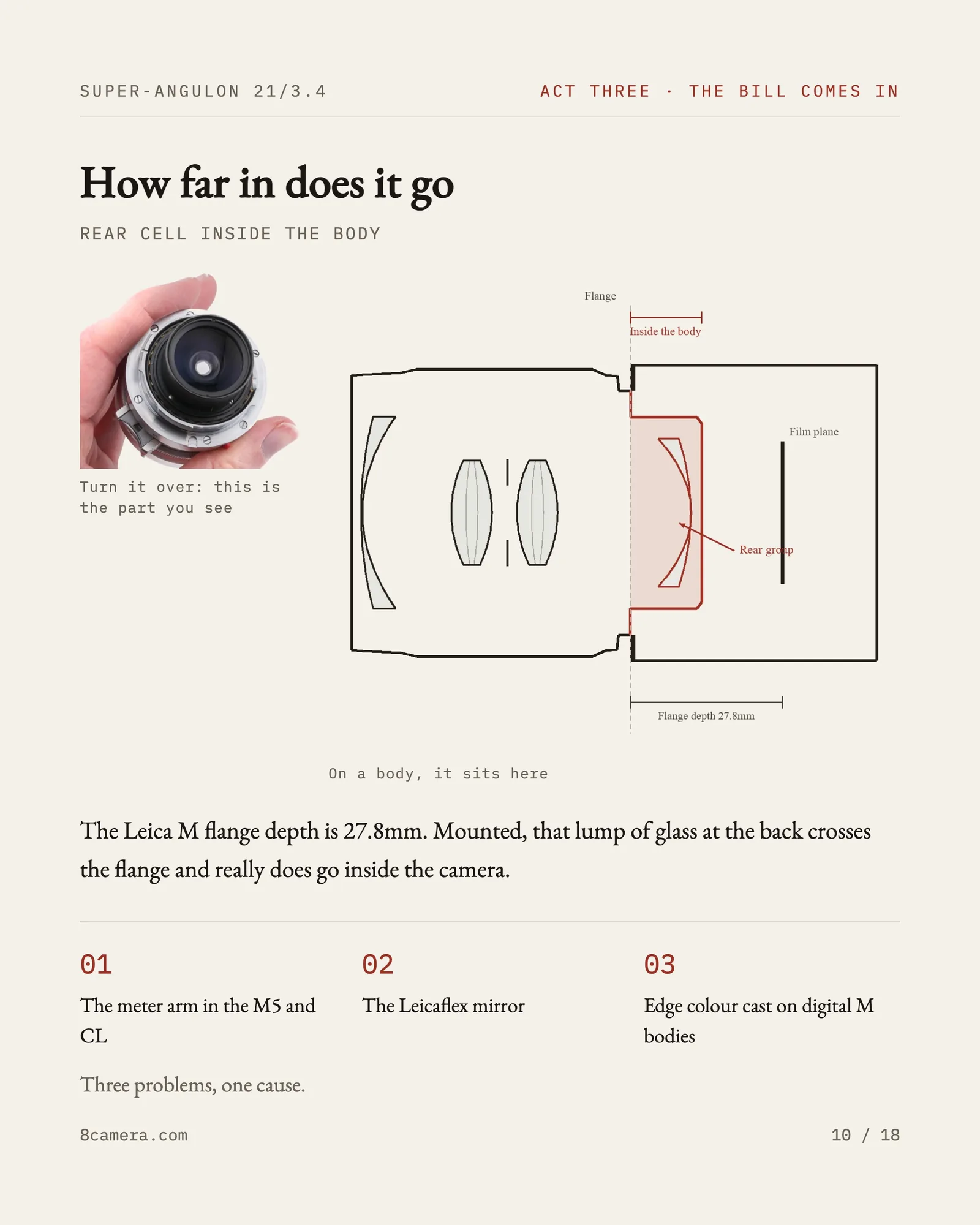
Does the Super-Angulon 21mm work on a Leica M5, M6 or CL?
It fits, but no version of this lens will give a through-the-lens meter reading on any Leica body. There are two separate reasons.
- M6, M7 and MP: blocked. These bodies meter off a white patch on the shutter curtain, and the rear tube covers the metering window. Nothing collides, but the reading is wrong.
- M5 and CL: collision. These cameras have a meter cell on a swinging arm that moves into the light path. On an unmodified lens the arm hits the rear group, and it can damage the arm.
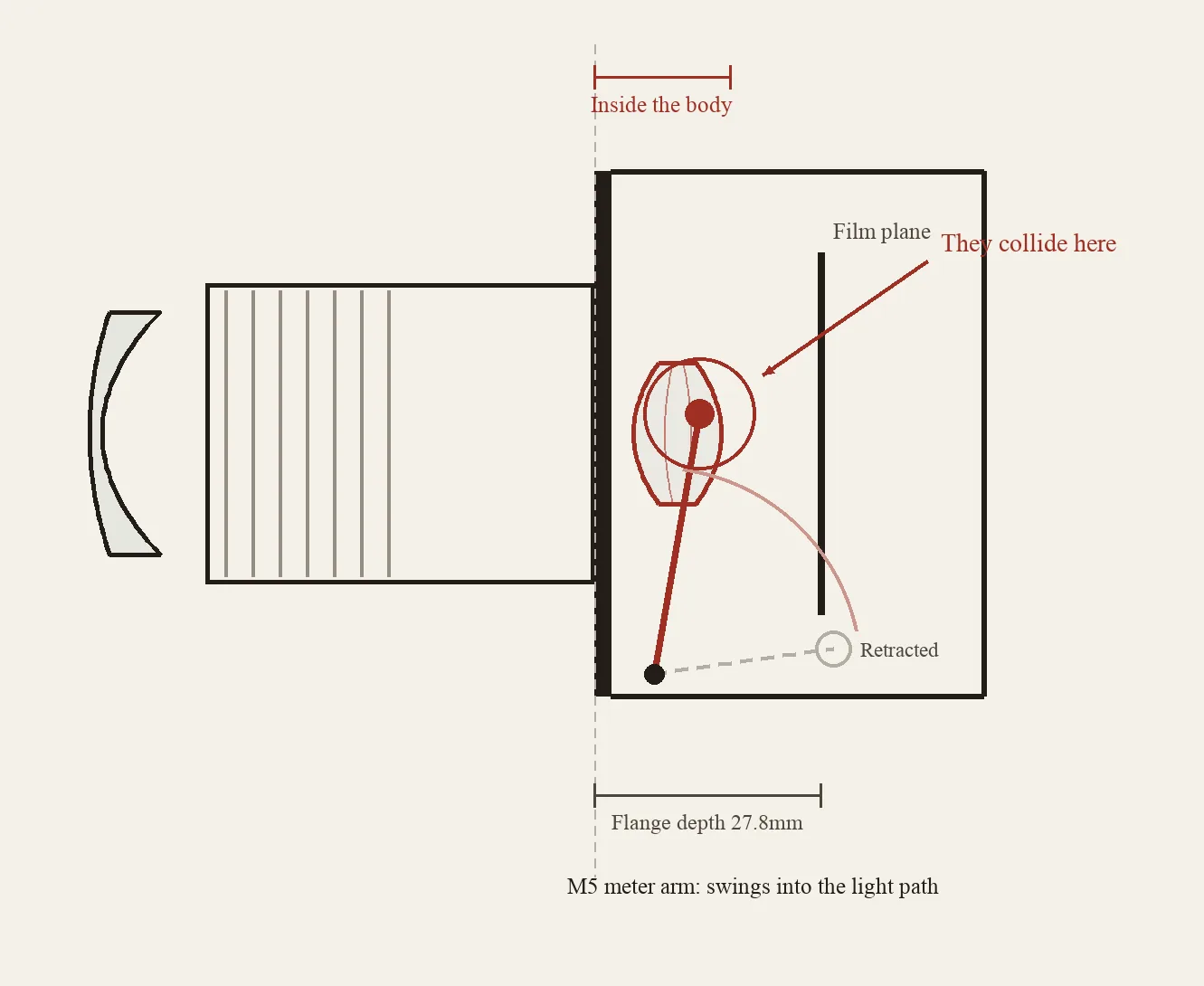
From 1970, from roughly serial 2,473,252, the lens was modified. A square notch was cut into the inner lip of the bayonet mount so that the camera's actuator is never triggered. The arm stays down, so nothing collides and the lens mounts safely. It still doesn't meter. Earlier lenses could be sent back to Leitz for the same conversion, so a lens with a lower serial number may still have the notch.
It's unusual for a lens maker to go back and change a lens that had been on sale for seven years just to suit one camera. Usually the camera has to work around the lens.
The first Elmarit-M 28mm f/2.8 has the same problem for the same reason. It is also a deep, non-retrofocus wide-angle, and it shares the same 12501 hood. Buyers of either lens need to check the same thing.
What about the Leicaflex? The R-mount versions
The R version, the Super-Angulon-R 21mm f/3.4 (11803), had a rear group so long that the mirror had to be locked up before mounting, and you framed with an accessory finder. That only worked on the original Leicaflex Standard, which had mirror lock-up. The Leicaflex SL replaced mirror lock-up with depth-of-field preview, and the lens had nowhere to go. Leica brought in a retrofocus Super-Angulon-R 21mm f/4 (11813) in 1968 for the SL and SL2.
Watch out second-hand: on the M side, the f/4 is the early symmetrical lens. On the R side, the f/4 is the later retrofocus design. The aperture number is the same, but the lenses are completely different.
How Leica finally built its own 21mm
At Photokina in 1980 Leica introduced the Elmarit-M 21mm f/2.8. It was the first 21mm Leica made itself, built in Canada. It used a retrofocus design, so the rear group moved back out of the body and the lens worked with every TTL-metering M. The cost was some distortion. Once the back focus gets longer and the symmetry goes, distortion has to be controlled in other ways.
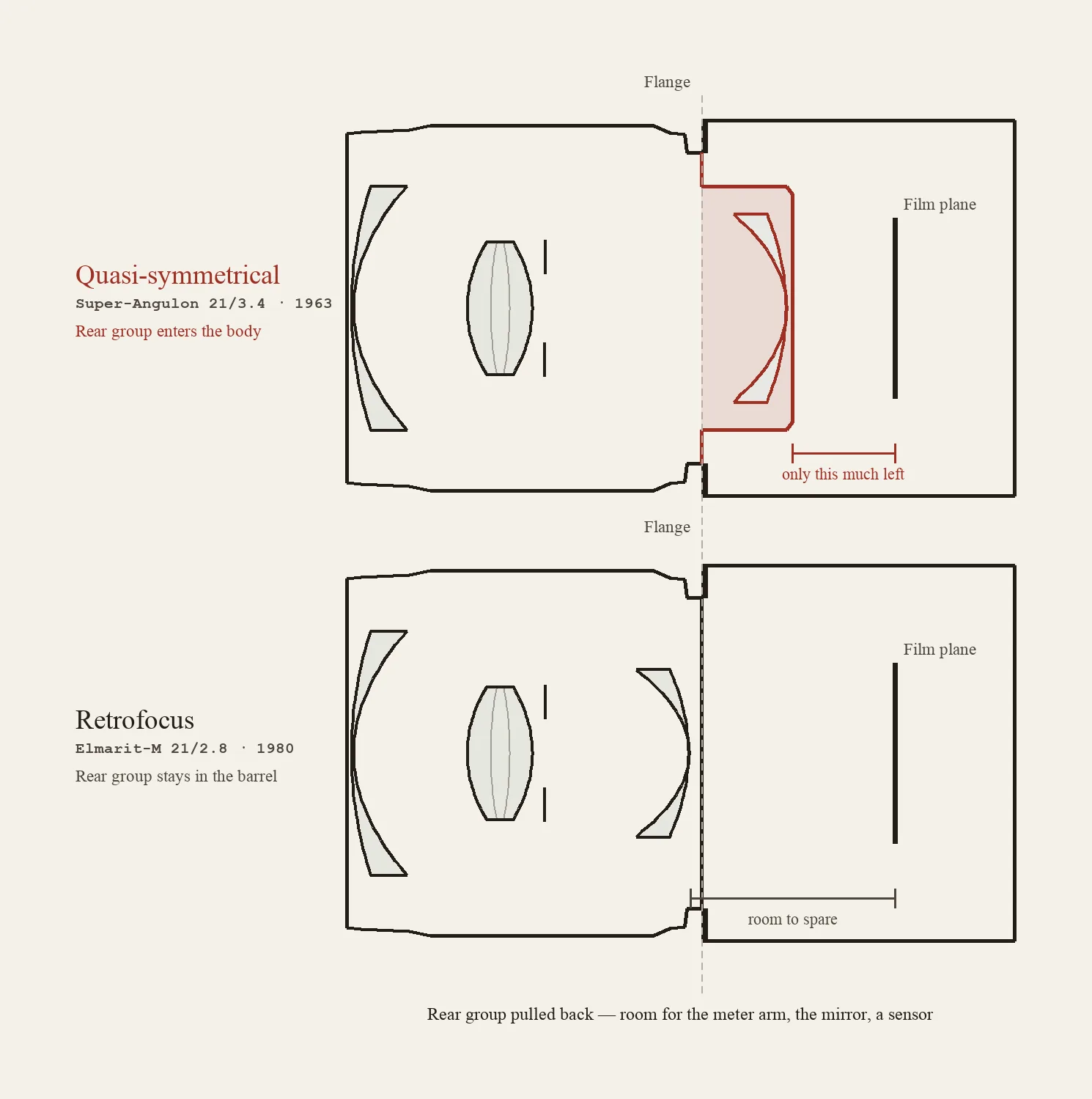
The Super-Angulon was discontinued the same year. Over seventeen years, just under 6,000 of the f/3.4 were made.
Is the Super-Angulon any good on a digital Leica M?
The deep rear group causes trouble again on digital. Light reaches the edges of the frame at a very steep angle. Film hardly cares, because the emulsion is exposed by light from any angle. A sensor is different: each pixel has a microlens designed for light arriving more or less head-on, with a colour filter and cover glass on top. Steep rays travel further through that layer and partly spill under the neighbouring pixel's filter. The three colour channels lose light unevenly, so the edges change colour as well as darken.
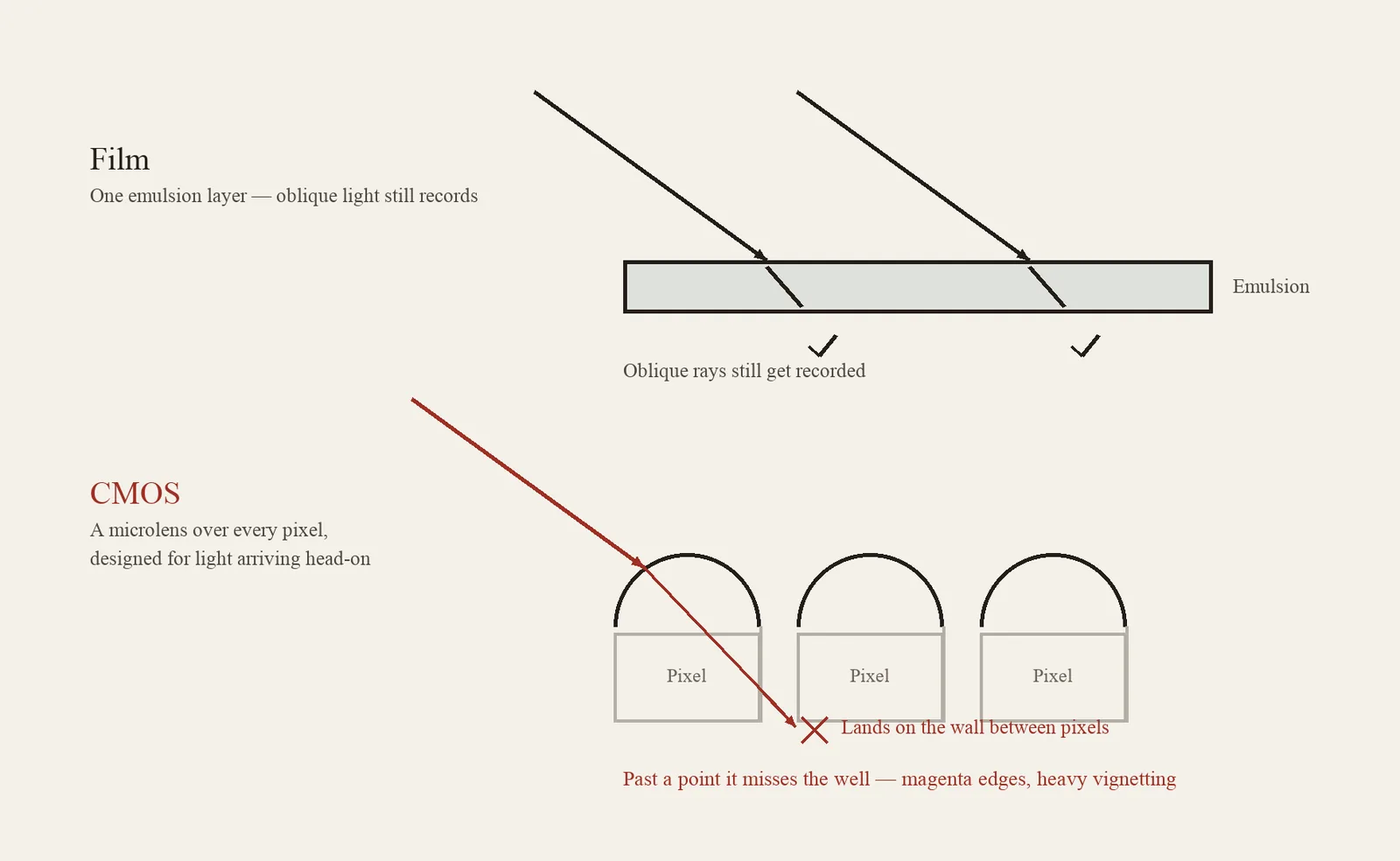
On a digital M the usual symptom is magenta down the left and right edges, a little in the corners, and much heavier vignetting than on film. Choosing Leica's 21mm profile in the camera doesn't remove it, and this lens can't be 6-bit coded. The fix that works is to photograph an evenly lit white wall at each aperture and build a correction profile with Cornerfix. The lens hasn't got worse with age. Cameras simply changed.
In 2011 Leica released the Super-Elmar-M 21mm f/3.4 ASPH. It has the same maximum aperture, but it is Leica's own design, retrofocus with aspherical surfaces, 8 elements in 7 groups, 263 g, and fine on digital. It also has nine aperture blades, like the 1958 f/4. After half a century, both the aperture and the blade count had come back round.
What to check when buying a Super-Angulon 21mm f/3.4
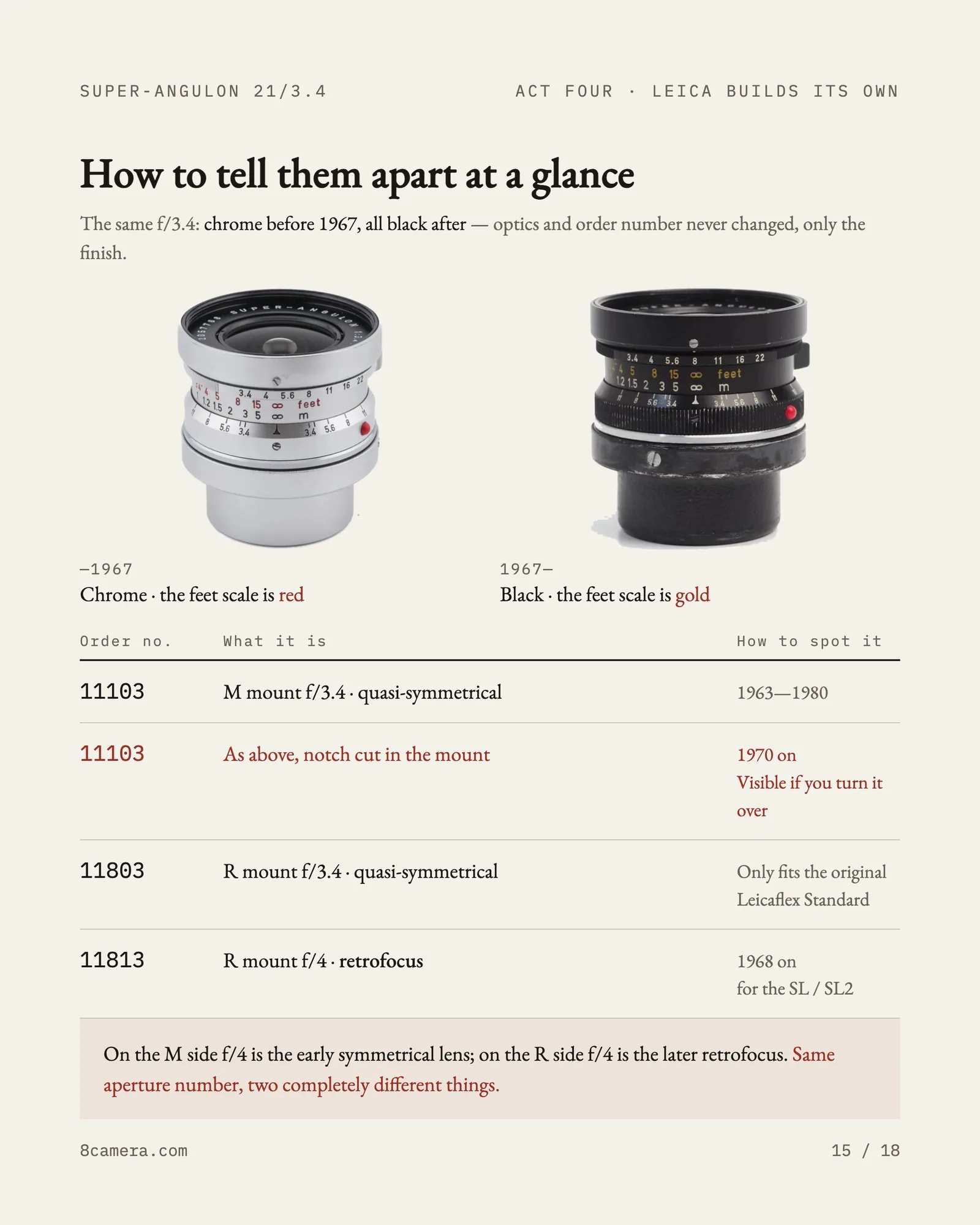
- Confirm which lens it is. The f/3.4 is engraved 1:3.4/21 on the front ring and its aperture scale starts at 3.4. An f/4 reads 1:4/21 and starts at 4. Don't go by colour: a chrome lens can be either.
- Chrome or black. The f/3.4 was chrome until 1967 and black afterwards. On a chrome lens the feet scale is red, and on a black one it is gold. Because the notch only appeared from 1970, no chrome lens left the factory with it.
- Look for the M5 notch. Turn the lens over and look at the inner lip of the mount at about one to two o'clock. A modified lens has a square step there, and an unmodified one runs smoothly all the way round. The notch is on the mount, not on the rear tube. Don't mount an unmodified lens on an M5 or CL, and remember that neither type will meter.
- Accessories. The filter thread is 48mm, an unusual size. You can also use a Series VII filter in the hood. The original hood is the square 12501, and the matching 21mm finder is the 12002 (originally coded SBKOO). Without a finder you're guessing at the framing.
- Close focus. The lens focuses to 0.4 m, but the rangefinder coupling doesn't reach that far, so the closest distances have to be set by scale.
- Glass condition. There are no electronics and no leaf shutter, and the optics are classic Schneider work, so mechanically this is one of the easier lenses to service. The real risks are coating wear, haze and fungus, so check the glass carefully with a torch.
Who is the Super-Angulon for today?
It is still happiest on an unmetered body such as an M2, M3 or M4, with an external finder and a roll of black-and-white film, photographing buildings. That is the job it was designed for. It works on a digital M if you're willing to profile out the magenta edges. As an everyday working lens it has been retired. As a piece of history, a Leica lens that one group of German engineers borrowed from another, it is still very much worth having.
If you'd like to see what wide-angles we currently have, browse our Leica lenses, or look through our wider Leica collection.