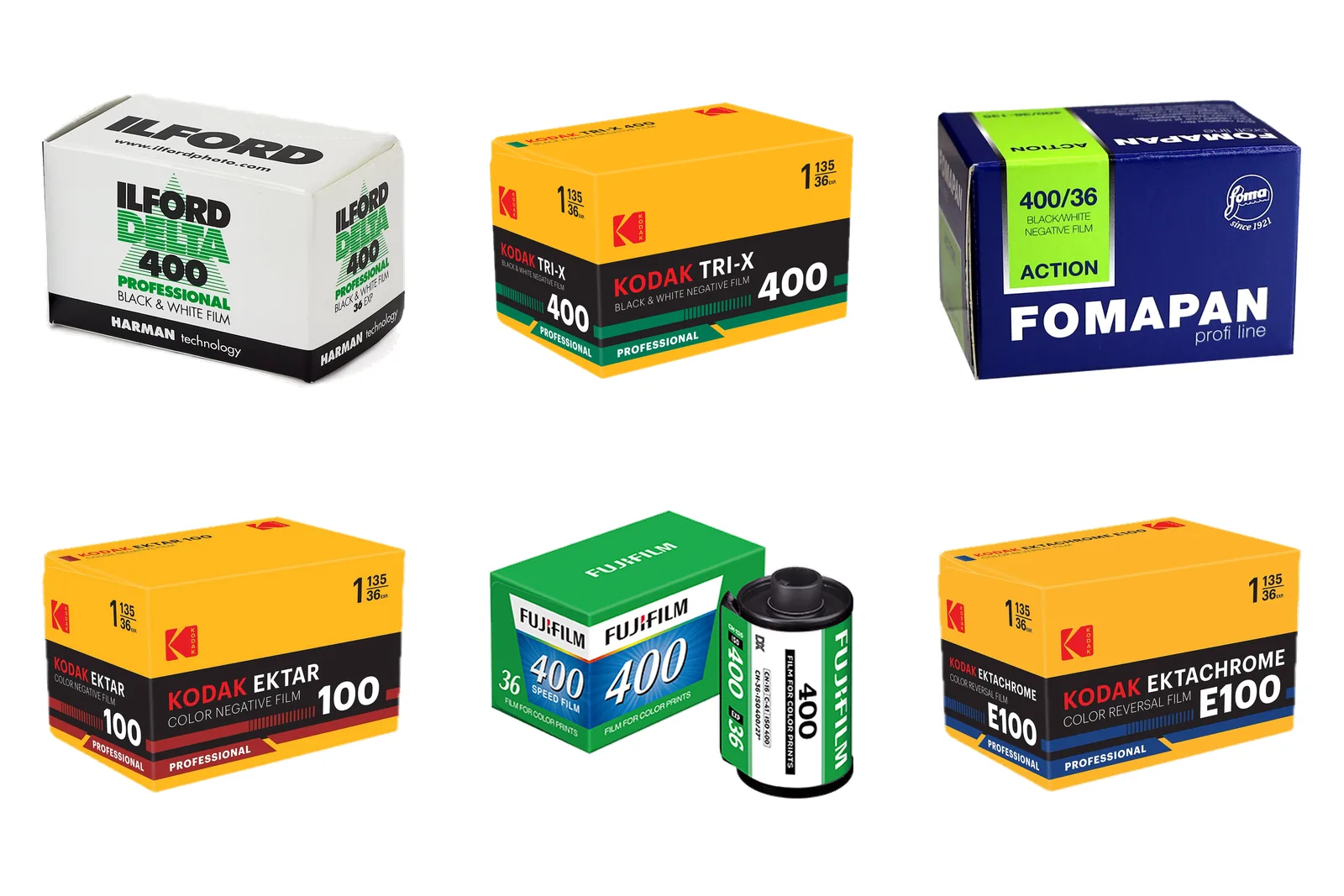
Most people choose their first roll by the colour of the box. A few minutes on how film types differ will save you a disappointing roll. This guide covers the three families of 35mm film, how to pick a speed, and which stocks are still made in 2026, with what each looks like.
Colour negative, black and white or slide: which should I buy?
Choose the type first and the brand second.
| Type | Process | How forgiving | Best for |
|---|---|---|---|
| Black and white negative | Black and white chemistry (or C-41 for XP2 Super) | Very, especially at ISO 400 | Learning, street, low light |
| Colour negative | C-41 | Forgives over, not under | Everyday colour, people, travel |
| Colour slide (reversal) | E-6 | Roughly half a stop either way | Landscape, architecture, projection, viewing the original |
Black and white is the best place to learn. Colour negative costs more to process, and the colour you get back depends partly on the lab's scanner presets. When a colour frame disappoints, you can't tell whether the fault was yours or the lab's. Black and white removes that variable.
Colour negative is the everyday choice. Underexposed frames tend to go purple, overexposed frames lean pink-yellow, and once you go past the film's range in either direction the colour balance goes and grain shows. If you are unsure, give it half a stop to a stop more.
Slide film is the demanding one. It develops into a positive you can hold up to the light, but latitude is narrow, so you meter for the highlights and err towards underexposure: the reverse of the negative-film habit.
How do I choose a film speed?
Choose for the light you will actually shoot in:
- ISO 100–200: bright sun and open shade.
- ISO 400: overcast days and indoors.
- ISO 800 and above: after dark.
Within one family, higher speed means coarser grain, but in black and white especially the 400s also recover from mistakes that would ruin a roll of 100.
Which black and white 35mm films are still made?
Fifteen black and white films are still made in 35mm. They differ on three things, grain, contrast and latitude, and for a beginner latitude matters most. Ilford HP5 Plus is the one we hand people for a first roll: it recovers from three or four stops of underexposure. Kodak Tri-X 400 is the choice for visible grain, Delta 400 and Ektapan 400 (formerly T-MAX 400) for fine grain, and Kentmere Pan 400 for a tight budget. The ISO 3200 films are really about ISO 1000, so meter them at 1600.
All fifteen, with a grain and contrast chart, latitude, sample photos and how pushing and the developer change the result, are in our black and white 35mm film guide.
Which colour negative 35mm films are still made?
With colour, the first question is what the colour looks like: Fujifilm leans cool and green; Kodak leans warm and yellow-red, and professional lines are more subtle than consumer lines. For people, Ektacolor Pro 400 (formerly Portra 400); for landscape, Ektar 100; for a first roll, Gold 200; for night, CineStill 800T.
All seventeen stocks, with a colour chart, sample photos, exposure latitude and what to ask your lab, are in our colour negative 35mm film guide.
What happened to Portra and T-MAX?
From 24 March 2026, Eastman Kodak renamed two lines that Kodak Alaris had previously distributed:
- T-MAX 100 / 400 / P3200 became Ektapan 100 / 400 / P3200
- Portra 160 / 400 / 800 became Ektacolor Pro 160 / 400 / 800
The emulsions and formulas did not change. The Portra and T-MAX trademarks sit with Kodak Alaris, so when Eastman Kodak took distribution back, it revived old names it owns. Tri-X, Ektar and Ektachrome keep their names. Old boxes are being sold through, so you'll see both on shelves for a while. They are the same film.
Kodak has not said which emulsions Kodacolor 100 and 200 use, so treat any claimed match as guesswork.
Which slide films are still made in 35mm?
Only four colour reversal films are still made in 35mm:
| Film | ISO | Character |
|---|---|---|
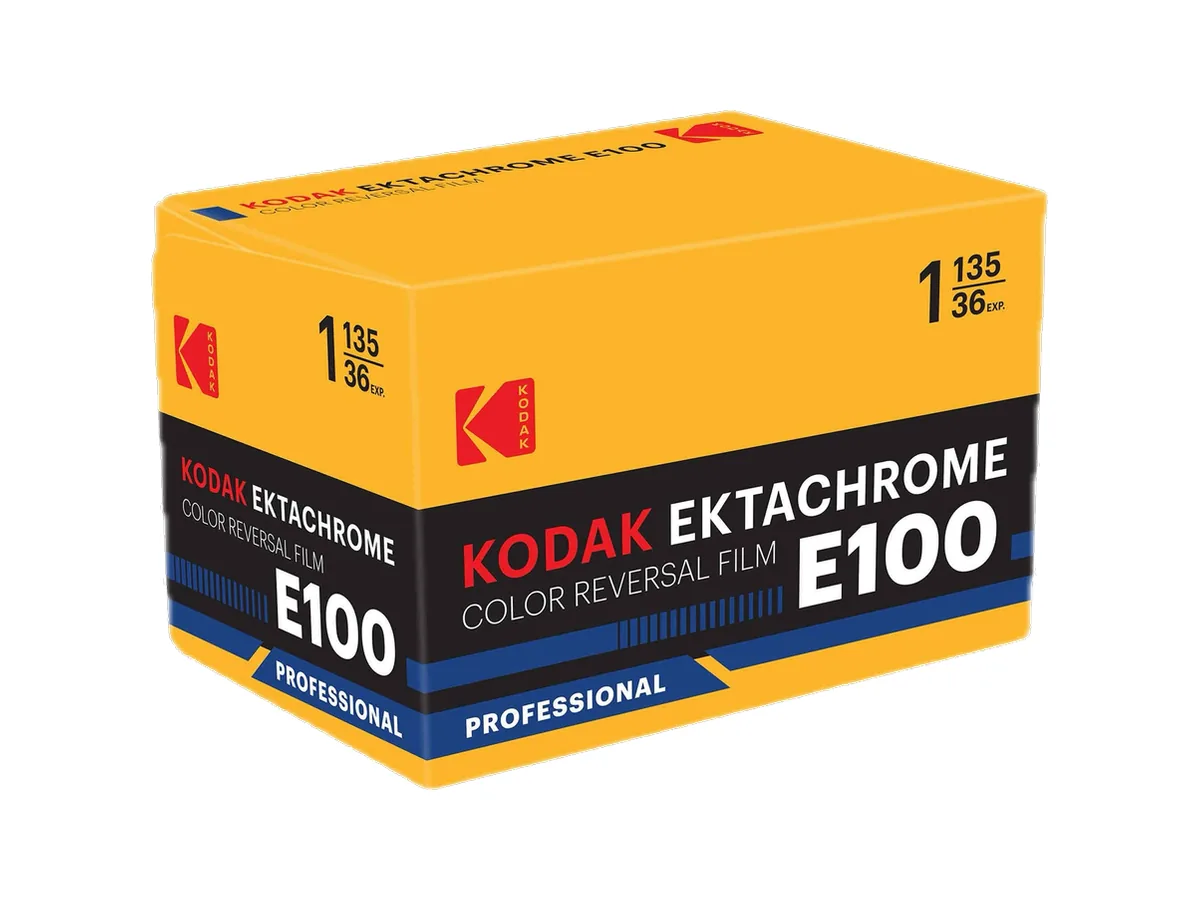
| Kodak Ektachrome E100 | 100 | Kodak's only slide film; discontinued in 2012, back in 2018 |
| Fujifilm Velvia 50 | 50 | Very high saturation, hard tonality, RMS 9; push +1 stop |
| Fujifilm Velvia 100 | 100 | Even more saturated, reds and greens emphasised, RMS 8; push +1 stop |
| Fujifilm Provia 100F | 100 | Natural colour, standard tonality, RMS 8; push +2 stops |
The RMS and push figures are from Fuji's own comparison table. All four need E-6 processing, which fewer labs offer and which is slower and dearer than C-41. Provia 100F is the most forgiving when you're unsure of the light. Buy one roll and learn on it before buying more.
Fuji's range has shrunk (Pro 400H and Pro 160NS ended in March 2022, Velvia 100F in June 2024) and UK supply of what remains is patchy, so if you see one you want, buy it.
What to check when buying
- Read the box, not just the name. Ektapan and T-MAX, Ektacolor Pro and Portra, are the same films in different packaging.
- Know where Fujifilm 400 comes from. The box says Made in USA, and it took over from Superia X-tra 400 in 2024. If you want Fuji's own cool greens, choose Fujicolor 100 or Superia Premium 400.
- Ask whether a cine respool still has its remjet. Some respooled motion picture films keep their remjet and must go to an ECN-2 lab; many C-41 labs refuse them. Check the Kodak code too (5219 is Vision3 500T).
- Hand-rolled bulk film is a trade-off. Worn cassette felts leak light, the bulk roll's age is unknown, and 36 exposures may come up short. Fine for practice.
- Tell the lab what you did. Say what speed you rated it at, whether to push or pull, and whether to reverse it. A roll shot at 1600 and developed as 400 is lost.
- Don't judge a colour lab on price alone. Ask whether auto colour correction can be switched off, what file size you'll get, and whether the roll is scanned with one setting or corrected frame by frame.
If you're still choosing a camera, browse our 35mm film cameras. If loading, exposure and processing are new to you, start with Film 101.